• Welcome to Photrio!
    Registration is fast and free. Join today to unlock search, see fewer ads, and access all forum features.
    Click here to sign up

This is killing me. Why do i keep getting these streaks on my film?

Junk it

A
Junk it

  • 1
  • 1
  • 28
Dawes 2

A
Dawes 2

  • 1
  • 0
  • 28

Recent Classifieds

Forum statistics

Threads
204,342
Messages
2,867,342
Members
102,230
Latest member
sesuone
Recent bookmarks
0
Joined
Oct 28, 2021
Messages
27
Location
Houston, Texas
Format
Medium Format
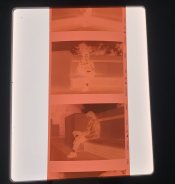
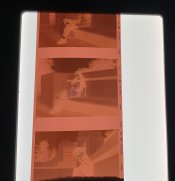
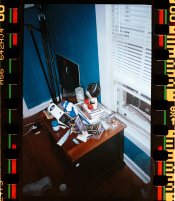
For context I am using the Cinestill cs41 Color kit and a jobo 1500 series reel tank. Not every time but often I will get these long streaks on the sides of my negatives and am confused if it is the stabilizer or the dev tank? I mix all my chemicals with distilled water.
DSCF1178.jpg
 
Yes. I mixed the chemicals two days ago and have developed approximately 5 rolls of 35mm and 2 rolls of 120 film. The two rolls of 120 are the most recent developed.
Okay ,,
It seems to me that the agitation was very slow.
I advise you to re-bleach (Step No. 2) + (Step No. 3)
Repeat these steps and you may get acceptable results.
 
Kind of looks similar to the patterns I can get if film overlaps/touches during development with black and white film. [I haven't worked with enough colour film to have screwed any of it up like that yet, so I'm not super confident how that problem looks with other processes.]

Had the film been loading onto the reels smoothly?

Also worth taking photos of the film that show all the way to the edge when you're trying to sort out oddities like this. Really helps narrow down what might or might not be going on.
 
a jobo 1500 series reel tank
Do you use a Jobo processor, or another kind of rotation system? If so, is it perfectly level?
If you're not using rotary processing, are you using the correct amount of processing liquids?
Can you post a photo of the negatives themselves that clearly shows the problem?
 
Do you use a Jobo processor, or another kind of rotation system? If so, is it perfectly level?
If you're not using rotary processing, are you using the correct amount of processing liquids?
Can you post a photo of the negatives themselves that clearly shows the problem?

I was going to say the exact same thing, classic not enough fluid in the tank look... but I don't use a jobo..
 
Do you use a Jobo processor, or another kind of rotation system? If so, is it perfectly level?
If you're not using rotary processing, are you using the correct amount of processing liquids?
Can you post a photo of the negatives themselves that clearly shows the problem?
I use a Unicolor uniroller system that automatically agitates. I have been using it with a towel since sometimes the tank lid leaks so maybe it's not 100% level. (it looks level to the eye) I also fill the tank with about 500ml of developer (the minimum calls for 470ml).

I am about to develop two more rolls and am going to pre soak them for 5 min before development and see if that can help as well.

DSCF1178.jpg
 
I was going to say the exact same thing, classic not enough fluid in the tank look.
Yeah, it has that look for sure.
@reelquickfilmlab How quickly do you go from a vertical position to fill the tank to the horizontal rotation position? Your problem might be due to too much delay there. If you let the tank sit for 10 seconds or so before you mount it into the roller base, you're in trouble.

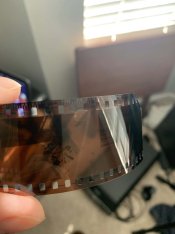
Hm, ok, that doesn't help all that much to be honest. I should have been clearer: can you post a photo (not a scan) of a piece of the film, backlit, that shows the entire width of the film and several affected frames?

It almost seems like you also (on top of the fluid problem) have some dichroic fog going on.

 
Yeah, it has that look for sure.
@reelquickfilmlab How quickly do you go from a vertical position to fill the tank to the horizontal rotation position? Your problem might be due to too much delay there. If you let the tank sit for 10 seconds or so before you mount it into the roller base, you're in trouble.


Hm, ok, that doesn't help all that much to be honest. I should have been clearer: can you post a photo (not a scan) of a piece of the film, backlit, that shows the entire width of the film and several affected frames?

It almost seems like you also (on top of the fluid problem) have some dichroic fog going on.

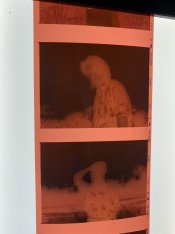
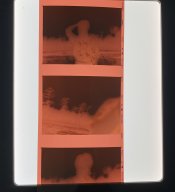
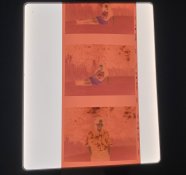
Hope these help

IMG_8568.jpg IMG_8569.jpg IMG_8570.jpg IMG_8571.jpg IMG_8572.jpg
 

Attachments

  • DSCF1178.jpg
    DSCF1178.jpg
    1.3 MB · Views: 204
Yeah, it has that look for sure.
@reelquickfilmlab How quickly do you go from a vertical position to fill the tank to the horizontal rotation position? Your problem might be due to too much delay there. If you let the tank sit for 10 seconds or so before you mount it into the roller base, you're in trouble.

Yea it is probably definitely sitting for more than 10 seconds. So should I just try to pour the chemicals in and out as quick as I can (regardless of letting the last few drops in) and place on the roller? Also is that more important to not let it sit with the developer than the blix? or does that apply to both.
 
A quick and dirty post processing inversion of one of those negatives gives me this:
upload_2021-10-29_13-22-1.png


If it is something like dichroic fog, that might not always show in that workflow.
I'm wondering if the problem is with the stabilizer.
 
Did you pre-soak?
 
So should I just try to pour the chemicals in and out as quick as I can (regardless of letting the last few drops in) and place on the roller? Also is that more important to not let it sit with the developer than the blix?
Yes to both, basically.
When pouring in the developer, do it as quickly as you can and then flip the tank onto the roller base. Shouldn't take more than about 10 seconds from the first drop entering the tank to the moment when the tank starts rotating.
When pouring out, same story; quick. No, a few remaining drops is not an issue; the stop bath or blix will kill them.
Indeed, this is mostly critical with the developer. I would also recommend using a stop bath between developer and blix if you're not already doing this. A 1-2% solution of acetic acid will do.
 
Yes to both, basically.
When pouring in the developer, do it as quickly as you can and then flip the tank onto the roller base. Shouldn't take more than about 10 seconds from the first drop entering the tank to the moment when the tank starts rotating.
When pouring out, same story; quick. No, a few remaining drops is not an issue; the stop bath or blix will kill them.
Indeed, this is mostly critical with the developer. I would also recommend using a stop bath between developer and blix if you're not already doing this. A 1-2% solution of acetic acid will do.

So I tried pouring the chemicals in and out quickly as well as doing a pre-soak for 5 mins at 100f or 38c and that seems to have solved the problem however I am noticing these water spots that I think are from the stabilizer on the negative. I have also been rinsing with lukewarm water between pouring out the developer and adding the blix.

DSCF0829.jpg IMG_8577.jpg
 
With smaller format the streaking is less of a problem. Water spots are from stabilizer, yes.
 
Presoak for color film is a must. Not recomended for bw.

The spots are only on the non-emulsion side of the film. Wipe it off with alcohol.
 
Presoak for color film is a must.

Kodak or Fuji ever said something like that?


I think it helps me a little with large format, but presoaking alone doesn't always give me perfectly even C-41 development on large format negatives.
 
Fresh chemicals, practice loading 120 film, use a processor with a lift, maybe try an AP tank and reel on your roller. AP reels are easy to load 120.
 
Kodak or Fuji ever said something like that?


I think it helps me a little with large format, but presoaking alone doesn't always give me perfectly even C-41 development on large format negatives.

Yes, Kodak advises to presoak C41 and slide films.
 
Yes, Kodak advises to presoak C41 and slide films.

Hmm, then they certainly hid the documents that advise pre-soak for C-41 (or E-6) very well.

Publicly accessible ones specifically advise (in bold font) AGAINST pre-soak:

Do not immerse the film in a warm water pre-soak. Warm-up step is done by warming the outside of the tube with hot air or in a tempered water bath.

Can you point me to the Kodak resource that supports the C-41 pre-soak claim? Thanks!
 
After developing some more 120 film the streaking is gone and I think it's most likely due to the faster pouring times. Thank you @koraks I did however try pre-soaking the film and am not sure if that played a part as well. But thank you all for the help. I now need to figure out what ratio to mix the stabilizer since the one Cinestill recommends is yielding spots on the negative.
 
Photrio.com contains affiliate links to products. We may receive a commission for purchases made through these links.
To read our full affiliate disclosure statement please click Here.

PHOTRIO PARTNERS EQUALLY FUNDING OUR COMMUNITY:


Ilford ADOX Freestyle Photographic Stearman Press Weldon Color Lab Blue Moon Camera & Machine
Top Bottom