

• Welcome to Photrio!
    Registration is fast and free. Join today to unlock search, see fewer ads, and access all forum features.
    Click here to sign up

Waist Level Finder, Re-Visited

Tablao Flamenco

A
Tablao Flamenco

  • 1
  • 0
  • 12
Untitled

A
Untitled

  • 1
  • 2
  • 66

Forum statistics

Threads
204,325
Messages
2,867,167
Members
102,223
Latest member
jeffwiedner
Recent bookmarks
0

RedSun

Member
Joined
Aug 27, 2012
Messages
680
Location
New Jersey,
Format
Multi Format
It is time to go back to MF again. So I took out my Bronica equipment. Since WLF can shed some weight off my GS system, I put on the WLF instead of my AE prism finder. I like the light weight and the magnifying glass. But I still do not feel comfortable with the WLF.

Many folks say, with WLF, you can lower the camera and keep both eyes open. This is only true without the magnifying glass. Even with the large 6x7 screen, it still seems dark. I think it would be worse with the 6x4.5 ETR. With the magnifying glass up, I'll have to close one eye and put another eye near the magnifying glass, just like the prism finder.

Then the more difficult thing is how to hold the camera. I'm supposed to hold the front left side to focus; then the right hand at the bottom of the body to control the shutter. To minimize the shake, I'll have to put the camera close to my body. When I put the camera at my waist level, it is so far from my eyes and hard to focus. If I put the camera to my chest level, I fee my heartbeat. It is hard to steady the camera and keep a good focus.

Camera movement won't be a problem when I put the camera on a tripod. But to use the WLF, I'll have pull down the tripod. This limits the height of the camera body. I may need to use a stand or short ladder to have a good shot.

When I put on the speed grip, even the large GS feels more stable. My right hand gets a good grip and the huge GS does not seem that heavy. I know the large mirror is still a problem. But if I put the camera on a tripod and the prism finder, movement won't be a problem.

I understand that a lot of people like WLF. So here I do not know if I've handled the WLF the wrong way. I've tried several times to use WLF, but still do not feel comfortable with it.
 
Does your camera WLF have a fresnel to help you focus? I have a couple TLRs which do have these fresnel screens and they are much, much easier to focus, even at waist height, than my WLF equipped cameras without them.
 
I understand that a lot of people like WLF. So here I do not know if I've handled the WLF the wrong way. I've tried several times to use WLF, but still do not feel comfortable with it.

Yep, I love a WLF. Works great for me. I like bending over a bit, looking down, the ground glass, the lower point of view, etc.

It not working for you means that it isn't for you. Don't sweat it? Go with the setup that gets out of your way and lets you take the photos you want. That's the goal, yes? Sure, in under 50 rolls you'd figure it out and get comfortable with it, I am certain. Do you want to go through that?
 
I use a waist level finder on my RZ67 and actually really like it. It does take a little while to get used to though. I normally use two eyes unless using the magnifier.

The only time I've had trouble with a dark ground glass was when I was focusing on a city skyline in the desert at 10pm. Other than that I have not had much issue.

Part of the reason I like the wl so much probably has to do with how I normally use the RZ. I have the normal strap set up a bit like a Black Rapid sling strap--though instead of the camera being upside down, it is right side up and pretty much right at waist level. This makes walking around with it really easy as it also moves the camera out of the way a bit. The sling style also means that the rz is really stable which makes for easier shooting.

I'm actually not a big fan of the speed grip. I have it, but rarely use it. It pushes the RZ past the 'acceptable portable size' limit (and it was already pushing the boundaries).

But different strokes for different folks. I once gave a prism a shot on the RZ and really didn't like it. The massive and bright ground glass spoiled me too much it seems. Plus I found focusing to be easier off of the ground glass than through the prism. The other issue is that while the RZ fits well in my hands, bringing it up to eye level is a bit absurd and gets to be annoying pretty fast.
 
suspect

I suspect those who sing the praises of WLFs used them on a Rolleiflex or Yashicamat TLR. And they can be great but it is just a tool and in some cases it is the wrong tool. I used a Rollei throughout the 1960s and a Yashicamat throughout the 1970s with WLFs and loved them although many times I used the eye level sports finder that is part of the WLF.
In those days a prism eye level finder was available, but was extremely heavy. I also used a Hasselblad with a waist level finder sometimes but used an eye level prism most of the time.
Use what works for you. Old Exactas and some other 35mm cameras used to come with a waist level finder but that has kind of died out, I think. You, of course, have a choice.
 
Put the camera up to your eye to focus w/ the magnifying glass up. Fold the magnifier down, lower the camera, compose, and shoot. It goes a lot faster than it sounds. If you're shooting at 50 plus feet, just set it to infinity, stop it down, and compose and shoot.
 
Does your camera WLF have a fresnel to help you focus? I have a couple TLRs which do have these fresnel screens and they are much, much easier to focus, even at waist height, than my WLF equipped cameras without them.

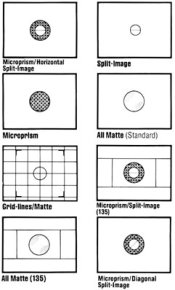
The screen I have is the very first one, at top left hand corner, micro-prism with horizontal split.

matglas100.jpg
 
Put the camera up to your eye to focus w/ the magnifying glass up. Fold the magnifier down, lower the camera, compose, and shoot. It goes a lot faster than it sounds. If you're shooting at 50 plus feet, just set it to infinity, stop it down, and compose and shoot.
That's what I've been doing for about 25 years, I have the prism finder for my Mamiya T.L.R. but rarely use it.
 
I use a shortened neck strap - the camera rests at mid-chest level when it is hanging from the strap.
 
Then the more difficult thing is how to hold the camera. I'm supposed to hold the front left side to focus; then the right hand at the bottom of the body to control the shutter.
You don't have to do it that way. It's very common to do the opposite: right hand to focus and turn the aperture ring, left under the body to trip the shutter with the index or second finger. It keeps the DoF preview lever out of your way better, IMO. Experiment and find what works best for you.
Myself, I sometimes do it one way, sometimes a different way.
 
Shortening the neck strap is a good idea, as someone said previously. I find it helpful too.
 
Shortening the neck strap is a good idea, as someone said previously. I find it helpful too.

This is a good idea. I was using it without neck strap.
 
You don't have to do it that way. It's very common to do the opposite: right hand to focus and turn the aperture ring, left under the body to trip the shutter with the index or second finger. It keeps the DoF preview lever out of your way better, IMO. Experiment and find what works best for you.
Myself, I sometimes do it one way, sometimes a different way.

I've seen a MF book with a picture like this. I've not thought about this. Always good to learn something new.
 
I use a Mamiya RB67. I hated the reverse way the WLF works. It drove me crazy. I just couldn't get the opposite way it moved when framing a photo. So I bought an eyefinder and a separate magnifier that slides over the eyefinder for better control of focus (mostly I don't use the magnifier). Now the camera aims the way I aim it. I shoot mostly landscapes on a tripod but I could see that for people shots, a WLF might be better because of the lower view.
 
I got my RB67 knowing that I'd be using it for different things than my 35mm cameras. Slower, more contemplative stuff mainly. So I don't use it hand-held (always on a tripod), the Olympus and Pentax SLRs are for the hand-held stuff.

I coarse-focus, take my time composing with the WLF, use the magnifier for final focusing and checking details, then shoot. The left/right reversal on the ground-glass is something you just get used to, then you don't notice it. Because I didn't expect to use it in the same way as my 35mm SLRs, the different way of working with the RB67 has always seemed quite natural to me; I never though of it as just a bigger OM-1. I guess it's a matter of how you approach it, but I love my WLF and wouldn't dream of getting a prism.
 
Alan:
I bought an eyefinder and a separate magnifier that slides over the eyefinder for better control
hmmm... the reverse doesn't drive me nuts, but often confuses me when I look up trying to compose the shot.. so what is an eyefinder? A picture is worth a thousand words, maybe you could you clarify with a shot of this on the RB67..
 
Photrio.com contains affiliate links to products. We may receive a commission for purchases made through these links.
To read our full affiliate disclosure statement please click Here.

PHOTRIO PARTNERS EQUALLY FUNDING OUR COMMUNITY:


Ilford ADOX Freestyle Photographic Stearman Press Weldon Color Lab Blue Moon Camera & Machine
Top Bottom
