• Welcome to Photrio!
    Registration is fast and free. Join today to unlock search, see fewer ads, and access all forum features.
    Click here to sign up

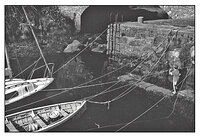
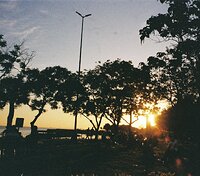
Color Carbon prints by Tod Gangler

Fire escape.

H
Fire escape.

  • 2
  • 1
  • 4
22886.jpg

A
22886.jpg

  • 2
  • 0
  • 17

Recent Classifieds

Forum statistics

Threads
204,343
Messages
2,867,386
Members
102,231
Latest member
kimlee2027
Recent bookmarks
0

mark

Member
Joined
Nov 13, 2003
Messages
5,704
Would it be kosher to discuss the negative creation process Tod Gangler might use to make the color separation negatives? I am intrigued by the images he creates and would like to know how he does it.
 
Never mind. They are digital negs. Damn!
 
The simplest analog color separation process will be using a colour enlargement on a copy stand, and snapping three shots of it with colour-separation filters.
 
Tod is very approachable.

He is using digital negatives now, but he used analog negatives for years, with great success.

My sense was that he would still be using analog materials if his favoured materials were still available to him.

He was quite happy to discuss his procedures (present and past) at the North West Alternative Photography Symposium in Bellevue Washington last fall.
 
Color separation negatives can be made either in camera or from chromes using TMax films, but the
devil is in the details. Making really large separations using continuous tone film would be quite
expensive in this day and age, even if you could locate a reliable supply of a suitable film. FP4 can
sometimes be used, but TMX or TMY is preferable for separation work. It takes a lot of work to
calibrate everything, esp with a process like color carbon, so if any one variable changes, or you lose a critical film, you're back to scratch.
 
Tod sells his prints for several thousands of dollars each print. :smile:
 
From my reading it seems the modern way of doing this requires a color image. Is there a way to do this starting with the BW image and working to the color image, since that is the way I want to go?
 
I think you asking about _ Three color carbon printing? I think "Keepers of light" by Willaim Crawford gives a good ( not Great) but good account of how to start with B&W negatives. But I think he is referring to 3 separate exposures to 3 separate films, with 3 separate filters, in close duration of each other of the same scene, without moving the camera!. ( too bad if a parked car moves in between your three exposures) Al though that might look kinda cool having a "megenta tissue" having the car in it , while the cyan and yellow tissues do not. But if you are asking about starting with one B&W negative, the answer as far as I know is no! sorry dude?? The best i can do for ya!
 
That is what I thought. I just don't like working on photo stuff with the computer. If this is somthing I want to pursue I guess I need to get over that. Whelp, it is off to dpug to ask.
 
That is what I thought. I just don't like working on photo stuff with the computer. If this is somthing I want to pursue I guess I need to get over that. Whelp, it is off to dpug to ask.

I'm in the same quandary; at some point down the road I will bite the bullet, gear up and learn how to make separation digital negatives.
 
3 separate exposures to 3 separate films, with 3 separate filters, in close duration of each other of the same scene, without moving the camera!. (too bad if a parked car moves in between your three exposures)


In-camera separations (analog or digital, one-shot or 3 separate exposes, assembled in photoshop or color carbon), will be the topic of Scott Bilotta's presentation at this months Historic Photo Process Forum. Here's his posting on the History of Color Photography Group:

Historic Photo Process Talk on Tri-Color Photography


Wed Jan 23, 2013 10:06 am (PST) . Posted by:
"Scott Bilotta" silver_recollection
I will be the speaker at this month's Santa Cruz Museum of Art and History (Santa Cruz, California) Historic Photo Processes Forum. The topic is tri-color photography via monochrome separations.


Prints made from separation photographs that I've taken and a variety of vintage and antique tri-color cameras will be on display.


I'll demonstrate the process of assembling separations in Photoshop using my photographs as well as vintage separations from my collection.


I'll demonstrate and describe the functional differences between the basic types of color cameras and show modern equipment that one can make or buy to practice tri-color separation photography.


Here's a link to the museum event page: http://www.santacruzmah.org/event/historic-photo-processes-forum/


If you'll be in the area, stop by and say hello.


happy trails,
Scott
 
I sat down last night, opened photoshop, opened an image, started working and got bored..

Not going to be in the area for the santa cruz thing but it looks interesting.
 
I think you asking about _ Three color carbon printing? I think "Keepers of light" by Willaim Crawford gives a good ( not Great) but good account of how to start with B&W negatives. But I think he is referring to 3 separate exposures to 3 separate films, with 3 separate filters, in close duration of each other of the same scene, without moving the camera!. ( too bad if a parked car moves in between your three exposures) Al though that might look kinda cool having a "megenta tissue" having the car in it , while the cyan and yellow tissues do not. But if you are asking about starting with one B&W negative, the answer as far as I know is no! sorry dude?? The best i can do for ya!

See also Chris James book on alternate photographic processes (http://www.christopherjames-studio.com/build/thebook.html ). He has a chapter on printing digital negatives for contact printing.

I have both books (2nd edition of the Chris James book), and for current use, the Chris James book is more useful.

Hope that helps,

Len
 
Photrio.com contains affiliate links to products. We may receive a commission for purchases made through these links.
To read our full affiliate disclosure statement please click Here.

PHOTRIO PARTNERS EQUALLY FUNDING OUR COMMUNITY:



Ilford ADOX Freestyle Photographic Stearman Press Weldon Color Lab Blue Moon Camera & Machine
Top Bottom