• Welcome to Photrio!
    Registration is fast and free. Join today to unlock search, see fewer ads, and access all forum features.
    Click here to sign up

Zone calibration for contact printing vs. enlargement

Venice

A
Venice

  • 0
  • 0
  • 3
Train

A
Train

  • 3
  • 2
  • 38

Recent Classifieds

Forum statistics

Threads
201,786
Messages
2,830,177
Members
100,950
Latest member
pec
Recent bookmarks
0

Jarin Blaschke

Member
Allowing Ads
Joined
May 30, 2013
Messages
378
Location
London and wherever
Format
Multi Format
Hi all:

I just moved up to 8x10 sheet film and am about conduct a simple test shoot to establish developing times. The goal is to find the developing time that correctly holds both Zone II and VIII information when printed on Galerie G3 paper.

My forthcoming images will exist as both enlargements and contact prints. I can only contact print at home, and need to rent a darkroom for enlargements.

If I calibrate film development to contact printing, will I find contrast to be much different when enlarging (presumably lower)? If it's only a nominal change, I can presumably tweak the print developer or its developing time when printing, but if it's something like half a grade or more that could be problematic.

Thanks,
Jarin
 

tedr1

Member
Allowing Ads
Joined
Feb 3, 2016
Messages
940
Location
50 miles from NYC USA
Format
Multi Format
Probably the enlarging lens reduces contrast a little, how much it changes may tricky to quantify. I was taught that paper and paper developer are formulated for complete development (unlike films) and I would expect changes of developing time to adjust density but not contrast. Changing to a different developer might change contrast, but that is outside my area of knowledge, I always use the developer recommended by the paper maker.
 
Last edited:

Bill Burk

Subscriber
Allowing Ads
Joined
Feb 9, 2010
Messages
9,463
Format
4x5 Format
I calibrate to between Galerie Grade 2 and Grade 3 - that way if I am right on the mark, either paper will "work"... but if I am low or high... one or the other grade is "right".

Contact and enlargement (with diffuse light source) should be close enough for this kind of plan to work out.
 
Joined
Sep 10, 2002
Messages
3,675
Location
Eugene, Oregon
Format
4x5 Format
If you calibrate for contact printing, then enlargements will likely need a bit more contrast (due to lens flare, etc. in the enlarging system) and vice-versa. I would tend to calibrate for enlarging, i.e., the contrastier choice, and then use a less-contrasty print developer for the contact prints, e.g., Dektol with a bit of Selectol Soft mixed in or split developing using soft and hard-working developers.

You're going to need to be doing something for intermediate contrast anyway with graded papers and split developing works really well for me.

Best,

Doremus
 
OP
OP
Jarin Blaschke

Jarin Blaschke

Member
Allowing Ads
Joined
May 30, 2013
Messages
378
Location
London and wherever
Format
Multi Format
I use Ansco 130, so I suppose I could conversely use less hydroquinone from the beginning for the contact prints, which will be more common than select enlargements. If full hydroquinone is not enough for enlargements, perhaps I could also increase the carbonate and restrainer (blacks and whites).

In theory, enlargements may also warrant a little less contrast for closer detail examination, while contact prints may require a touch more contrast to retain impact in their smaller size. I'm curious to see how prominent the difference is.

J
 

silveror0

Member
Allowing Ads
Joined
Dec 3, 2007
Messages
364
Location
Seattle area, WA
Format
Large Format
...I just moved up to 8x10 sheet film and am about conduct a simple test shoot to establish developing times. The goal is to find the developing time that correctly holds both Zone II and VIII information when printed on Galerie G3 paper.

My forthcoming images will exist as both enlargements and contact prints. I can only contact print at home, and need to rent a darkroom for enlargements.

If I calibrate film development to contact printing, will I find contrast to be much different when enlarging (presumably lower)? If it's only a nominal change, I can presumably tweak the print developer or its developing time when printing, but if it's something like half a grade or more that could be problematic...

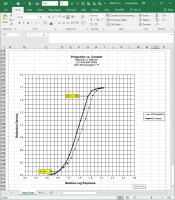
After I finished modifying my enlarger to an LED light source, I wanted to check out its performance with variable contrast paper and in the process I was curious to find out if there really is a contrast difference between enlargements and contacts. I was using Ilford MGIV paper and developer at the time, so that’s what I tested with. I found that the diffuser(s) I’d chosen were causing color issues that prevented getting contrast more than grade 3 and had to change them to solve the issue. All my tests were done with this new light source, using a Stouffer 31-step wedge for both enlargements and contacts. I plotted the curves for each with a #2 filter under the lens; then, to more easily see the difference in the slopes, I moved them to a common Zone VIII density to see where the Zone II densities fell. The result is attached and shows that, with the density matched at Zone VIII, the projection curve has more than one zone less density than the contact’s Zone II. Flare in the enlarger/lens system is undoubtedly a contributor to this difference.

I suspect the differences between the light sources used for contacts at home and enlargements at a rental darkroom will cause you some grief, not to mention the differences from one enlarger to another.

2017-05-20 (1).png
 
Last edited:
Joined
Jan 7, 2005
Messages
2,739
Location
Los Angeles
Format
4x5 Format
The obvious answer is to test. Find the LER of the paper for the printing condition. That said, given Jarin's situation, I would calibrate to the contact print. Contact printing produces the most consistent conditions. Enlargement has too many variables, especially if you can't guarantee using the same set-up like in a rental darkroom. Even using the same equipment won't eliminate all the variables. The degree of flare will change depending on the density distribution in the negative.
 

Bill Burk

Subscriber
Allowing Ads
Joined
Feb 9, 2010
Messages
9,463
Format
4x5 Format
That makes sense, Jarin you could calibrate to the contact print.

I remember now that I stopped making contact print proofs of my 4x5 negatives when I couldn't match the look of the proof with an enlargement from the same negative... I decided to just make 11x14 enlargements of "everything".

When you contact print, there will be no flare added at the printing stage. When you enlarge, flare will make the negative "seem" to have less contrast... so you may need a higher grade of paper to print on.

So I might still recommend to calibrate to Grade 2. Don't "expect" the negative that looks good on grade 2 to look the same when enlarged, you might need Grade 3.
 

MattKing

Moderator
Moderator
Joined
Apr 24, 2005
Messages
55,156
Location
Delta, BC Canada
Format
Medium Format
Would anyone really expect a full grade difference in contrast between a contact print and an enlargement?

J
Definitely.
However, it is difficult to say how much of that is due to the difference between the printing processes and how much is due to the difference in size and viewing distances for the results.
I tend to prefer more contrast in bigger prints.
 

Bill Burk

Subscriber
Allowing Ads
Joined
Feb 9, 2010
Messages
9,463
Format
4x5 Format
I've definitely found the "same grade" is wrong for the enlargement.

Since I print on Galerie, 2 and 3 are my obvious choices.

Note: I print black borders, which exacerbates flare "significantly".
 
OP
OP
Jarin Blaschke

Jarin Blaschke

Member
Allowing Ads
Joined
May 30, 2013
Messages
378
Location
London and wherever
Format
Multi Format
Wow. Interesting - that's more of a difference than expected. I'm standardizing on Galerie grade 3; I can go down to grade 2, or go up to Fomabrom N and C. We'll see where Lodima grade 4 comes in on that scale (if it ever arrives...).

Thanks for all your replies! I shall report back when I have some results. Between family and work, photography processes travel in slow motion...

J
 

Peter Rockstroh01

Member
Allowing Ads
Joined
Apr 20, 2015
Messages
140
Location
Bogota, Colombia
Format
Multi Format
I've definitely found the "same grade" is wrong for the enlargement.

Since I print on Galerie, 2 and 3 are my obvious choices.


Most of my negatives are printed on Galerie Grade 2 in 8x10 or Galerie Grade 3 in 11x14. I need about one grade per size increase.
I used to print 16x20 enlargements on Galerie, Brilliant or Oriental Grade 4. The same negatives I can contact print on Azo, which
gives me about a Grade 1 contrast.
The negatives have a gradient that more or less matches the paper´s gradients. If there´s no other way and the image is worth it,
I´ll use Multigrade, but I prever grande papers.
 
Photrio.com contains affiliate links to products. We may receive a commission for purchases made through these links.
To read our full affiliate disclosure statement please click Here.

PHOTRIO PARTNERS EQUALLY FUNDING OUR COMMUNITY:


Ilford ADOX Freestyle Photographic Stearman Press Weldon Color Lab Blue Moon Camera & Machine
Top Bottom