

• Welcome to Photrio!
    Registration is fast and free. Join today to unlock search, see fewer ads, and access all forum features.
    Click here to sign up

Yellow marks along sprocket holes of entire film?

Recent Classifieds

Forum statistics

Threads
202,019
Messages
2,833,871
Members
101,074
Latest member
T B
Recent bookmarks
0

supersara2001

Member
Allowing Ads
Joined
Jan 9, 2013
Messages
8
Location
Cardiff, Wal
Format
35mm
Hiya,

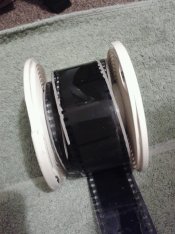
I just developed an in-date roll of Ilford HP5+ in Ilfosol 3, with Ilfostop & RapidFixer as I've done a few times over this week. There's yellow/cream strips along the sprocket holes along the length of the film. The images themselves are untouched thankfully. I've not seen these marks before so I was wondering if anyone could confirm if it's emulsion that wasn't removed properly? As I opened the reel the markings correspond to the areas which sit in the grooves of the reel. Is there any chance the reel is a little too tight for the film & the chemicals just weren't able to get to the film?

My chemicals are still fairly new & I didn't change my method. However I loaded the film onto a 'new' film reel that I've borrowed from the university's darkroom via the photographic society. I normally load immediately before developing but my plans had to change & my film was on the reel & safely in the tank for 3 days before today, could that affect it?

Do I need to wash/re-fix the film? I didn't pre-soak, but I never usually do and I've not seen this before. It's currently hanging up to dry so I'd like to know if I need to do anything or if I can ignore it seeing as it's on the edges of the film (it covers where the frame markings are).

Thanks,

Sara
IMG_20130114_161301.jpg
 

fotch

Member
Allowing Ads
Joined
Mar 16, 2005
Messages
4,774
Location
SE WI- USA
Format
Multi Format
You photo's indicate that the "chemicals just weren't able to get to the film". I wonder if the 3 day delay was a factor that resulted in the reels contacting the film in such a way it prevented the chemicals from making contact. If not that, then I would suspect the reels. Odd problem.
 

jeffreyg

Subscriber
Allowing Ads
Joined
Jun 12, 2008
Messages
2,770
Location
florida
Format
Medium Format
I'm not familiar with the reel pictured but could it have been wet when you rolled the film and the film stuck to the reel and as mentioned the chemicals didn't come in contact with that part of the film?

http://www.jeffreyglasser.com/
 

Worker 11811

Member
Allowing Ads
Joined
Jan 18, 2010
Messages
1,719
Location
Pennsylvania
Format
Multi Format
I agree with the consensus. Chemistry did not evenly contact the film. Refix and rewash.

Watch your agitation and make sure the reels are clean and dry.

I often use a toothbrush and hot water to clean mine out. Some people recommend putting them into the dishwasher. (Top rack with no drying heat!)

Inspect the reels to ensure that they are clean, dry and undamaged before using again.

This reminds me it's probably time for me to do the same! :wink:
 
OP
OP

supersara2001

Member
Allowing Ads
Joined
Jan 9, 2013
Messages
8
Location
Cardiff, Wal
Format
35mm
Thanks all :smile:

I've never re-fixed/re-washed before. Apart from using my usual go-to reel & dry the film, do I need to be aware of anything? I fixed for 10 minutes already, so how much longer should I go for? Sorry for all the questions, but I really do appreciate the help!

I know the reel was dry cos it hasn't been used since I was lent it in November, but I'm half-wondering if the tank itself was still damp when I loaded it. If so I might hold off for another day just to be on the safe side.
 

Worker 11811

Member
Allowing Ads
Joined
Jan 18, 2010
Messages
1,719
Location
Pennsylvania
Format
Multi Format
Always fix for the least amount of time necessary to do the job. The longer the film is in the fixer, the more it soaks in, deeper into the emulsion (and paper, if making prints) it gets and the harder it is to remove. The more fixer remains in or on the film, the greater chances of degradation as time passes. One of the biggest problems for film preservation is degradation because enough of the chemicals weren't removed.

You're using rapid fixer. In my experience, five minutes ought to be enough time with rapid fixer. This assumes that you are using fresh fixer, not recycled, that you use it at the correct dilution and with the right temperature and agitation. If you do everything "normally" and according to the manufacturer's instructions, you've got all this covered.

However, if the instructions say to fix for ten minutes and you otherwise follow the instructions, ten minutes it is! :wink:

There are ways to determine the exact amount of time needed to correctly fix film, using a clip of undeveloped film and a stopwatch but, for now, let's just do things by the book.

Other than that, just put the film back on the reels, put it into the tank and pour in the fixer, just as if you were doing it the regular way, for the first time. Make sure you rinse the film the way you usually do and use rinse agent if that's part of your process. Hang the film up to dry as usual and proceed normally from there.

I suppose you could cut the film apart and redo just the parts that need it. You are probably going to cut the film into short strips anyway. Right? However, it might be wise to refix everything. It could be correct to assume that, if some of the film, didn't get fixed properly that there might be other parts that weren't fixed either. A prudent person might just refix everything just to be safe. How much extra work is it, really?

Whether you do it today or tomorrow, still, check your reels to be they are clean, dry and undamaged before you process any more film. An ounce of prevention is worth a pound of cure. Right? :wink:
 

AgX

Member
Allowing Ads
Joined
Apr 5, 2007
Messages
29,972
Location
Germany
Format
Multi Format
I've not seen these marks before so I was wondering if anyone could confirm if it's emulsion that wasn't removed properly?

The emulsion is not to be removed. The emulsion is a mixture out of unsoluble (lightsensitive) crystals, dyes and lot of additives embedded in gelatin. The aim of processing is to change the exposed crystals into metallic silver, de-colour or wash-out the deyes, make those remaining crystals soluble and wash out all soluable stuff, with the silver bound in the gelatin remaining.

In your case at least the fixing stage did not work locally (indicated by the opaque look of the rebates).

The optimum remedy would be fixing and washing the film again. As it is only about the rebates, washing again would be sufficient.
I'm sure though that other members would consider this over the top, and just advise to keep the film as it is.
 

kevs

Member
Allowing Ads
Joined
Aug 21, 2006
Messages
711
Location
North of Pangolin
Format
Multi Format
Get rid of your plastic reels and start using stainless. It cut my cursing-at-plastic-reel time from about 20 minutes a week to zero.

With respect that's poor advice. Multitudes of people use plastic reels without problems, myself included. If you have a problem with them, the chances are its caused by a faulty operator. I've never used stainless steel tanks but I'm sure they're just a s good as plastic, but I'm equally sure that both systems are fit for purpose.
 
OP
OP

supersara2001

Member
Allowing Ads
Joined
Jan 9, 2013
Messages
8
Location
Cardiff, Wal
Format
35mm
You're using rapid fixer. In my experience, five minutes ought to be enough time with rapid fixer. However, if the instructions say to fix for ten minutes and you otherwise follow the instructions, ten minutes it is! :wink:

There are ways to determine the exact amount of time needed to correctly fix film, using a clip of undeveloped film and a stopwatch but, for now, let's just do things by the book.

I developed some colour film in the fixer on Friday, so I wasn't sure if that would have affected the fixer or not and left it in longer just to be sure. Good to know that 5 minutes is all it needs for B&W though. My darkroom tuition was from a self-taught fellow, so my technical knowledge as such is nil. So far I've mainly just followed the instructions from him & from the Ilford fact sheets, I'll have to trawl the charity shops for some darkroom books! The only way is up though, right? :smile:

Thank you again
 

kevs

Member
Allowing Ads
Joined
Aug 21, 2006
Messages
711
Location
North of Pangolin
Format
Multi Format
Thanks all :smile:

I've never re-fixed/re-washed before. Apart from using my usual go-to reel & dry the film, do I need to be aware of anything? I fixed for 10 minutes already, so how much longer should I go for? Sorry for all the questions, but I really do appreciate the help!

I know the reel was dry cos it hasn't been used since I was lent it in November, but I'm half-wondering if the tank itself was still damp when I loaded it. If so I might hold off for another day just to be on the safe side.

Hi Supersara and welcome to Apug,

Re-fixing and re-washing won't harm your film, just do it as normal, agitate the fixer to make sure it gets to the rebates, wash and dry as usual. There's some possibility that the fixer can start dissolving the shadow details on the negative after a few hours in the fixer, but that won't be a problem here.

Drops of water inside the tank could cause condensation on the film, as could a change between warm and cool environments (outside to inside, warm bathroom or kitchen etc). It's possible that condensation formed on the film stuck it to the spiral, stopping chemicals getting to the surface. I've sometimes left film undeveloped in tanks for several days and haven't had any problems. That's the only thing I can think might cause this.

Cheers and good luck,
kevs
 
Last edited by a moderator:
OP
OP

supersara2001

Member
Allowing Ads
Joined
Jan 9, 2013
Messages
8
Location
Cardiff, Wal
Format
35mm
Ah, my bad sorry. I was under the impression the emulsion was separate to the cellulose instead of being part of it. I'll re-fix & re-wash the film in a different reel tomorrow & hopefully that will solve the problem. Thanks!
 

MattKing

Moderator
Moderator
Joined
Apr 24, 2005
Messages
55,325
Location
Delta, BC Canada
Format
Medium Format
Ah, my bad sorry. I was under the impression the emulsion was separate to the cellulose instead of being part of it. I'll re-fix & re-wash the film in a different reel tomorrow & hopefully that will solve the problem. Thanks!

The emulsion is on top of the cellulose triacetate backing, so your assumption is correct, but the fixer doesn't remove the emulsion, it just removes the undeveloped silver from that emulsion.

Most likely there was moisture either on the reels or in the air in the tank. Sitting there for three days, the emulsion on the film absorbed that moisture, causing the film to stick in the channels of the reels. When you started the development process, the developer and other liquids weren't able to be absorbed into the emulsion because the stuck on reel got in the way.

You do not necessarily need to put the film back on to the reels to refix and wash them, but you can. The entire process can of course be done in the light as well.
 

Ambar

Member
Allowing Ads
Joined
May 9, 2011
Messages
104
Location
Rio de Janei
Format
35mm
Most likely there was moisture either on the reels or in the air in the tank. Sitting there for three days, the emulsion on the film absorbed that moisture, causing the film to stick in the channels of the reels. When you started the development process, the developer and other liquids weren't able to be absorbed into the emulsion because the stuck on reel got in the way.

+1
 

georgegrosu

Member
Allowing Ads
Joined
Oct 15, 2007
Messages
434
Location
Bucharest, R
Format
Multi Format
supersara2001, from what I understand, you have some yellow spots on the film.
Refixare and rewashing operations are never bad.
After me, the yellow dots that you know the film appeared to be thiosulphate decomposition in sulfite and colloidal sulfur.
Those particles can be colloidal sulfur yellow.
Washing with water and use to end substance that reduce surface tension
can do better.
Filter the fixer solution or replace.

George
 

AgX

Member
Allowing Ads
Joined
Apr 5, 2007
Messages
29,972
Location
Germany
Format
Multi Format
Those "creamy" stripes were visible after opening the reel, they can't be due to decomposition at this stage.
 
OP
OP

supersara2001

Member
Allowing Ads
Joined
Jan 9, 2013
Messages
8
Location
Cardiff, Wal
Format
35mm
Most likely there was moisture either on the reels or in the air in the tank. Sitting there for three days, the emulsion on the film absorbed that moisture, causing the film to stick in the channels of the reels. When you started the development process, the developer and other liquids weren't able to be absorbed into the emulsion because the stuck on reel got in the way.

I think this is almost certainly the cause having thought about it. I develop & leave the tank to air dry in the bathroom. As of now, my habit will change to leaving it dry in the spare room where I store everything & load the films.

Thank you all, I really appreciate the help & warm welcome to the forums :smile:
 

Worker 11811

Member
Allowing Ads
Joined
Jan 18, 2010
Messages
1,719
Location
Pennsylvania
Format
Multi Format
I have an old dish rack from the kitchen to dry utensils and containers in.
(Took the one from the kitchen counter then bought the wife a new one.)

Setting containers right side up while drying lets water collect at the bottom where it doesn't dry quickly. Setting containers upside down stops water collecting but, without enough air circulation, they don't dry quickly that way, either. Having a drying rack where containers can sit, upside down, with good air circulation, allows them to dry better.

I suppose, if you were careful to clean everything well enough, that you could dry your developing tank on the sink board in your kitchen but I prefer to keep darkroom stuff and food stuff separate. However, if you live in an apartment with limited space and resources, you might have to get creative. Just be extra careful to keep chemicals and foodstuffs far apart.
 

N467RX

Member
Allowing Ads
Joined
Apr 21, 2011
Messages
47
Format
35mm Pan
I'm pretty sure that that happened to me before, but not as noticeable, and that was a roll that I loaded onto a wet reel (developed, washed the reel, shook some of the water out and reloaded it -I only have one Jobo tank and reel set andI like it a lot more than my Paterson tank)
 
Photrio.com contains affiliate links to products. We may receive a commission for purchases made through these links.
To read our full affiliate disclosure statement please click Here.

PHOTRIO PARTNERS EQUALLY FUNDING OUR COMMUNITY:


Ilford ADOX Freestyle Photographic Stearman Press Weldon Color Lab Blue Moon Camera & Machine
Top Bottom
