• Welcome to Photrio!
    Registration is fast and free. Join today to unlock search, see fewer ads, and access all forum features.
    Click here to sign up

Yay! for Sean ... and a quick question about manual flash

Millstone, High Water

A
Millstone, High Water

  • sly
  • Dec 17, 2025
  • 2
  • 4
  • 66
The Party

A
The Party

  • 0
  • 0
  • 51

Recent Classifieds

Forum statistics

Threads
201,243
Messages
2,821,094
Members
100,614
Latest member
generic
Recent bookmarks
0

Anupam Basu

Member
Allowing Ads
Joined
Nov 17, 2005
Messages
504
Location
Madison, WI
Format
Multi Format
Many thanks for starting this forum, Sean. I hope it will become a great source of help and information on macro photography.

To tag a quick question to what is essentially a lame attempt to be the first person to post on the forum :D : is there any way to easily measure the amount of light lost to a diffuser or softbox attached to a flash and come up with a revised GN for doing manual flash photography? I can only think of testing as the alternative but am wondering if there is any other way.

-Anupam
 

Dan Fromm

Member
Joined
Mar 23, 2005
Messages
6,902
Format
Multi Format
Not to be a complete idiot, but why do you want to use a softbox/diffuser when shooting closeup. If the flash isn't too far from the subject it is effectively a large, not a point, source of light and will give fairly soft lighting. If I weren't non-digital I'd show you some scans, but since I'm not you'll have to take my word for it.

If your problem is specular reflections, a light tent -- a diffuser around the subject, not around the flash -- is the classical solution.
 

df cardwell

Member
Allowing Ads
Joined
Jul 16, 2005
Messages
3,357
Location
KY USA
Format
Multi Format
Well, there are two controls for light:

Size, relative to the subject, and
Distance from the subject.

Distance from the subject affects the gradation across the field,
so if you want an even light across the field, you move the light back,
but if you want a variation across the field, the light belongs close to the subject.

I suppose if one is making a clinical image,
the light should be further away,
but for an expressive image, you can bring it close.
 
OP
OP
Anupam Basu

Anupam Basu

Member
Allowing Ads
Joined
Nov 17, 2005
Messages
504
Location
Madison, WI
Format
Multi Format
Dan Fromm said:
If your problem is specular reflections, a light tent -- a diffuser around the subject, not around the flash -- is the classical solution.

Dan, you are right. My problem is indeed specular reflections. But I can't figure out a way to put a light tent around insects in the field, as in (there was a url link here which no longer exists), for example.

The other thing I have been trying is cross polarized flash, but so far my results have been miserable - need to experiment a bit more with it to figure out what the problem might be.

-Anupam
 

David A. Goldfarb

Moderator
Moderator
Allowing Ads
Joined
Sep 7, 2002
Messages
19,992
Location
Honolulu, HI
Format
Large Format
Flashmeter or testing are the options. It's not that big a deal to test, if you don't have a flashmeter. Before I had a flashmeter, I tested all my studio reflectors and diffusers and came up with guide numbers, and would map out studio setups in advance before shooting, so I would have the right f:stop. As long as I didn't change the light-to-subject distance, I had some flexibility in moving the lights during the session. It was absolutely reliable.

So do a test with slide film at a non-macro distance so you don't have to calculate exposure factor. Figure a softbox is going to cost you between 1.5 and 2.5 stops and shoot a series of frames a half stop apart.

Then when you are shooting macro, don't forget to include the exposure factor for high magnification.
 

Claire Senft

Member
Allowing Ads
Joined
Dec 7, 2004
Messages
3,239
Location
Milwaukee, W
Format
35mm
In a darkened room with a fairly bright light ie 200 watt hold an incident meter in a fixed position reading the central part of the beam. Take a reading at a particular shutter speed without the diffuser in place, note the fstop. Take the same reading with the diffuser in place at the same shutter speed. How much did the fstop change? The change is your correction.
 

mgb74

Subscriber
Allowing Ads
Joined
Jan 24, 2005
Messages
4,783
Location
MN and MA US
Format
Multi Format
David A. Goldfarb said:
(snip) So do a test with slide film at a non-macro distance so you don't have to calculate exposure factor. Figure a softbox is going to cost you between 1.5 and 2.5 stops and shoot a series of frames a half stop apart.

I understand the advantages of using slide film (narrow latitude, no printing compensation), but would using b/w film and viewing the negs themselves be reasonably valid?
 

David A. Goldfarb

Moderator
Moderator
Allowing Ads
Joined
Sep 7, 2002
Messages
19,992
Location
Honolulu, HI
Format
Large Format
If you are good at reading negs, you could do that, but slide film usually will give you a more precise test. If you're using B&W neg film, you could print a contact sheet at minimum time for maximum black for this sort of test.
 

naturephoto1

Member
Allowing Ads
Joined
Mar 26, 2006
Messages
1,960
Location
Breinigsville
Format
Multi Format
Though small manual flash units are inexpensive, if you are working in the studio you may also want to consider using fiber optic lighting for close-up/macro work particularly as the subject gets smaller and smaller. Metering will be simpler and easier and you can see the actual effect on your subject. Another item that can be useful is to use small mirrors and work with 1 flash or light source.

Rich
 

Dan Fromm

Member
Joined
Mar 23, 2005
Messages
6,902
Format
Multi Format
Anupam Basu said:
Dan, you are right. My problem is indeed specular reflections. But I can't figure out a way to put a light tent around insects in the field, as in (there was a url link here which no longer exists), for example.

The other thing I have been trying is cross polarized flash, but so far my results have been miserable - need to experiment a bit more with it to figure out what the problem might be.

-Anupam
Sorry, Anupam, but as a cheapskate no-good rat of a nonsubscriber I can't view images in the gallery.

I'm not sure that it is relevant, but in my aquarium photography I rely on geometry to control reflections from the tank's front. This might work for you.

Cheers,

Dan
 

Dan Fromm

Member
Joined
Mar 23, 2005
Messages
6,902
Format
Multi Format
df cardwell said:
Well, there are two controls for light:

Size, relative to the subject, and
Distance from the subject.

Distance from the subject affects the gradation across the field,
so if you want an even light across the field, you move the light back,
but if you want a variation across the field, the light belongs close to the subject.

I suppose if one is making a clinical image,
the light should be further away,
but for an expressive image, you can bring it close.
All that you've typed is true, and I don't understand the distinction you make between clinical and expressive images.

But and however, when shooting small mobile subjects in the field when and as they're found there are only two practical flash rigs. A flash bracket that somehow attaches to the camera body. A flash bracket that some how attaches to the lens or the camera's front standard. Flash brackets that stand on the ground aren't compatible with opportunistic shooting.

Both of the setups place the flash(es) near the subject, offer limited depth of illumination (I don't know if the concept is new to you, I've carried it around for decades). The best way I've come up with to get well-lit backgrounds is to have an assistant hold a flash (usually the third one) about the right distance from the background.

Obtaining, training, and keeping an assistant can be a problem. I once solved the problem by building a three-flash bracket for one of my friends. Heard his laments, went into the workshop, and emerged with a wife eliminator. And when his wife saw it, she instantly recognized what it was for. I found the thing too heavy and clumsy, but then it was really more a proof-of-concept prototype than a production version.

Come to think of it, this discussion really belongs in the lighting forum. Moderator, do your duty!

Cheers,

Dan
 

Claire Senft

Member
Allowing Ads
Joined
Dec 7, 2004
Messages
3,239
Location
Milwaukee, W
Format
35mm
Why is this seen as difficult or requiring a flashmeter? The question is: How much light is lost due to a diffuser?
 
OP
OP
Anupam Basu

Anupam Basu

Member
Allowing Ads
Joined
Nov 17, 2005
Messages
504
Location
Madison, WI
Format
Multi Format
A multiple flash setup is exactly what I have in mind Dan, only since I don't have a wife/girlfriend eliminator and since my girlfriend's fidgeting scares away the bugs anyway, I am trying a two flash setup.

The idea is to have two flashes either side of the lens - the smaller flash, an SB-18 without adjustable outputs will light the subject while the other, a SB-28, will be aimed at the background. It's power will be adjusted depending on the distance of the background. I am also hoping that if I put the SB28 on wide angle, it'll spill enough light sideways to act like a kind of fill-flash to balance the SB18's light.

-Anupam
PS: My pic was a standard dewy damsel shot that is in my PN portfolio as well, the kind Arnab takes - so you know what I mean about popping a light tent on it - I'd have a damsel in quite a bit of distress :smile:
 

Claire Senft

Member
Allowing Ads
Joined
Dec 7, 2004
Messages
3,239
Location
Milwaukee, W
Format
35mm
I suppose that an enlarger would be workable. Lowere your head yo the bottom, remove your lens and carrier, tape the meter so the cell is in the center of the beam. Take a reading at a constant time. Note the fstop. Put the diffuser in the beam and note the fstop. How much light was lost? I would guess about 1.7 to 1.8 stops. As long as the light is bright enough to be well within the sensitivity ranhe of the meter it should work. As an altenate you could use daylight tomorrow.
 
OP
OP
Anupam Basu

Anupam Basu

Member
Allowing Ads
Joined
Nov 17, 2005
Messages
504
Location
Madison, WI
Format
Multi Format
Mark H said:
What about a ring flash?

How would a ring flash help? As far as I can see, it would have the disadvantage of being close to the subject resulting in rapid falloff of light as has been pointed out in the above posts. Along with this it does not address the issue of background lighting, unless you are using an additional flash for that. Thirdly, sidelighting with fill looks nicer and more natural than flat front lighting.

-A
 

naturephoto1

Member
Allowing Ads
Joined
Mar 26, 2006
Messages
1,960
Location
Breinigsville
Format
Multi Format
I have one of the Lepp II brackets made by Saunders. I presume that it or an updated version is available. With the bracket you can mount 2 flash units and a camera. You can position the flash units where you want in relation to each other. The flash distances and angles can be adjusted. If your camera and flash units allow for TTL the flash output can be adjusted through the camera.

Rich
 

Buster6X6

Member
Allowing Ads
Joined
Nov 29, 2004
Messages
715
Location
London Ontar
Format
Multi Format
Hi Anupam
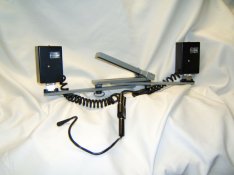
I made a two flash unit out of desposable cameras I got from my photo store for free.I inserted the guts into a small plastic box and attached to commercial flash bracket. Works really good.
 

Attachments

  • DSCF0483.JPG
    DSCF0483.JPG
    58.2 KB · Views: 162

Dan Fromm

Member
Joined
Mar 23, 2005
Messages
6,902
Format
Multi Format
Rich, Buster6x6:

Ages ago my wife browbeat me into buying her one of the original Lepp brackets. It and Buster's share a weakness that I find completely crippling.

My flash rigs are minimally, if at all, adjustable. I find that having a fixed flash-camera-lens geometry greatly simplifies the task of calibrating the setup.

The original Lepp design has much in common with ball heads, which I also have great difficulty using. Lepp I uses a single knob to lock the flash holder, rods, ... on two axes. I gave up on trying to set the thing up repeatably, which is essential for working from a table mapping magnification to aperture.

I was so annoyed with Lepp for sending such a useless overpriced POS to market that I've refused to look at the Lepp II or any of his other products. Please enlighten me, Rich. Does Lepp II use a single knob to lock one or two axes?

To get back on track, Anupam, poverty is no excuse for not shooting calibration shots. I did my first sets while a starving grad student.

Faith in manufacturers' claimed guide numbers is also no excuse for not shooting calibration shots. In my limited experience, most flashes put out 0.5 to 1.0 stops less light than claimed. The only ways to find out what a flash puts out are shooting calibration shots or using a flashmeter. GN arithmetic works well, but gives the right answer only if the real GN is used.

Cheers,

Dan
 
OP
OP
Anupam Basu

Anupam Basu

Member
Allowing Ads
Joined
Nov 17, 2005
Messages
504
Location
Madison, WI
Format
Multi Format
Dan Fromm said:
To get back on track, Anupam, poverty is no excuse for not shooting calibration shots.

Dan, my excuse wasn't poverty - it was lazyness :smile: - I thought I didn't do enough flash photography to justify the hassle. Point taken, though - I will do some thorough testing to get this flash thing down.

-A
 

naturephoto1

Member
Allowing Ads
Joined
Mar 26, 2006
Messages
1,960
Location
Breinigsville
Format
Multi Format
Hi Dan,

I do not remember the Lepp I. The Stroboframe Lepp II is as you mention a mounting surface for the camera, a pair of adjustable rods and 2 small ball heads at the end of the rods which are locked from the bottom as on a monopod or tripod. At times this is a bit to adjust and 4 hands would be better than 2. At the end of the rods nearest the camera mounting the rods can be adjusted on 2 axes- up, down, left, and right as well as 360 degree rotation and the ability to shorten or lengthen the rod distances between the camera and the flash heads. As you tighten the lock you can adjust the tension a bit so that the left and right adjustment is not adjusted as much as the up and down. At the far end of each rod as I mentioned there is a small ball head that is locked into position from the bottom. When released, the ball head bases can be rotated 360 degrees. Each of the tiny ball heads has a stop to keep the flash shoe from sliding out of the shoe. These tiny ball heads can then be adjusted just like any of the larger ball heads.

The Lepp II sounds like it is an improved version of the Lepp I. Adjustments certainly would be easier if first mounted on a tripod. There is a tripod thread on the unit as well. Once the adjustments are made for the camera and lens however, the system does operate well and allows one to use a main and a fill flash set up however.

Additionally, I have an older LL Rue Flash bracket made by Kirk Photo (Enterprises) which is similar to the John Shaw Butterfly Bracket. Kirk Photo and Really Rite Stuff have made improvements on this system and also include Arca type QR plates/system to the unit. For my Rue Bracket, I just added the plates to the existing bracket for mounting the camera and mounting the bracket onto a tripod.

Rich
 

Photographica

Subscriber
Allowing Ads
Joined
Jul 8, 2004
Messages
114
Location
Indiana
Format
4x5 Format
Claire Senft said:
I suppose that an enlarger would be workable. Lowere your head yo the bottom, remove your lens and carrier, tape the meter so the cell is in the center of the beam.

Claire's process is a good way to get you pretty close claibrations and fairly easy. I was fortunate enough to get a densitometer a couple of years ago and now use it to get reasonably accurate calibrations of my exposures. I have also used my darkroom color analyzer to get good relative readings -- which is really the same as described in Claire's message. To add to this... since you have an enlarger, you can pick up a pretty good color analyzer for a few dollars these day (I saw one auction sell three at $5 for the lot) Shoot a roll and get some good numbers to work with.

Now, to relate this to the macro subject --

I learned that my variable power flashes are very inaccurate at the lower power settings:

I calibrated my variable power flashes for my macro set up... since I was getting pretty close to the subject, I really needed to crank the power down on my flashes. Let me tell you, I was amazed at how inacurate the dials and settings were in the low power settings. They're consistant, but way off from the control markings. Now that I know what to adjust to, my macro exposure is very predictable.

Summary: for macro work where you need to reduce the flash's power, expect the controls to be very inaccurate... testing really is worth the time.

Bill Riley
 
Photrio.com contains affiliate links to products. We may receive a commission for purchases made through these links.
To read our full affiliate disclosure statement please click Here.

PHOTRIO PARTNERS EQUALLY FUNDING OUR COMMUNITY:


Ilford ADOX Freestyle Photographic Stearman Press Weldon Color Lab Blue Moon Camera & Machine
Top Bottom