• Welcome to Photrio!
    Registration is fast and free. Join today to unlock search, see fewer ads, and access all forum features.
    Click here to sign up

Why was Verichrome a B&W Film?

Bend in the river

H
Bend in the river

  • 1
  • 0
  • 28
Wheels within Wheels

D
Wheels within Wheels

  • 1
  • 0
  • 32

Recent Classifieds

Forum statistics

Threads
203,227
Messages
2,851,755
Members
101,736
Latest member
MathieuR
Recent bookmarks
0

Michel Hardy-Vallée

Membership Council
Subscriber
Allowing Ads
Joined
Apr 2, 2005
Messages
4,794
Location
Montréal, QC
Format
Multi Format
No seriously, why did Kodak used "True Colours" (Veri + Chrome) as a brand for a B&W film?

I've always been confused by that name, provided that now all the films/process that end in -chrome are for color images: Kodachrome, Ektachrome, Cibachrome, etc.

Anybody has fond memories of that discontinued film? I think I was born not long before they pulled it out of the shelves, so it's something I've forever missed.
 
mhv said:
No seriously, why did Kodak used "True Colours" (Veri + Chrome) as a brand for a B&W film?

I've always been confused by that name, provided that now all the films/process that end in -chrome are for color images: Kodachrome, Ektachrome, Cibachrome, etc.

Anybody has fond memories of that discontinued film? I think I was born not long before they pulled it out of the shelves, so it's something I've forever missed.
I believe that "ordinary" (i.e. blue-sensitive only) rollfilm was still quite common for snapshot cameras up to WWII as a cheaper alternative to orthochromatic film, which despite having a name which means "correct color" was sensitive to blue and green but not red. I imagine that typically Kodak wanted to make their own name and therefore concocted "Verichrome". As snapshotters did not use color film, the potential confusion between Verichrome and Kodachrome (available prewar as movie film, 35 mm and sheet film but not, as far as I know, rollfilm) did not arise. I think orthochromatic Verichrome turned into panchromatic Verichrome Pan sometime in the early 1950s. I certain remember it fondly, although being thickly coated (I believe double-coated) it was not as sharp as modern films.
 
Verichrome came out when most films were only blue sensitive. It exhibited better tonal balance because it was blue-green sensitive. Later Kodak improved the film to have red sensitivity and changed the name to Verichrome Pan to show that it was now a truly panchromatic film. Annoyed the hell out of me at the time since I could no longer develop the film by inspection with a red safelight.
 
Speaking of Verichrome Pan, I recently developed a roll of J&C Pro film. The overall appearance of the film and the negatives reminded me of Verichrome Pan. This is a fun film to use in older cameras such as folders and box cameras.
 
Wow Gerald & David, thanks a lot for sharing your experiences! I had some hunch like Titrisol about the spectral sensitivity from the name Verichrome Pan, but I'm glad I know the whole story now. Do you know when Verichrome (ortho) was introduced?

Also, as a broader question, is there a good book or website on the history of photgraphic emulsions? I'd be curious to know what were those blue-sensitive emulsions, who made them, etc etc. Something in the line of "The History of the Photographic Lens".
 
JC pro film is very good IMHO.
Donald Qualls mentioned Verichrome a few months ago and it maybe a verichrome shinese knock off for what we know.

Gerald Koch said:
Speaking of Verichrome Pan, I recently developed a roll of J&C Pro film. The overall appearance of the film and the negatives reminded me of Verichrome Pan. This is a fun film to use in older cameras such as folders and box cameras.
 
J+C100

Gerald-I too feel the J+C100 has the look of VerichromePan Film. Any update to how this latest batch is behaving?
Best, Peter Schrager
 
It still curls like hell. No problems, even with 80F water here in NC lately.

peters: not as good as the Fomapan 200 you sent me :wink:
 
mhv said:
Do you know when Verichrome (ortho) was introduced?
QUOTE]
To answer questions like this, we Brits look at old copies of the British Journal of Photography Almanac. According to this, in 1926 Kodak was just offering "Kodak Film" (blue-sensitive), whereas by 1933 Verichrome had appeared. The ad does not call it "new", so I suppose it had been out a couple of years, but still explains why it is better film. So the short answer is - about 1930!
 
Last edited by a moderator:
David H. Bebbington said:
mhv said:
Do you know when Verichrome (ortho) was introduced?
QUOTE]
To answer questions like this, we Brits look at old copies of the British Journal of Photography Almanac. According to this, in 1926 Kodak was just offering "Kodak Film" (blue-sensitive), whereas by 1933 Verichrome had appeared. The ad does not call it "new", so I suppose it had been out a couple of years, but still explains why it is better film. So the short answer is - about 1930!

Amazing ad, bring more! :smile:
 
Other B&W 'chromes' were Ilford Selochrome, Selochrome Pan, and Hyperchromatic; Ansco Plenachrome; Barnet Sensichrome; Ensign Ultrachrome; Ferrania Ultrachromatica; Gevaert Gevachrome; Kodak Polychrome and Lumière Altichrome.
 
Kodak has a very interesting time line on its website which lists the dates when various films appeared on the market. It contains a lot of other interesting dates. Don't remember the exact title but its interesting to go exploring on their website.
 
Verichrome came out in 1930-1931 as the successor to Kodak NC (Non-Curling) film. It was indeed ortho. Verichrome Pan came out in 1956, and was discontinued by the mean people in 2002. I've still got hundreds of my grandmother's negatives on both flavors of Verichrome
 
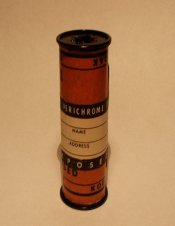
I wonder what developer I should use with this?
 

Attachments

  • verichrome.jpg
    verichrome.jpg
    76.6 KB · Views: 241
mhv said:
I think it's http://www.kodak.com/global/en/corp/historyOfKodak/chronology.jhtml?pq-path=2217/2687/2695

Verichrome was introduced in 1931, according to it:

"KODAK VERICHROME Film was introduced offering greater latitude and finer grain than the KODAK NC (Non-Curling) Film that had been the standard since 1903."

Non-curling was a sales argument!
You'd better believe it. Even the Verichrome was tricky to see-saw through a tray of MQ developer in red light. This is the way most of us kids did our film. I did my first roll about 65 years ago. I was born in 1927.
 
jamnut said:
I wonder what developer I should use with this?

HC-110, Dilution G. Reduced agitation, and extended process. Try something along the lines of continuous agitation first minute, then 5 inversion every 3rd minute, total time around 20 minutes. That'll get you anything that's left on that film, in printable density.
 
Verichrome Pan was dual emulsion film. One coat was lower contrast and the other higher. It was an excellent film for use in simple cameras using drug store processing, where everything got run through the same soup for the same time. Pretty technical, those guys. It rarely failed to give a usable negative, though. You really had to goof big time to defeat the stuff. I'm still using it in some of my old folders. I bought a bunch when big yellow announced it's demise.
 
No seriously, why did Kodak used "True Colours" (Veri + Chrome) as a brand for a B&W film?

I've always been confused by that name, provided that now all the films/process that end in -chrome are for color images: Kodachrome, Ektachrome, Cibachrome, etc.

Anybody has fond memories of that discontinued film? I think I was born not long before they pulled it out of the shelves, so it's something I've forever missed.

Kodak had nothing to do with the origin of Verichrome.

Verichrome was introduced by Wratten & Wainright in the early 1900's as one of the first emulsions with a broader spectral response compared to Orthochromatic films. So as you say True Colour - Veri Chrome :smile: The company were at the forefront of Panchromatic research and were later bought by Kodak,

Ian
 
Last edited by a moderator:
It was not the ":look" of VP which I liked; it was the long-tonal range and exposure latitude I liked. Unless that is what you all mean by "look." An early mentor, who shot weddings, used it only: it gave him detail in the tux and the dress which Plus-X could not. He souped in D76 1:1. I also sold hundreds of rolls of VP to a local portrait photographer who shot it in the studio in a 'blad and souped it in Versatol
(1:7, I think)
 
When most people used black & white films and most amateurs used rollfilm not 35mm, film manufacturers encouraged them to use orthochromatic films. These were claimed to have greater exposure latitude than pan films, so were considered more suitable for box & simple folding cameras which had very little exposure adjustment capability. Most major manufacturers used "chrome" as part of the name of their ortho rollfilms. So Kodak had Verichrome, Ilford had Selochrome, Agfa had Isochrome etc etc. Those that survived into the 1950's/60's were converted into panchromatic emulsions or withdrawn. It was really only from the late 1930's that "chrome" was also used frequently to indicate colour slide films.
 
I still have several hundred rolls in my freezer. I purchased a large lot of it when it was discontinued. I love the tonality it gives in PMK and have recently switched to using it with Pyrocat HD though I am still refining the development times. It is still my favorite film in 120 size. While not as tight-grained as Acros 100, it does have a beautiful repsonse to colors and a "full bodied" tonality.
 
Photrio.com contains affiliate links to products. We may receive a commission for purchases made through these links.
To read our full affiliate disclosure statement please click Here.

PHOTRIO PARTNERS EQUALLY FUNDING OUR COMMUNITY:


Ilford ADOX Freestyle Photographic Stearman Press Weldon Color Lab Blue Moon Camera & Machine
Top Bottom