
• Welcome to Photrio!
    Registration is fast and free. Join today to unlock search, see fewer ads, and access all forum features.
    Click here to sign up

Why is my ECN-2 developer so unusably bad?

Tree Farm

H
Tree Farm

  • 0
  • 0
  • 7
A long time ago...

A
A long time ago...

  • 0
  • 0
  • 57

Recent Classifieds

Forum statistics

Threads
201,206
Messages
2,820,446
Members
100,585
Latest member
DrRickRem
Recent bookmarks
0

ferrocyanide

Member
Allowing Ads
Joined
Aug 15, 2023
Messages
6
Location
Canada
Format
35mm
Hello,

I decided to start mixing ECN-2 chemicals from scratch to save money. Following Kodak's guide, I mixed all of the necessary components.

However, the results were terrible. I have experience using C-41 kits and they always came out perfect, but with these chemicals, not so.

Here are sc*ns of the images (sorry, just to demonstrate the issue). There is weird colour casts. Ignore the dust, I just didn't care about that since i knew the pictures were going to be garbage by looking at the negatives.

The strange thing is, the last several pictures of the roll also had almost no density, even though I'm certain I exposed them right. Dense negatives Screwed up negatives (Sorry, it's hard to get good negatives)

What could I have done wrong while mixing the developer? I heated distilled water to the right temperature using a sous-vide, and added all of the chemicals in the order Kodak states, mixing the CD-3 for 10 minuites, but it still doesn't work. I even tested the pH and it's correct.

What's going wrong here?
 

koraks

Moderator
Moderator
Joined
Nov 29, 2018
Messages
26,094
Location
Europe
Format
Multi Format
Hi @ferrocyanide , welcome to Photrio!

Nice to see that you're working on ECN2 materials as well; I've been doing that quite a bit lately as well. I'm sorry you're running into trouble with it, though.

Some thoughts:
1: The white spots etc. look like (mostly) remjet remains and probably some dust. How do you clean the remjet from the film? Keep in mind you need to wipe off the remjet remains even if you're using a dedicated remjet 'removal' bath (which doesn't really remove all of the remjet).
2: The red band/gradient along the long edge of the film looks like a light leak of some sort. There are several stages of the process where these might originate from; one thing that comes to mind is loading the film onto development reels in a room that's not sufficiently dark.
3: On the thin negatives, do the edge markings look the same density as on the first part of the film? If so, it's really an exposure problem. If the edge markings are also weaker, it's a processing problem. Reduced development can occur in rotary tanks with insufficient developer volume. What kind of tank and processing setup do you use, and how much chemistry do you use?

mixing the CD-3 for 10 minuites

CD3 dissolves virtually instantly. If yours took longer than 30 seconds to fully dissolve, there's something odd with it or the developer formula you're using.

PS: I loved to mess around with such 'bushcraft' fire making techniques for a while when I was younger, takes me back :smile:
 
OP
OP

ferrocyanide

Member
Allowing Ads
Joined
Aug 15, 2023
Messages
6
Location
Canada
Format
35mm
Thank you for the response!

This is actually Portra 160 film, the white specs are all dust.
I am almost certain this isn't a light leak, I shot the roll on my F90x which has never had a problem with light leaks, and the negatives show no sign of light leaks on the film boarders.
The markings are there all the way, so maybe it is an exposure problem, but I doubt that since I was shooting aperture priority ( the camera has a nearly infallible meter ), and the falloff of density happened on two rolls that I did in the same tank. The only issue I can think of is possibly that I used too much chemistry since it was slightly over the top of the spiral?
I use a Paterson 2-reel tank and a sous-vide, I measured approx 580ml but it might be more like 590, the container I used only has markings at 550 and 600 so it was an eyeball situation.
The Kodak guide recommended mixing the CD3 for 10 minutes, so I just took their word on that, haha.

That firemaking demostration was really cool to watch! I just wish the pictures I got looked better :sad: Maybe it's a bad idea to do two rolls from your vacation in completely untested chemistry.

I am really quite stumped here, the only thing I can think is maybe the developer isn't mixed well enough? I really am very puzzled. The worst part is I was about to start a business developing film, but this chemistry issue is really slowing me down.
 

koraks

Moderator
Moderator
Joined
Nov 29, 2018
Messages
26,094
Location
Europe
Format
Multi Format
This is actually Portra 160 film

Forgive me for asking the obvious question of why you'd want to process this film in ECN2? I think this may be a big part of your problem:
1: ECN2 developer will give a lower gamma than C41 developer. Hence, C41 negatives processed 'by the book' in ECN2 chemistry will come out very flat. This is to be expected.
2: The dye couplers in C41 film are not designed to work properly with CD3 developer. The resulting dyes may (will) be off in color and there may (will) be distorted color balance and crossover. The dyes may also suffer from poor long-term stability.
You may get negatives of normal contrast by (significantly) extending development in ECN2 developer. Try e.g. 5 minutes instead of 3, see what that gives you.

For normal results, consider using C41 chemistry.

Also, the ECN2 bleach that us amateurs mostly use (a ferricyanide bleach) has never been rigorously tested by Kodak with C41 films. The dyes may or may not suffer from longevity issues as a result of such a bleach. In my experience they will survive in the short term just fine. I don't know what this means for the longer term.

The markings are there all the way

If the markings are of the same density along the entire film strip, then differences in density between the negative are exposure-related.

I use a Paterson 2-reel tank and a sous-vide, I measured approx 580ml but it might be more like 590, the container I used only has markings at 550 and 600 so it was an eyeball situation.

That sounds perfectly fine.

The Kodak guide recommended mixing the CD3 for 10 minutes, so I just took their word on that, haha.

Ah, gotcha. I never noticed that :smile: It always dissolves quickly for me and I just proceed at that point. Anyway, this won't be the cause of your problem, I think.

Maybe it's a bad idea to do two rolls from your vacation in completely untested chemistry.

I guess so. You're in good company (if I can be considered such). I usually mess up part of my vacation photos by running silly experiments on them and/or being nonchalant with them.

The worst part is I was about to start a business developing film

Ah. Don't give up the day job just yet!
In all seriousness, more power to you if you want to try and start something in the area of analog photography. But I'd really recommend getting things crystallized out very, very well before you offer a commercial service. This means both at the theoretical and practical/process control fronts. Frankly, your questions suggest that it might be useful to invest some more time in both areas. Besides, customers can be very unforgiving if they end up with compromised negatives due to a lab fault. There's plenty of stories about that here, and labs are blamed easily (even if they're not at fault...)

I am really quite stumped here, the only thing I can think is maybe the developer isn't mixed well enough?
A thorough description of the exact materials and procedures you've used may give some clues.
 

lamerko

Member
Joined
Oct 27, 2022
Messages
778
Location
Bulgaria
Format
Multi Format
As far as I can see, there are two main problems.
First, the remjet is not cleaned - with Kodak films, physical cleaning is eventually required.
Second - there is a transfer of the manifestations into the bleaching, in which colored casts were obtained. Unlike C-41, if ferricyanide bleach is used, there should be a very good wash before it - no developer residue should be allowed.
About mixing the CD-3 - they do recommend waiting 10 minutes, but it's not because it dissolves hard, but maybe for some other reason - maybe there is some reaction that needs to be waited. But I don't think it's drama - it's probably something only a lab would catch :smile:
 
OP
OP

ferrocyanide

Member
Allowing Ads
Joined
Aug 15, 2023
Messages
6
Location
Canada
Format
35mm
I'm using this process purely for cost cutting. I'm saving like $4 a roll by mixing from bulk.

From what I've seen ecn-2 and c-41 are fairly compatible, I've gotten great results from vision3 in c-41, and I've seen people get great results with c-41 in ecn-2.

Here's what I did:
Purchase constituant chemucals from flic film
Heat distilled water in sous vide to 38C
Pour 450ml into pitcher
Weigh out and mix every part one by one, mixing about a minute and then continue mixing if there is visual remaining powder at the bottom until it's gone
Top off to 580ml
Pour into bottle
 
OP
OP

ferrocyanide

Member
Allowing Ads
Joined
Aug 15, 2023
Messages
6
Location
Canada
Format
35mm
As far as I can see, there are two main problems.
First, the remjet is not cleaned - with Kodak films, physical cleaning is eventually required.
Second - there is a transfer of the manifestations into the bleaching, in which colored casts were obtained. Unlike C-41, if ferricyanide bleach is used, there should be a very good wash before it - no developer residue should be allowed.
About mixing the CD-3 - they do recommend waiting 10 minutes, but it's not because it dissolves hard, but maybe for some other reason - maybe there is some reaction that needs to be waited. But I don't think it's drama - it's probably something only a lab would catch :smile:

Hi, thanks for your reply


This is actually portra 160, no need for remjet removal

I did a wash before the bleach, flushing the tank out about 5 or 6 times.

The only thing I can think it might be is because I didn't use a stop bath and just washed it out after the developer. Maybe that's it?
 

koraks

Moderator
Moderator
Joined
Nov 29, 2018
Messages
26,094
Location
Europe
Format
Multi Format
I'm using this process purely for cost cutting. I'm saving like $4 a roll by mixing from bulk.
YMMV, but saving $4 on a $15 roll of film, ending up essentially trashing it, sounds like bad economy to me!

From what I've seen ecn-2 and c-41 are fairly compatible

They are absolutely not.

Here's what I did:

Ok, well, that's not quite the detail I had hoped for. I see nothing wrong with the generic description, but it would be hard to trace down a problem in a detail somewhere if the detail is missing.

The only thing I can think it might be is because I didn't use a stop bath and just washed it out after the developer.

If you used a ferricyanide bleach (which still has not been made explicit) then yes, the omission of a stop bath followed by a thorough wash between developer and bleach may be part of the problem. But as said, due to the fundamental differences between ECN2 and C41 processing and chemistry, you're going to end up with crap negatives anyway if you process C41 film in ECN2 developer without adjusting anyting. And even with adjustments so you end up with a sort of correct gamma, there will be additional problems.
 

lamerko

Member
Joined
Oct 27, 2022
Messages
778
Location
Bulgaria
Format
Multi Format
From what I've seen ecn-2 and c-41 are fairly compatible, I've gotten great results from vision3 in c-41, and I've seen people get great results with c-41 in ecn-2.

I've only tested a sample of C-41 film in ECN-2 chemistry - it came out apparently fine, but no optical print, just scanning. There are doubts that the negatives processed in this way may not have archival value, but maybe they will get better in the next 20 years - personal opinion :smile:
 
OP
OP

ferrocyanide

Member
Allowing Ads
Joined
Aug 15, 2023
Messages
6
Location
Canada
Format
35mm
YMMV, but saving $4 on a $15 roll of film, ending up essentially trashing it, sounds like bad economy to me!


They are absolutely not.


Ok, well, that's not quite the detail I had hoped for. I see nothing wrong with the generic description, but it would be hard to trace down a problem in a detail somewhere if the detail is missing.


If you used a ferricyanide bleach (which still has not been made explicit) then yes, the omission of a stop bath followed by a thorough wash between developer and bleach may be part of the problem.

I am using Ferricyanide. I'll give it another shot with a vinegar stop bath. Thanks for your help!
 
OP
OP

ferrocyanide

Member
Allowing Ads
Joined
Aug 15, 2023
Messages
6
Location
Canada
Format
35mm
I've only tested a sample of C-41 film in ECN-2 chemistry - it came out apparently fine, but no optical print, just scanning. There are doubts that the negatives processed in this way may not have archival value, but maybe they will get better in the next 20 years - personal opinion :smile:

Yes that's what I'm going for, "apparently fine," I just want to scan my stuff in
 

lamerko

Member
Joined
Oct 27, 2022
Messages
778
Location
Bulgaria
Format
Multi Format
Hi, thanks for your reply


This is actually portra 160, no need for remjet removal

I did a wash before the bleach, flushing the tank out about 5 or 6 times.

The only thing I can think it might be is because I didn't use a stop bath and just washed it out after the developer. Maybe that's it?

Interesting - it looks quite dirty to me. Maybe too much dust?

The ECN-2 process requires a brake bath - it must be without intermediate washing - as quickly as possible. And unlike other processes, Kodak recommends sulfuric acid as such. This is a very strong brake bath. I haven't tried without it - it's probably from there.
 

Rudeofus

Member
Joined
Aug 13, 2009
Messages
5,113
Location
EU
Format
Medium Format
Yes that's what I'm going for, "apparently fine," I just want to scan my stuff in

Since you said "C-41 and ECN-2 are fairly compatible": Cinestill sells C-41 dev kits to use with ECN-2 materials, and people seem to get acceptable results. However: the C-41 CD is more active than the ECN-2 CD, therefore ECN-2 film is overdeveloped in C-41 CD. This is why Cinestill can mark ISO 500 film as 800T.

If you go the other way, develop C-41 film in ECN-2 soup with the standard process, then you will likely underdevelop your film. This will give you funny colors, weak shadows and much more prominent dust. If you really want to go this route (@koraks has already explained why this is less than optimal), then at least increase CD time to create enough contrast and shadow detail.
 

Quiver2

Member
Allowing Ads
Joined
May 14, 2019
Messages
56
Location
Milan, OH
Format
Multi Format
You know there are some C-41 formulas that are pretty close to the real thing. I even use one of them, though because of reasons I use CD-2 instead of the CD-4 component. In any case here's a C-41 formula that should be pretty close to the real thing. Keep in mind that this was written before I realized that I was sent CD-2 instead of CD-4. Not entirely Artcraft's fault. They were sent a batch of mislabeled CD-2.

My C-41 varition

The CD-4 color developing agent that is found at Artcraft Chemical dose not dissolve into solution in the usual mixing order. Also potassium iodide is difficult to measure and keep in a stock solution. This is a cross of two formulas that appears to work well.

800 mL tap water
2 g Calgon
3.5 g Sodium Sulphite
2g HAS (hydroxylamine sulfate)
5.0 g CD-4
30 g Sodium Carbonate
3.0 g Sodium Bicarbonate
2.0 g Potassium bromide
water to make 1 Liter

Reduce the color developer component by a factor of 0.83 when using CD-2. This color developer is more active. So mass for CD-2 should be 4.15g to 4.2g. 2.3g of Sodium bromide can be substituted for the Potassium bromide. Conversion factor is 1.15.
 

lamerko

Member
Joined
Oct 27, 2022
Messages
778
Location
Bulgaria
Format
Multi Format
This is some simplified formula with rounded values. It will probably need a more serious pH adjustment. Besides the potassium carbonates being changed to sodium carbonates (probably to make it easier to find), it is noticeable that there is a higher amount of bromide and CD-4. One of the patents is as follows:

Water - 800 mL
Potassium carbonate (potash) - 34.30 g
Potassium bicarbonate - 2.32 g
Sodium sulfite - 0.38 g
Sodium metabisulphite - 2.78 g
Sodium bromide - 1.30 g
Potassium iodide (KI) - 0.0012 g (1.20 mg)
Hydroxylamine sulfate (HAS) - 2.41 g
CD-4 - 4.52 g
DTPA-Na5 - 3.37 g
water to make 1 Liter, pH: 10.0

The iodide is really hard to measure. It is easiest to make a 0.1% solution (1g/1L) and add 1.2 mL of the solution. It's probably okay to skip it.
DTPA can also be omitted if deionized water is used. A pH correction will be required in this case. It can also be replaced with EDTA.Na2 - this is easy to find and much cheaper. HAS can also be expensive or hard to find - it can be missed if the color developer is a one-time use.
 

koraks

Moderator
Moderator
Joined
Nov 29, 2018
Messages
26,094
Location
Europe
Format
Multi Format
It's probably okay to skip it.

Yeah. I never noticed much difference between including it and leaving it out.

DTPA can also be omitted if deionized water is used.

Even with tap water it can be omitted; the 'penalty' is that the solution can be cloudy, but it doesn't hurt. Just doesn't look as nice as a crystal clear solution. What gives.

I agree on the HAS but have to admit I never tried leaving it out. According to Photo Engineer the HAS would possibly contribute to an insignificant degree to development. He also suggested leaving it out if so desired, at least for one-shot and immediate use.

In my use I always substituted potassium bromide for the sodium bromide, keeping difference in molar mass in mind.

For the potassium carbonate it's important to establish if the formula listed assumes anhydrous or mono-hydrate. Mono-hydrate is common. Keep in mind that the term 'potash' is unspecific and can refer to a range of materials. I would not recommend using the term in the context of photographic formulae due to its lack of a clear definition. It also doesn't serve any clear purpose since it doesn't help in e.g. buying the right material.
 

lamerko

Member
Joined
Oct 27, 2022
Messages
778
Location
Bulgaria
Format
Multi Format
For the potassium carbonate it's important to establish if the formula listed assumes anhydrous or mono-hydrate. Mono-hydrate is common. Keep in mind that the term 'potash' is unspecific and can refer to a range of materials. I would not recommend using the term in the context of photographic formulae due to its lack of a clear definition. It also doesn't serve any clear purpose since it doesn't help in e.g. buying the right material.

Yes, this name "potash" was found in old German and Russian literature - it was not even clear what the chemical actually was. In my books translated into Bulgarian, no surprise, that's what they called him. This is probably the reason why it is easier to find here under this name even in specialized stores. There are also quite a few other "strange" chemical names left over from another era :smile:
 

Rudeofus

Member
Joined
Aug 13, 2009
Messages
5,113
Location
EU
Format
Medium Format
Regarding HAS and sequestering agents: their main purpose in C-41 CD is long term stability. HAS acts as reducer, which takes aerial Oxygen before CD-4 can do it, and DTPA/ATMP will effectively prevent Fenton's reaction. While Fenton's reaction will typically not cause catastrophic effects in color developers like it does in "sudden death lf XTol", it will accelerate deterioration of the developer. All that will not matter much, if you use your developer right after mixing, that's how Stefan Lange could use Hexametaphosphate instead.

@lamerko In German language there is the word "Potasche", in which "asche" means ash (as in "solid leftovers after something has (been) burned"). "Potasche" is used synonymously with Potassium Carbonate. Russian Literature from 100 years ago was likely influenced by this German term. I would therefore be quite surprised, if "potash" means any other compound than Potassium Carbonate.
 

Anon Ymous

Member
Allowing Ads
Joined
Feb 7, 2008
Messages
3,675
Location
Greece
Format
35mm
It can also be replaced with EDTA.Na2 - this is easy to find and much cheaper.
Or the 4Na salt, which is alkaline, as opposed to the 2Na salt. There might still be a need to adjust pH, but you should be close.

Even with tap water it can be omitted; the 'penalty' is that the solution can be cloudy, but it doesn't hurt. Just doesn't look as nice as a crystal clear solution. What gives.
This crud that is formed in solution might stick to the film and that's something you definitely don't want to happen. I've had this happen to my film from cloudy solutions and it was no fun at all. There might be a chance that acidic solutions that follow take care of it, but I definitely don't want to bet on it.
 

lamerko

Member
Joined
Oct 27, 2022
Messages
778
Location
Bulgaria
Format
Multi Format
The Bulgarian language is relatively close to Russian - after all, we gave them not only the Cyrillic alphabet, but also part of linguistics. At the same time, the Russian language had a lot of influence on the Bulgarian language. It may be strange for some, but in addition to Russian, the German language also has a great influence on Bulgarian. In general - mess.
For the term - both in Bulgarian and in Russian, "поташ" (potash) means potassium carbonate. It probably comes from the German "pottasche" or the French "potasse" - both spelled pretty close, though spelled a little differently.
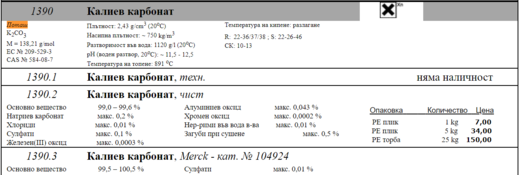
Here is a screenshot from perhaps the biggest chemical dealer in Bulgaria :smile:
(поташ) = potash
(Калиев карбонат) = potassium carbonate
 

Attachments

  • Screenshot 2023-08-18 155530.png
    Screenshot 2023-08-18 155530.png
    15.9 KB · Views: 66
  • Screenshot 2023-08-18 1558033.png
    Screenshot 2023-08-18 1558033.png
    102.8 KB · Views: 54

koraks

Moderator
Moderator
Joined
Nov 29, 2018
Messages
26,094
Location
Europe
Format
Multi Format
I would therefore be quite surprised, if "potash" means any other compound than Potassium Carbonate.

It usually means potassium carbonate with unspecified hydration, which will usually be the monohydrate... So usually it means exactly what we assume it means - except when it doesn't :wink:

This crud that is formed in solution might stick to the film and that's something you definitely don't want to happen.

I've never noticed this, but your remark is duly noted and it's a risk one should take into consideration. In my experience no 'crud' (it's more cloudiness) will stick to the film if the developer is used immediately. I can imagine there will be a problem if the developer is mixed, then left to sit for a day or longer so that the cloudiness precipitates and can cluster together, forming larger particles that will present a problem. It's a "YMMV" situation.

It probably comes from the German "pottasche" or the French "potasse"

The provenance is actually Dutch: "potas" ("potassche") which literally means "ashes from the pot (oven)", referring to the old-fashioned production method.
 

Rudeofus

Member
Joined
Aug 13, 2009
Messages
5,113
Location
EU
Format
Medium Format
It usually means potassium carbonate with unspecified hydration, which will usually be the monohydrate... So usually it means exactly what we assume it means - except when it doesn't :wink:

If you look at the German language wiki article for Potassium Carbonate, then "Pottasche" is a synonym for Potassium Cabonate, which tells me, that at some point "Pottasche" was used differently from Dutch "potas(sh)" or English "potash". Since 150 years ago German language was quite dominant in scientific literature (see e.g. the official seal of Stanford University), I suggest, that "potash", "potas" or "Pottasche" found in older chemical literature most likely refers to Potassium Carbonate, and not some poorly defined residue in a pot used for burning wood.

BTW: wikipedia articles for Potassium Carbonate list anhydrous and sesqihydrate form, but no mono hydrate. Looking at Sigma Aldrich's offering suggests, that the anhydrous form is the most popular and available form.
 

koraks

Moderator
Moderator
Joined
Nov 29, 2018
Messages
26,094
Location
Europe
Format
Multi Format
I suggest, that "potash", "potas" or "Pottasche" found in older chemical literature most likely refers to Potassium Carbonate, and not some poorly defined residue in a pot used for burning wood.

Oh, I never suggested otherwise. However, I did warn against using the term 'potash' in photographic formulae today. At best, it's outdated and at worst, it's unnecessarily ambiguous.

BTW: wikipedia articles for Potassium Carbonate list anhydrous and sesqihydrate form, but no mono hydrate.

I stand corrected!
 
Photrio.com contains affiliate links to products. We may receive a commission for purchases made through these links.
To read our full affiliate disclosure statement please click Here.

PHOTRIO PARTNERS EQUALLY FUNDING OUR COMMUNITY:


Ilford ADOX Freestyle Photographic Stearman Press Weldon Color Lab Blue Moon Camera & Machine
Top Bottom