• Welcome to Photrio!
    Registration is fast and free. Join today to unlock search, see fewer ads, and access all forum features.
    Click here to sign up

Why don't reflective meter reading of zone V card and an incident reading match?

Man walking.

A
Man walking.

  • 1
  • 1
  • 28
_Z721713-positive.JPG

H
_Z721713-positive.JPG

  • 4
  • 3
  • 117

Recent Classifieds

Forum statistics

Threads
202,006
Messages
2,833,643
Members
101,065
Latest member
canadian_xpress
Recent bookmarks
0

mr.datsun

Member
Allowing Ads
Joined
Oct 27, 2008
Messages
379
Location
The End of t
Format
Sub 35mm
Trying to calibrate exposure, film and dev with meter and wedge step:

I thought I already understood this well but now I'm getting confusing results.

Equipment:

Stoufer RZ1 (with zones)
Weston Master V meter with diffusion cone
Kodak 18%

The Kodak 18% grey matches zone V on the Stouffer step wedge. As I thought.

If I take an incident reading with the cone on I get exposure value 8.

Then if I take a reflective reading using the card, I get a full stop difference at exposure value 9.

I have assumed for years that incident readings taken with my meter would give an exposure for equivalent of a zone V card reflective reading. Am I wrong?

Which is the true mid-grey (V) exposure?
 

Bill Burk

Subscriber
Allowing Ads
Joined
Feb 9, 2010
Messages
9,477
Format
4x5 Format
The incident reading is calibrated to the dome itself.

The 18% gray card is a "known reflectance" that is suitable for determining exposure - but from what I gather and am starting to believe... It's NOT what the reflected light meter is calibrated to.
 

MattKing

Moderator
Moderator
Joined
Apr 24, 2005
Messages
55,303
Location
Delta, BC Canada
Format
Medium Format
Did you read the instructions that go with the gray card?

I ask, because very few seem to read them.

The angle you hold the card is important - if done properly, it will tend to give a reading that is about 1/2 stop less than reading the card "straight on".
 

johnnywalker

Member
Allowing Ads
Joined
Sep 23, 2002
Messages
2,323
Location
British Colu
Format
Multi Format
I've never had any luck getting them to read the same. Even after reading the instructions, I've decided it's all in the way you hold your tongue.
 

Bill Burk

Subscriber
Allowing Ads
Joined
Feb 9, 2010
Messages
9,477
Format
4x5 Format
That's why I held my tongue.

Yesterday I was experimenting with flare. In a backlit scene, with lots of flare, I aimed spotmeter at graycard and it measured same as incident mode... when I was close enough with the spotmeter to minimize flare. When I backed away enough to induce flare, my spotmeter reading went up a stop.

In a low flare situation, the two modes agreed.
 
OP
OP

mr.datsun

Member
Allowing Ads
Joined
Oct 27, 2008
Messages
379
Location
The End of t
Format
Sub 35mm
Did you read the instructions that go with the gray card?

I ask, because very few seem to read them.

The angle you hold the card is important - if done properly, it will tend to give a reading that is about 1/2 stop less than reading the card "straight on".

I knew you had to hold it at angle (1/3 towards camera axis) but this gives around 1/4 to 1/3 stop difference for me. That counts for a bit but still around 2/3 stop out.
 
OP
OP

mr.datsun

Member
Allowing Ads
Joined
Oct 27, 2008
Messages
379
Location
The End of t
Format
Sub 35mm
The incident reading is calibrated to the dome itself.

The 18% gray card is a "known reflectance" that is suitable for determining exposure - but from what I gather and am starting to believe... It's NOT what the reflected light meter is calibrated to.

Bill, so are you suggesting that the incident reading with dome is a more reliable method? i.e independent of tongue locations?
 

markbarendt

Member
Allowing Ads
Joined
May 18, 2008
Messages
9,422
Location
Beaverton, OR
Format
Multi Format
It is a pretty safe assumption that the incident meter is "right" as far as the ISO standard.

When using any target in the scene it is important that it be used in a consistent manner and that you know what the offset is.

The grey card, as Bill indicated, isn't necessarily a match for the ISO standard.

Take a reading with the incident meter then with any target in that same spot, take a reflected reading with your spot meter. The difference is the offset you need to use for that target.
 

Bill Burk

Subscriber
Allowing Ads
Joined
Feb 9, 2010
Messages
9,477
Format
4x5 Format
There are techniques for holding the incident meter as well (towards the light vs towards the camera) that can affect the result too.

But in general, I think the incident meter gives you a direct calculation that you are able to use directly off the calculator dial, while the 18% gray card gives you a reading that you are supposed to adjust.
 

Chan Tran

Subscriber
Allowing Ads
Joined
May 10, 2006
Messages
7,153
Location
Sachse, TX
Format
35mm
My meter reads the same for incident (with a flat receptor) and the spot meter off the gray card.
 

250swb

Member
Allowing Ads
Joined
Apr 22, 2012
Messages
1,613
Location
Peak District
Format
Multi Format
Perhaps this is why Ansel suggests making your own grey card? It is not the exact 18% grey reflectance that is important but the way the notional tone affects the rest of the processing chain. So you make a Zone V grey card to suit your meter.

Steve
 

Chan Tran

Subscriber
Allowing Ads
Joined
May 10, 2006
Messages
7,153
Location
Sachse, TX
Format
35mm
If the reflected light meter is calibrated for a K14 and the incident light meter with a flat receptor is calibrated for C250 then a 17.59% gray card should give identical reading. Meters are calibrated for K12 to K14 often. But I don't know about the Weston it seems 1 stop is a lot.
 
OP
OP

mr.datsun

Member
Allowing Ads
Joined
Oct 27, 2008
Messages
379
Location
The End of t
Format
Sub 35mm
Interesting ideas about meters and calibration that I need to read up.

On a more practical level, is there any possibility that my Weston is giving incorrect readings. It's not exactly new, do the selenium meters begin to fail with age?
 

Alex Muir

Member
Allowing Ads
Joined
Dec 23, 2009
Messages
407
Location
Glasgow, Scotland
Format
Medium Format
I understand that the selenium cells in meters like the Weston series do deteriorate. I have a Master IV in beautiful cosmetic condition, but the readings are useless. It used to be possible to have the cell replaced, but it would be cheaper to get a more recent version second-hand. I have to say that I also see differences between readings with incident and reflected measurements.
 

Bill Burk

Subscriber
Allowing Ads
Joined
Feb 9, 2010
Messages
9,477
Format
4x5 Format
The selenium cell, if it is un-damaged, can last a very long time.

I have a Master II which gives reasonable readings, but have had a couple Westons that didn't work as well. In general I find they are fully good or totally bad (though the problem can be loose connections).

I think the Weston series of meters are "pretty well" designed, as far as protecting the selenium cell goes.

You might need to get in the habit of using Tungsten speed ratings that are lower than Daylight speed ratings. Sensitivity of selenium cell to near infra-red makes the needle jump higher under Tungsten than it should.

---

By the way 1 stop higher reading of 18% gray card seems perfectly reasonable.

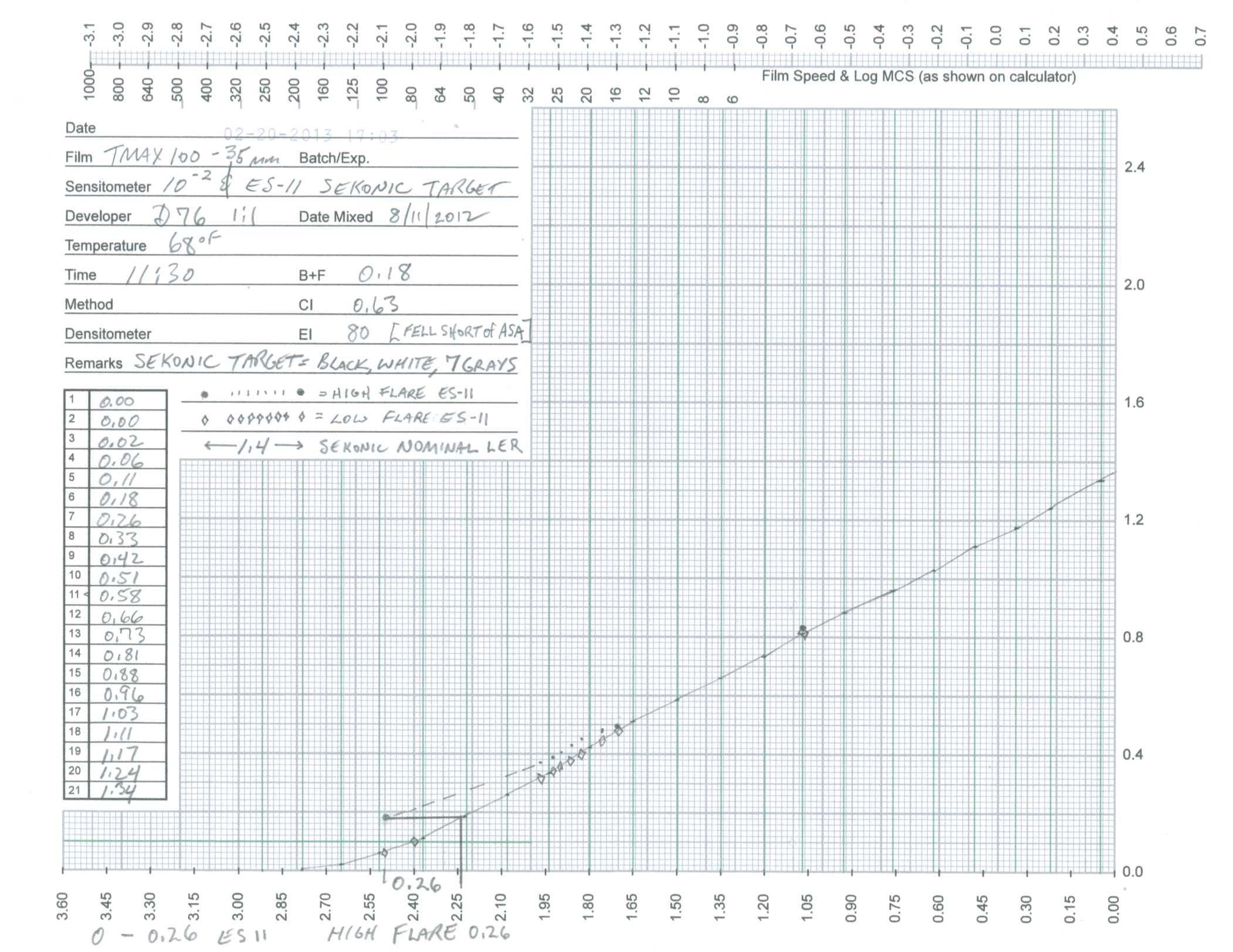
I accidentally did an 18% gray card exposure test, so here is the graph...

Basically the lowest diamond on the lower-left of the curve is 2 1/3 stop below 18%. (18% is the middle of the cluster of diamonds mid-curve). Imagine that lowest diamond is about Zone III. Really would have rather placed Zone II down that far on the curve. So one stop more would have been a better exposure.

ESIIFLARE.jpg
 

mark

Member
Allowing Ads
Joined
Nov 13, 2003
Messages
5,706
The card is only reading a small part of the scene, the dome is reading the entire scene.


Yep. But I would word it as the dome is an average. the reflected is a small part.
 
Last edited by a moderator:

RPC

Member
Joined
Sep 7, 2006
Messages
1,633
Format
Multi Format
The card is only reading a small part of the scene, the dome is reading the entire scene.

The dome is used to read the light illuminating the scene, not the scene itself. The gray card is used to represent a typical scene, not be a part of one unless you put it in the scene and spot read it. In any case the meter should be calibrated to give the same results, or at least close.
 
OP
OP

mr.datsun

Member
Allowing Ads
Joined
Oct 27, 2008
Messages
379
Location
The End of t
Format
Sub 35mm
You might need to get in the habit of using Tungsten speed ratings that are lower than Daylight speed ratings. Sensitivity of selenium cell to near infra-red makes the needle jump higher under Tungsten than it should.

---

By the way 1 stop higher reading of 18% gray card seems perfectly reasonable.

Bill, your comment about Tungsten speed rating is interesting. I keep asking myself why Tri-X Super 8 Reversal is rated at 160ASA for Tungsten and 200ASA for daylight. I never thought about b&w Tri X 35mm having two different ratings as I thought it was panchromatic. Is this related to the selenium meter sensitivity that you mention (which I guess many Super 8 cameras, like mine have) or another factor?

Thanks for showing us the graph. It looks fascinating and satisfyingly methodical. Your description kind of makes sense but I'm afraid I still find it hard to read it without the background knowledge...

You comments on the Weston make me think that mine is working within acceptable limits and I will carry on with the 18% grey difference in mind when metering but probably rely on the incident reading until my results tell me differently. I'm testing with a Stouffer zone wedge step as my guide.
 
Last edited by a moderator:

fotch

Member
Allowing Ads
Joined
Mar 16, 2005
Messages
4,774
Location
SE WI- USA
Format
Multi Format
The dome is used to read the light illuminating the scene, not the scene itself. The gray card is used to represent a typical scene, not be a part of one unless you put it in the scene and spot read it. In any case the meter should be calibrated to give the same results, or at least close.

Not necessarily, it depends on the where and how the light falls, and where the gray card is for the reading. Example: wooded area in bright sun. If say, outdoors, in a field, nothing to obstruct or alter the light, then, in theory, should be close to the same.
 

Chan Tran

Subscriber
Allowing Ads
Joined
May 10, 2006
Messages
7,153
Location
Sachse, TX
Format
35mm
The dome isn't an average measurement of the scene but rather a measurement of light falling on the dome which is a small area. (if you call it average, it averages within the area of the dome only not the scene.). The spot meter measures light reflected of a small area (depending on the how far you position the meter). So neither the spot meter nor incident meter is an average reading.
 
Photrio.com contains affiliate links to products. We may receive a commission for purchases made through these links.
To read our full affiliate disclosure statement please click Here.

PHOTRIO PARTNERS EQUALLY FUNDING OUR COMMUNITY:


Ilford ADOX Freestyle Photographic Stearman Press Weldon Color Lab Blue Moon Camera & Machine
Top Bottom