
• Welcome to Photrio!
    Registration is fast and free. Join today to unlock search, see fewer ads, and access all forum features.
    Click here to sign up

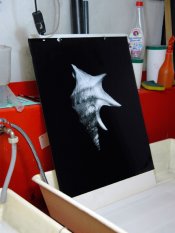
White Pigment Carbon Printing on Black Ground - from Positives

Rainy Day Trees

A
Rainy Day Trees

  • 6
  • 1
  • 92
One Way

A
One Way

  • 3
  • 1
  • 91

Recent Classifieds

Forum statistics

Threads
203,157
Messages
2,850,714
Members
101,704
Latest member
yppnq
Recent bookmarks
0

holmburgers

Member
Allowing Ads
Joined
Aug 13, 2009
Messages
4,439
Location
Vienna, Austria
Format
Multi Format
So this is one of those crazy ideas you get while laying in bed late at night, and as it turns out I'm not the only one!

Instead of making black carbon "glop" and printing that under a negative on white paper, you make white goo and print that under a positive on black paper. Voila!

Here are some other discussions on this topic, and I hope some of the carboneers here will chime in.
(you know who you are! :wink:)

http://johnmilleker.com/weblog/?p=1285
http://johnmilleker.com/weblog/?cat=321
http://bostick-sullivan.invisionzon...__+titanium++dioxide__fromsearch__1#entry6445
http://bostick-sullivan.invisionzone.com/index.php?/topic/245-white-carbon-print/

If you can find any more resources, or examples, please share them. I think this could be a very cool way to make carbon prints from any positives you might have lying around.
 
This has been on my things-to-do-after-the-kids-move-out list for awhile.

Having the blacks sink down instead of rising up sounds like it would be neat thing. I went as far as to make a couple 8x10 positives, but this process will have to wait its turn in my life!

Vaughn
 
Just "accidentally" put white ink into your next glop and then "accidentally" use exposed & developed photo paper for your final support. With no more effort than usual you might have it made!

But seriously, it does sound very interesting. I'll be sure to report back if I get around to it soon.
 
I have tried this - it did not work particularly well as 'white' reflects the very light that it is needed to penetrate the tissue. Similarly, using a metalflake pigment didn't turn out so wonderful (but the glop did have a nice shimmer to it!)
 
Hey Ian! Long time no see :D

I remember that you mentioned this aspect when I proposed it to you a while back. The 1st two links by John Milleker definitely seem to confirm this problem, but if you look at that last post, the posted example is quite good. So there appears to be hope for this method working.

Being a carbon-newbie myself, I can only say that perhaps the pigment concentration and sensitizer concentration will have to be tweaked till the sweet spot is found. Even though the white is reflective, the fact that it is equally reflective over its entire surface would suggest that there will still be a differential and thus we just have to find the proper balance to exploit it.
 
Thanks Jim, here is the formula used successfully by damiano from over there at B&S.

"My tissue is around 4 grams of titanium white W&N in 100 cc of gel 8 %. I [sensitize] 0.3 % (yes 0.3) AD and exposure is [4 times what] I use for black...dam"

(forgive my corrections!)

So indeed, things are much different. Exceptionally high contrast with 0.3% and significantly longer exposures probably due to the highly reflective nature of the white pigment.
 
Hey Ian! Long time no see :D

I remember that you mentioned this aspect when I proposed it to you a while back. The 1st two links by John Milleker definitely seem to confirm this problem, but if you look at that last post, the posted example is quite good. So there appears to be hope for this method working.

I should also add that white pigments tend to scatter light, reducing local contrast and acutance :blink:

Had direct-positive via white pigment been viable, I would think it would have been adopted commerically... then again, who knows.
 
Last edited by a moderator:

Attachments

  • damiano - white carbon print bostick&sullivan.jpg
    damiano - white carbon print bostick&sullivan.jpg
    122.3 KB · Views: 199
Well...since one of the links the OP provided is a thread I started, I thought I'd chime in...

First off, I'll note that I started that thread about 2 weeks after hearing/learning about carbon for the first time...talk about a noob!

I don't have much to offer, other than it is something I'm still very interested in trying. I'll be using digi-negs, so I can't post my results here if and when I try it, so you'll just have to keep an eye on the B&S forum or DPUG.

--Greg
 
Hey Greg, I was hoping you'd chime in!

You can talk about the carbon print itself... we don't need to censor ourselves when it comes to digital negs, just don't go in depth about those aspects. Afterall... I use a digital lightmeter sometimes!

As Hexavalent mentions, the light reflecting property might pose a problem, however, using carbro would eliminate this problem. There is at least 1 paper I know of that is suitable for carbro; David Lewis' bromoil paper and it is reasonably priced; <$1/8x10".
 
I made gum one print, now buried somewhere, on paper that I stained black with permanent ink, and white tube watercolor paint from a film positive. I didn't do more than one coat, probably because of my ADD nature. But it was promising. That white carbon print above, looks pretty darn good.
 
Photrio.com contains affiliate links to products. We may receive a commission for purchases made through these links.
To read our full affiliate disclosure statement please click Here.

PHOTRIO PARTNERS EQUALLY FUNDING OUR COMMUNITY:


Ilford ADOX Freestyle Photographic Stearman Press Weldon Color Lab Blue Moon Camera & Machine
Top Bottom