• Welcome to Photrio!
    Registration is fast and free. Join today to unlock search, see fewer ads, and access all forum features.
    Click here to sign up

which power plug

Recent Classifieds

Forum statistics

Threads
201,768
Messages
2,829,823
Members
100,936
Latest member
rdbirt
Recent bookmarks
0

removedacct3

Member
Allowing Ads
Joined
Mar 19, 2009
Messages
628
Location
-
Format
Multi Format
Hello,

Today my father gave me his fiber print dryer. An old-fashioned one .... curved metal plate, white cotton cloth and various springs to press the print against the heated plates. The type plate says it is a HOGGLANSPRESS (Type 5 Volt 110 Watt 300), ELEKTRO-INDUSTRI FALKOPING SWEDEN. The press itself seems to be in good shape. It is in working condition. Unfortunately that can not be said from the plug that connects the power cord to the press. That plug is in bad shape. It is just not safe anymore and needs to be replaced.

As far as a layman can estimate, this machine seems to be quite old. Old enough not to use modern standard plugs. I can not identify the type of plug this thing uses.

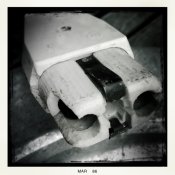
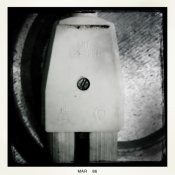
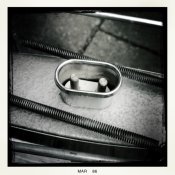
I like the overall look of this machine and I would prefer if I can replace the plug instead of converting the dryer to accept a modern plug. So, I have shoot some misplaced artistry Histamatic images of this plug (male and female) hoping that someone is able to identify the type of plug I am looking for. A web shop selling these plugs and is willing to ship to the Netherlands would be a bonus.

Thank you very much for your help!
 

Attachments

  • powerplug_01.jpg
    powerplug_01.jpg
    126.3 KB · Views: 204
  • powerplug_02.jpg
    powerplug_02.jpg
    110.1 KB · Views: 201
  • powerplug_03.jpg
    powerplug_03.jpg
    93.7 KB · Views: 194

Dr Croubie

Member
Allowing Ads
Joined
Mar 21, 2013
Messages
1,986
Location
rAdelaide
Format
Multi Format
Looks like it takes one of those many different things all mysteriously called a "kettle cord".
How big is it? ie, what is the distance between the centre of the pins in probably most important.

Just looking at: https://en.wikipedia.org/wiki/IEC_60320
It looks like a regular C2 plug, but they take bugger all current.
A C8 might fit, but they're not rated for high temps or current.
The plug you've got says it's 10A/250V rated.
So yes, you're right in that looks like a very old (or at least, non-IEC standardised) type.

Your best bet is probably to take it to an appliance specialist and ask for something that'll fit.
Rewiring the innards with a new socket is not something to do yourself, if anything goes wrong and your house burns down your insurance is void.

I'd also be more concerned about the fact that it's 110 V, Europe uses 230 V these days. At the least you'll need a step-down transformer or it'll catch fire anyway.
 

Sirius Glass

Subscriber
Joined
Jan 18, 2007
Messages
50,814
Location
Southern California
Format
Multi Format
Check to see the voltage on the metal plate. It is probably the standard two pronged 220-240V. If it starts smoking or gets too hot on 220-240V, then it is 120V, but that seems highly unlikely.
 

AgX

Member
Allowing Ads
Joined
Apr 5, 2007
Messages
29,972
Location
Germany
Format
Multi Format
Apt cables can be got very often at fleamarkets here (and thus around Marssen too) for about 2€.

That is the outdated version of the "Heißgeräte-Stecker".
 

jvo

Subscriber
Joined
Dec 6, 2008
Messages
1,782
Location
left coast of east coast
Format
Digital
this looks to be the dryer side of the cord (yes, kettle cord, and they evolved to the black plastic used on many coffee makers), and the opposite end would be a standard 110v male socket to go in the wall? am i seeing that correctly?

jvo:sideways:
 

AgX

Member
Allowing Ads
Joined
Apr 5, 2007
Messages
29,972
Location
Germany
Format
Multi Format
I did not read that 110V thing in the original post.

In the best case that press has a temperature switch that takes control.
In the worst case it will overheat/burn.

I would not bother for that thingy with a transformer as that would have to take 300W ! Not economic.
The better way would be to put resistors in series (incandescant lamps).
Best way would likey be to put that thingy aside...
 
Last edited:

Sirius Glass

Subscriber
Joined
Jan 18, 2007
Messages
50,814
Location
Southern California
Format
Multi Format
The type plate says it is a HOGGLANSPRESS (Type 5 Volt 110 Watt 300), ELEKTRO-INDUSTRI FALKOPING SWEDEN.

That is what I missed in the original post.
 

AgX

Member
Allowing Ads
Joined
Apr 5, 2007
Messages
29,972
Location
Germany
Format
Multi Format
In the Netherlands up to the 70s there locally were households than ran on 127 V .


(Partially that had been upgraded to 220V, in a weird system with both contacts at a wall socket being hot. Dangerous for the uninistiated DIY guy...)
 
Last edited:

paul ron

Member
Allowing Ads
Joined
Jan 22, 2004
Messages
2,709
Location
NYC
Format
Medium Format
then to wire a 110v in a 220v both hot, just use one leg and a ground.

i had a guitar amp wired like this to be used in italy.

your dryer will also need a heater cord... a specialy insulated wire meant for high wattage appliances.
 

AgX

Member
Allowing Ads
Joined
Apr 5, 2007
Messages
29,972
Location
Germany
Format
Multi Format
Paul, as I indicated that was an ancient net.
With the demise of that 127V net the upgrading by those two hot pins also vanished.


From that time there still could be transformers around. But these would be low power ones. And I never came across one anyway.
 
OP
OP

removedacct3

Member
Allowing Ads
Joined
Mar 19, 2009
Messages
628
Location
-
Format
Multi Format
Oops, a typo. A nasty one. The machine's type plate says 220 V instead of 110 V.
 

Dr Croubie

Member
Allowing Ads
Joined
Mar 21, 2013
Messages
1,986
Location
rAdelaide
Format
Multi Format
Oops, a typo. A nasty one. The machine's type plate says 220 V instead of 110 V.

Well that's good then, saved you a whole heap of hassle and pain (and probably wouldn't have been worth the bother it if it were 110V).
 

bernard_L

Member
Allowing Ads
Joined
Feb 17, 2008
Messages
2,132
Format
Multi Format
then to wire a 110v in a 220v both hot, just use one leg and a ground.
NOT !!
first, this statement is confusing neutral and ground (protective); at best this would work in a three-phase AC distribution, with 220V between any two phases, and 127 (not 110) volts between any phase and neutral, and assumes that the neutral is made available at wall plugs (no reason to be if the installation has been converted to 220V).
second, and most important: no amateurish improvisation with AC mains
 

paul ron

Member
Allowing Ads
Joined
Jan 22, 2004
Messages
2,709
Location
NYC
Format
Medium Format
NOT !!
first, this statement is confusing neutral and ground (protective); at best this would work in a three-phase AC distribution, with 220V between any two phases, and 127 (not 110) volts between any phase and neutral, and assumes that the neutral is made available at wall plugs (no reason to be if the installation has been converted to 220V).
second, and most important: no amateurish improvisation with AC mains


yes, sorry i should have included a disclaimer, wiring should be left to the pros.

when we bought the amp it came with the italian power cord. i wanted to know how to adapt it to the USA power outlets. the salesmen had another power cord for 110v that looked exactly like your standard pc computer cord for $25. well i was stumped n compared the wiring of both cords.

the italian cord was wired to the right pin and the center pin. the left pin was blank. so it was wired to one live phase and the center ground... there is no neutral.

the USA generic computer cord was wired to both blades and the third pin was ground. that would be one live phase, neutral and the ground.... our neutral and ground both tie in to an earth ground at the entrance box generally hard wired to a cold water pipe.

so yes, this is not for first time diyers, but. if you are handy, its an easy fix. just be sure to know exactly what your electrical system hookup is.
 

Sirius Glass

Subscriber
Joined
Jan 18, 2007
Messages
50,814
Location
Southern California
Format
Multi Format
Check to see the voltage on the metal plate. It is probably the standard two pronged 220-240V. If it starts smoking or gets too hot on 220-240V, then it is 120V, but that seems highly unlikely.

Despite the fact it says "110V" eh?

I missed that. Then a step down transformer or down converter is in the future.

That is what I missed in the original post.

Oops, a typo. A nasty one. The machine's type plate says 220 V instead of 110 V.

I am vindicated! Only once I made a mistake. I thought that I might have been wrong, but it turns out that I was right all the time.
 

Dr Croubie

Member
Allowing Ads
Joined
Mar 21, 2013
Messages
1,986
Location
rAdelaide
Format
Multi Format
the italian cord was wired to the right pin and the center pin. the left pin was blank. so it was wired to one live phase and the center ground... there is no neutral. ... our neutral and ground both tie in to an earth ground at the entrance box generally hard wired to a cold water pipe.

That's how it works in Australia too, we have a MEN (Multiple Earthed Neutral) system in a TN-C-S configuration. Here earth is bonded both to a copper stake in the ground and a copper water pipe for redundancy.
But once it's past your meterbox the Earth and Neutral are not the same thing for a reason, and that reason is variously called ELCB (Earth-Leakage Circuit Breaker), RCD (Residual Current Device), RCBO (Residual Current Break-Open), or even just here on the TV ads they're called a 'Clipsal Safety Switch'.
Either way, what they do is simple. All current coming in via the Live has to leave via the Neutral. If it doesn't, then it's leaving via a person to Earth which is called electrocution, so an ELCB cuts off the power.
Wiring anything to Earth (if you've got an ELCB installed, they've been mandatory in new Aussie houses for at least 15 years but older houses might not have them) will just cut the power to your whole house.

Of course, I don't fully know what the systems are like around the world. When I worked in The Netherlands I'm pretty sure they also had a TN-C-S, but most of my work there was in 3-Phase and I didn't do that much with the distribution systems.
There is such thing as a 110/220 V 2-Phase system where you get a regular 110 V between the two legs and neutral, for 220V you use the two legs (kind of like how we get 415V from a 240V 3-Phase).
But that kind of wiring has to come from the street and wired into your house (if it's even available, I can't remember what countries even do it), no amount of cocking around with cables will help you change voltages.

As for that cable, sounds like it was wired for a TN-C network where Earth and Neutral are the same thing and the installer got lazy.
If you plug it in you'll just be using Live-Earth and if you've got an ELCB it'll blow, if you don't then it might work but be very dangerous.
If you don't have an ELCB installed and you're on a TT system, well, nice knowing you.
 

Hilo

Subscriber
Allowing Ads
Joined
Apr 19, 2011
Messages
922
Format
35mm
Is the outcome sofar you have the right voltage and no plug yet?

Send me a pm, I am in The Netherlands too and last year I bought such a plug for a Büscher dry mounting press. I need to check where I got it and give you the exact size of it . . .
 

Hilo

Subscriber
Allowing Ads
Joined
Apr 19, 2011
Messages
922
Format
35mm
here you go:

Dead Link Removed
 
Photrio.com contains affiliate links to products. We may receive a commission for purchases made through these links.
To read our full affiliate disclosure statement please click Here.

PHOTRIO PARTNERS EQUALLY FUNDING OUR COMMUNITY:


Ilford ADOX Freestyle Photographic Stearman Press Weldon Color Lab Blue Moon Camera & Machine
Top Bottom