• Welcome to Photrio!
    Registration is fast and free. Join today to unlock search, see fewer ads, and access all forum features.
    Click here to sign up

Which Light Meter ?

Up_the_TransAm.jpg

D
Up_the_TransAm.jpg

  • 0
  • 0
  • 11
IMG_3569 800x533.jpg

IMG_3569 800x533.jpg

  • 1
  • 0
  • 22

Recent Classifieds

Forum statistics

Threads
202,871
Messages
2,846,796
Members
101,579
Latest member
And ee
Recent bookmarks
0

Helios 1984

Member
Joined
Aug 4, 2015
Messages
1,866
Location
Saint-Constant, Québec
Format
35mm
Hi folks,

I am an amateur who's looking for a vintage light meter for practical use.
Here's what I understand so far (Correct me if I did a mistake):

Selenium = No battery, variety of cool looking meters available for dirt price, may or may not work properly if the selenium cell is beginning to fail.
CdS = Require infamous Mercury battery that are no longer produced for the past 20 years, battery conversion kit available $$, may or may not require re-calibration.
Silicon Blue = Require 9v battery that are available everywhere, more expensive.

I already scrolled down the net to find THE meter, here's my list:

9v Battery
- Gossen Profisix aka Luna-Pro SBC
- Gossen Lunasix F aka Luna-Pro F

Mercury Battery
- Gossen Lunasix 3 aka Luna Pro
- Weston Ranger 9

Where should I look to find those devices, what should I avoid, which one is the most reliable ?
Any recommendation will be welcomed.
thank you for your time.
 
Welcome to APUG.
I have experience with three of the four meters listed - the exception being the Weston Ranger 9.

I do have use for a flash metering function, so in my case I have a slight preference for the Gossen Luna-Pro F.

But I got almost 30 years of good service out of my Profisix - including many years with the flash metering attachment - so wouldn't hesitate to recommend it.

I have a Luna Pro in one of my bags, with adapters for 675 hearing aid cells, and am happy with it.

All are older meters, and are of similar durability. So if you get one in good shape, and have it serviced and calibrated, it will probably last for a long time.

My most used meter right now is a Gosen Digiflash.
 
Welcome to APUG.
I have experience with three of the four meters listed - the exception being the Weston Ranger 9.

I do have use for a flash metering function, so in my case I have a slight preference for the Gossen Luna-Pro F.

But I got almost 30 years of good service out of my Profisix - including many years with the flash metering attachment - so wouldn't hesitate to recommend it.

I have a Luna Pro in one of my bags, with adapters for 675 hearing aid cells, and am happy with it.

All are older meters, and are of similar durability. So if you get one in good shape, and have it serviced and calibrated, it will probably last for a long time.

My most used meter right now is a Gosen Digiflash.

The Luna-Pro F was on top of my list as it's the youngest and also because because it use 9v battery.
 
Last edited by a moderator:
I have the LunaPro SBC. It is really is my favorite meter. It is easy to use, easy read. I like the analog dial that shows all shutter speeds and the coresponding f-stops. This type of display just makes sense to me. I also like that the dial shows the ev number. (this way of displaying all selections is the reason that the Pentax digital spot meters appeal to me over the Minolta). The SBC is big.
So with all that said:
I also own a Minolta Auto Meter iv-f. When I rarely use flash I like the Minolta over other flash meters I've used. I'm just not a huge fan of having to scroll though the different selection. The Minolta are also very likeable meters, just a different type of display. I prefer the positioning of the sensor on the Minolta over how the Luna-Pro has done this.

I think it's fair to say even after you have handled the meters you think you will like, that some of the advantages and shortcomings will only be evident after having worked with the different choices.
 
The sensing cell in selenium meters do go bad particularly if the meter has been exposed to high light levels for a period of time. These meters should always be keep in their cases when not in use.

You can use a Wein (zinc air) battery as a proper substitute for a mercury one. There are also adapters that allow a silver oxide battery to replace a mercury one. Some people use a large hearing aid battery. Both the zinc air and silver oxide cells have the correct voltage and discharge rates. Others like an alkaline battery do not.
 
"The sensing cell in selenium meters do go bad particularly if the meter has been exposed to high light levels for a period of time. These meters should always be keep in their cases when not in use."
This may be true, but my experience has been that a selenium cell kept in the dark of the case will slowly lose sensitivity. They seem to be best stored in moderate light, like on a book shelf not directly in front of a window. I have two Weston Master II's both of which I bought new. They have always been stored as above, and are as accurate as ever when compared to my newer meters. Of course they have never been good in very low light.

I also have a Luna Pro SBC, among others, which has been a very faithful servant. I like the 9 volt battery,and the ability to read in very low light.
 
I have the Gossen LunaPro SBC which has features that most other light meters dream about. I can compensate for filters and I can use the Zone System. I also have an adapter for a 15 degree or a 7.5 degree field of view with a viewer for more specific readings. My only complain is that it seems to like to eat 9 volt batteries so I carry spare batteries.
 
I really like the big old Luna Pro SBC. I have and use other meters (all of them Gossen) but the Luna pro SBC is the one I reach for most often....except when using multiple studio flash heads...then I reach for the Gossen Luna Pro Digital-F.
 
I use Weston II and IIIs and they are all within a 1/3 stop of each other.
They are really cheap make sure you get the incident dome and filter.
Gossip is easy to spread. The selenium cells go off with moisture ingress, the westons post III don't seem to have been sealed they die even in the dark.

They are calibrated for the zone system so change you into Ansell Adams.

One of mine went down an underground escalator bump bump,... Bump still ok.
 
Same experience here with older Weston's. Mine also agree with modern calibrated meters. The failures I've had were corrosion on internal connections rather than selenium cell failure.
 
...

9v Battery
- Gossen Profisix aka Luna-Pro SBC
- Gossen Lunasix F aka Luna-Pro F

Mercury Battery
- Gossen Lunasix 3 aka Luna Pro
- Weston Ranger 9


I found the Luna-Pro SBC/F to be rather bulky for carry around, and a bit over-complicated for general use. It's almost double the size of the original Luna-Pro/Lunasix 3. Don't get me wrong, it's a fantastic tool...very quick readings. It's the most advanced of the options. Also, and I'm not sure if it is a common concern, my example ate batteries. It was really annoying...I had to take the battery out every time or I'd have a dead meter (and yes, I was aware of the switch-lock). That killed it for me as much as the size.

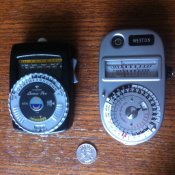
I alternate between the Luna-Pro/Lunasix 3 and the Ranger 9, but the Gossen is my go to at the moment. They're both a bit slower with the CdS cells, but just as useful from lowlight to direct sun. The Weston is a little less sensitive in low light. It's also taller with the built in 18 degree VF, but it sits a little flatter then the Luna-Pro/Lunasix. The Gossen has a ton of accessories available for it, which is another plus. I keep the 7/15 degree spot in the bag for general use.

I use hearing-aid batteries from the grocery - cost me $6 for an 8 pack last time I was there. Close to the same voltage as the mercury cells...they may not last as long as an alkaline/silver cell, but they do the job. Gossen also makes an adapter for $40...might fit in the Ranger 9 as well.

photo2.JPG

The Gossen would be my suggestion between the two I use - they're pretty common, have a lot of cool features/accessories, and are a snap in most any situation. FWIW, the later black ones supposedly have better response to blue/green light. If you can find the Luna-Pro S that would give you some of the same calculator dial features as the SBC.

The Weston took me a while to find, but it's a great meter as well. It's a damn pretty sight...You can print out a copy of the Ansel Adams Zone System dial like I did from here, if you find one.
 
Last edited by a moderator:
Thank you for all the answers, guys, it's really appreciated : )
Any of you used professional calibration service ? If yes, how much does it cost ?
 
The cameras shutter is unlikely to be accurate at any speed.
The efficiency of the shutter varies...
If you are using E6 find a black person grey card sunny day incident meter on nose bracket pick slide you like
Ie waste a film in end to end test.
 
The cameras shutter is unlikely to be accurate at any speed.
The efficiency of the shutter varies...
If you are using E6 find a black person grey card sunny day incident meter on nose bracket pick slide you like
Ie waste a film in end to end test.

Cameras need to be accurate within one f/stop. Light meters need to be able to deal with that.
 
+1 on posts of Jim Noel and Xmas. Some Internet ruuumooors never die. Have Gossen Sixtomat, Zeiss Ikophot, Weston Master V. All spot on. I also came across some dead Selenium meters. Real difference is CdS or Silicon meters reach lower light levels (EV0 versus EV7).
 
Hi Helios, may I ask why vintage? If it's the price, then I can recommened a budget Gossen Sixtomat Digital: http://www.gossen-photo.de/foto_p_sixtomat.php

I have been using mine for many, many years. Feather-light and very reliable, uses one AA battery and comes in a nice soft pounch.
 
Hi Helios, may I ask why vintage? If it's the price, then I can recommened a budget Gossen Sixtomat Digital: http://www.gossen-photo.de/foto_p_sixtomat.php

I have been using mine for many, many years. Feather-light and very reliable, uses one AA battery and comes in a nice soft pounch.

LCDs can have a limited life.
That is not calibrated for the zone system.
My oldest Weston II is from '47...
People who use batteries need to know where planet B is...
 
I regularly use Weston Master II and the contemporary GE meters, and occasionally use a Norwood Director. If in good condition, all are practical and reliable. One possible problem not addressed in above posts is an out-of-balance meter movement. To check this, cover the selenium cell and rotate the meter about the axis of the meter movement with the axis horizontal. The meter reading should not change. If it does change, it can be re-balanced, but this is a fairly delicate operation. An out-of-balance meter makes less difference in the GE meters than in the Weston and Norwood because the meter axis is vertical in normal use with the GE meter. One other occasional problem with old meters is the zero adjustment. With the selenium cell covered, the meter should read zero. This is an external screw adjustment. The meter movement balance should be correct before making the adjustment. Internal repairs to these meters should be done in a clean environment. Any tiny iron particle will be attracted to the pole pieces of the meter's magnet, where it causes problems.
 
Hi Helios, may I ask why vintage? If it's the price, then I can recommened a budget Gossen Sixtomat Digital: http://www.gossen-photo.de/foto_p_sixtomat.php

I have been using mine for many, many years. Feather-light and very reliable, uses one AA battery and comes in a nice soft pounch.

I've had my Sekonic 308 so long, it's almost-vintage,

If it's just a style thing, I get it, but a digital meter that takes one AA (and an extra one takes almost no space) which lasts a year or so, and has no accuracy worries, is smaller than a deck of cards, and has just the right features with no fluff… I can't see using an antique meter when there's meters this good out there.

If you want a meter for the zone system, I'd think a spot meter might be more appropriate?

(My Minolta Spot Meter was built something like 30 years ago and the LCD hasn't "faded"…)
 
Hi folks,

I am an amateur who's looking for a vintage light meter for practical use.
Here's what I understand so far (Correct me if I did a mistake):

Selenium = No battery, variety of cool looking meters available for dirt price, may or may not work properly if the selenium cell is beginning to fail.
CdS = Require infamous Mercury battery that are no longer produced for the past 20 years, battery conversion kit available $$, may or may not require re-calibration.
Silicon Blue = Require 9v battery that are available everywhere, more expensive.

This is a generalization, but note that:

a) there are selenium meters that still work OK even after 50 years
b) there are CdS meters that use modern silver-oxide cells, and in any case, zinc-air is a good substitute
b.1) some CdS cells definitely lose calibration with age; fortunately this does not seem to happen with the most reputed brands of meters

I would say that any Sekonic, Gossen, or Minolta, Weston, or Pentax meter is an excellent meter, as long as you check that the calibration is still OK both in daylight and in low-light.
 
Hi Helios, may I ask why vintage? If it's the price, then I can recommened a budget Gossen Sixtomat Digital: http://www.gossen-photo.de/foto_p_sixtomat.php

I have been using mine for many, many years. Feather-light and very reliable, uses one AA battery and comes in a nice soft pounch.

I've had my Sekonic 308 so long, it's almost-vintage,

If it's just a style thing, I get it, but a digital meter that takes one AA (and an extra one takes almost no space) which lasts a year or so, and has no accuracy worries, is smaller than a deck of cards, and has just the right features with no fluff… I can't see using an antique meter when there's meters this good out there.

If you want a meter for the zone system, I'd think a spot meter might be more appropriate?

(My Minolta Spot Meter was built something like 30 years ago and the LCD hasn't "faded"…)

I'm a tactile person, the big dials on these older models seems suited for me. Yes, I also appreciate good looking industrial designs : )
 
I have a Master II that Quality Light Metric reconditioned for me. I found a nice Invercone for it. Works great and is within 1/3 of the center weight meter on my F5. I've about $100 USD total into it and it will likely outlive me now. Learning how to use it help me a great deal with exposure in general.
 
LCDs can have a limited life.
That is not calibrated for the zone system.
My oldest Weston II is from '47...
People who use batteries need to know where planet B is...

Well, you can continuously measure the whole scene with it and you get contrast indication so you know which zones you need to compensate for, very useful, plus LCD lifespan is several thousant hours or more.
 
Yes it is easier to select a zone with a meter like you suggest with a narrower acceptance angle than a Weston.

But the Weston exposure calculator is calibrated in zones so you don't risk making an arithmetic mistake. I only use zone 1... Or incident on nose...

I'm ok on one two buckle my shoe, more is difficult when the bride is having a hissy fit.
 
I have the Gossen Luna Pro SBC which has features that most other light meters dream about. I can compensate for filters and I can use the Zone System. I also have an adapter for a 15 degree or a 7.5 degree field of view with a viewer for more specific readings. My only complain is that it seems to like to eat 9 volt batteries so I carry spare batteries.

The Gossen Luna Pro SBC takes reflective and incident readings. No flash readings.
The Sekonic L308S takes reflective, incident readings and flash readings. No spot meter capability.
 
Last edited by a moderator:
Photrio.com contains affiliate links to products. We may receive a commission for purchases made through these links.
To read our full affiliate disclosure statement please click Here.

PHOTRIO PARTNERS EQUALLY FUNDING OUR COMMUNITY:


Ilford ADOX Freestyle Photographic Stearman Press Weldon Color Lab Blue Moon Camera & Machine
Top Bottom