• Welcome to Photrio!
    Registration is fast and free. Join today to unlock search, see fewer ads, and access all forum features.
    Click here to sign up

Which lens is sharper - 1.4, 1.8. 2 at F8

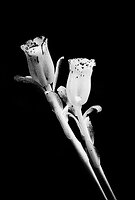
Indian ghost pipe plant.

H
Indian ghost pipe plant.

  • 2
  • 0
  • 23
2026-01-136.jpg

A
2026-01-136.jpg

  • 0
  • 0
  • 30

Forum statistics

Threads
202,940
Messages
2,847,821
Members
101,546
Latest member
Milanw
Recent bookmarks
0

delta02

Member
Allowing Ads
Joined
Nov 29, 2015
Messages
6
Format
35mm
I tend to think faster is better, but then I know that an F1.8 is probably sharper than a F1.4 at F8. I'm curious if this applies for slower lenses. For example, how sharp is a F2 50mm compared to a F1.8?

Most of my shooting is late afternoon and at F8, so I might be better off just buying the slower lenses from now on.

Thanks!
 
In general 1.2 and 1.4 were optimized for wide open, I have the Pentax and Miranda 1.4 and 1.8, I find the 1.8 just a little sharper stopped down, but not enough to make much a difference, if I had to have just one lens I would pick the 1.4.
 
Welcome to APUG

Each at the maximum aperture?
Each at the same f/stop?
 
You really cannot make a blanket statement. It all depends on the design of each lens. Some of the sharpest lenses that I have used have had a maximum aperture of f/2.8. There are also other factors such as contrast to consider besides resolution.
 
Back in the heyday and 35mm film cameras, independent lens tests usually stopped before f8. Smaller apertures than f8 tend to produce results similar for all lenses. Do you know why?
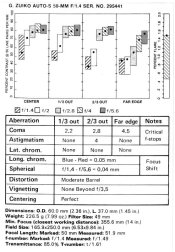
OlympusZuiko14.jpg
 
Many f/2 lenses are absolutely terrific if you don't need the extra speed or want the narrow DOF which might make the background look more blurry and help your subject stand out more. My favs are 50/2 lenses. That said the 1.4 lenses can perform very well but might give up other areas like distortion, etc. that could give more character or personality which you might or might not like, and why I like the Nikkor 50/1.4 and 35/1.4 lenses. Now all that said most lenses tend to perform their best 2-3 stops down from wide open. And in the end proper technique in holding your camera steady makes the most difference in performance!
 
All would be the same at F/8. Diffraction would be kicking-in whatever
The difference with an F/1.2 lens— is that at 1.4, it would be sharper than a F/1.4 wide-open, and at F/2 would far outperform a 1.8 or 2 wide-open.

Consider the F/1.2— barring a Noct-Nikkor or Noctilux with aspheric elements— as a very good F/1.4 , or a great f/2. the maximum aperture being a bonus.
I have all three max aperture, and a 2.8 Micro Nikkor. I would never in the past consider the F.1,2 as a general-use lens. But thinking it out and experience have corrected that.
All told the F/1.2, if its size and weight is not a problem, is my all-around 50mm lens.

If your shooting is confined to bright light, any will do. A 55mm F/2.8 AIS micro might give a slight edge, and have its own close-up advantages.
 
doubt you'll see any difference at f8. L
 
even less at f/11 or f/16 or f/22 or ...
 
Leaving aside the whole issue of sharpness (and why it doesn't really matter), if you're shooting mostly at f/8 and smaller, the differences are going to be negligible - just grab any old lens and you'll be fine. Seriously, a meniscus lens at f/8 will be more than acceptably sharp as long as you're not planning on blowing up a 36x24 negative to a wall-sized mural. Now, there are other questions - contrast, OOF rendering, etc. - that you should consider, but sharpness isn't one of them.
 
Most of my shooting is late afternoon and at F8, so I might be better off just buying the slower lenses from now on.

I'd save the weight and size in my camera bag and money in the pocket and get the f/2 or macro option and not look back.
 
People seem to have forgotten how narrow the depth of field is at moderate focal distances with an f2 lens. I use an f2 wide open for portraits because it's soft(ish) but gives sufficient depth to keep facial features in focus. Wider aperture lenses suffer from noses and ears out of focus, but users keep them wide open on the basis they haven't paid five times the price to use a lens at a setting of a "cheaper" lens.

Even at f4 there's a pleasing separation between subject and background, and most lenses are close to their sharpness peak.
 
Many f/2 lenses are absolutely terrific if you don't need the extra speed or want the narrow DOF which might make the background look more blurry and help your subject stand out more. My favs are 50/2 lenses. That said the 1.4 lenses can perform very well but might give up other areas like distortion, etc. that could give more character or personality which you might or might not like, and why I like the Nikkor 50/1.4 and 35/1.4 lenses. Now all that said most lenses tend to perform their best 2-3 stops down from wide open. And in the end proper technique in holding your camera steady makes the most difference in performance!

I found a Nikkor-H 50mm f2 (Ai'd) for cheap and was totally excited because of all the praise I heard about it. But upon testing it out, I found that wide open, it has the "dreamy"/foggy look that the 50mm 1.2 has wide open. I was disappointed. Is it sharp at 2.8? Yes! But I could always just use the 50mm 1.2 at 1.4/1.8 for similar performance (and don't mind the weight).
 
I found a Nikkor-H 50mm f2 (Ai'd) for cheap and was totally excited because of all the praise I heard about it. But upon testing it out, I found that wide open, it has the "dreamy"/foggy look that the 50mm 1.2 has wide open. I was disappointed. Is it sharp at 2.8? Yes! But I could always just use the 50mm 1.2 at 1.4/1.8 for similar performance (and don't mind the weight).

Hmm, don't have that with mine. You mentioned you got it cheap, was it hazy inside by chance or had minor micro-scratches or "cleaning marks"? Did you use a hood? Wide open is not as sharp as f/2.8-f/8 but I certainly would not describe it was dreamy or foggy.
 
Hmm, don't have that with mine. You mentioned you got it cheap, was it hazy inside by chance or had minor micro-scratches or "cleaning marks"? Did you use a hood? Wide open is not as sharp as f/2.8-f/8 but I certainly would not describe it was dreamy or foggy.

Hood, yes. Cheap because I got it at an estate sale for $25. it looks pretty clean. I'll check again and post samples.
 
I tend to think faster is better, but then I know that an F1.8 is probably sharper than a F1.4 at F8. I'm curious if this applies for slower lenses. For example, how sharp is a F2 50mm compared to a F1.8?

Most of my shooting is late afternoon and at F8, so I might be better off just buying the slower lenses from now on.

Thanks!

If you intend to shoot at f/8 buy the cheaper lens ;Large apertures arean advantage for the viewfinder, autofocus and built-in meter but not for image taking.:smile:
 
Back in the heyday and 35mm film cameras, independent lens tests usually stopped before f8. Smaller apertures than f8 tend to produce results similar for all lenses. Do you know why?
View attachment 120655

f8-11 is the typical 'sweet'spot' for 35mm lenses;by f/8 all abberations are minimized or gone and above f/11 ,diffraction takes over.:sad:
 
When I posted I was thinking about classic lens, the newer Sigma Art and Zeiss 1.4s are a different breed, the Sigma is just as good wide open as at F8 and shows very little distortion at F 16, 13 elements in 8 groups. I had been considering getting one, but I now shoot with Minolta AF, unless I get the Minolta 7 Minolta film bodies will not not AF with this lens.
 
I tend to think faster is better, but then I know that an F1.8 is probably sharper than a F1.4 at F8. I'm curious if this applies for slower lenses. For example, how sharp is a F2 50mm compared to a F1.8?

Most of my shooting is late afternoon and at F8, so I might be better off just buying the slower lenses from now on.

Thanks!
Does sharpness really matter?
It is for me a wee from pixel fan prospective.
I do like blurred images over hyper sharp ones , it might be an indication that I am getting older though [emoji2]
 
the newer Sigma Art and Zeiss 1.4s are a different breed, the Sigma is just as good wide open as at F8

Very true. I have the Sigma 35 f1.4 ART lens and it's sharp regardless the f-stop...love that lens. Big and heavy for a 35mm lens, yes, but a real honey.
 
Thanks again, great info! Well, sharpness isn't the only thing to consider...I just used it loosely as a proxy for "good lens".
 
I have done a bunch of tests with some of my lenses because I use them for critical archival work. Buy f/8 they're really all just about the same. In just about every case in the 50mm range, above f7.1 diffraction began to take its toll. F8 was usually worse. So from there it's downhill in a way that doesn't have much to do with the lens. As I remember from lens tests in old magazines, 5.6-8 was around the sweet spot for most everything. If you want to see something really illuminating, go to the interactive "results" panel at slrgear.com reviews, like this one, http://slrgear.com/reviews/showproduct.php/product/1231/cat/12 and you can see some beautiful graphics showing what you're up against.

What I ultimately learned was that the cheap zoom that came with my Nikon was, in its mid range equal or a bit better than the expensive macro, and this was confirmed in use. In the same vein, my particular 50/1.4 is a sharper lens than my 50/1.8, markedly so at f/2, so I'm wary of generalizations.
 
Last edited by a moderator:
I've recently tested my Yashica lenses on a digital body, and was surprised by the results. At 100% enlargement the ML (multicoated) lenses were perceivably sharper than the DSB (single coated), but it was a close run thing and only visible at sizes larger than most darkroom printers would go. The ML lenses controlled flare from direct light sources better, though I found the overall rendering of the DSB lenses nicer, though again there was nothing much in it.

The biggest difference was colour saturation where the DSB single coated lenses were noticeably more saturated than the multi-coated MLs, which had more muted renderings on the 28mm, 35mm and 50mm. Each was tested wide open, and at all stops to f11. I was surprised at the results, and will do the same for my Canon and Nikon lenses as time allows. Bear in mind a crop sensor camera with a glassless adapter avoids edge aberrations evident at 36 x 24 mm.
 
Photrio.com contains affiliate links to products. We may receive a commission for purchases made through these links.
To read our full affiliate disclosure statement please click Here.

PHOTRIO PARTNERS EQUALLY FUNDING OUR COMMUNITY:


Ilford ADOX Freestyle Photographic Stearman Press Weldon Color Lab Blue Moon Camera & Machine
Top Bottom