
-
Welcome to Photrio!Registration is fast and free. Join today to unlock search, see fewer ads, and access all forum features.Click here to sign up
You are using an out of date browser. It may not display this or other websites correctly.
You should upgrade or use an alternative browser.
You should upgrade or use an alternative browser.
What's the smallest neg that's useful for Alt Processes?
-
A
- Thread starter chip j
- Start date
Recent Classifieds
-
For Sale FS: 35mm Rodenstock APO-Grandagon, Linhof select
- Started by dirkfletcher
-
For Sale Kodak Ektra 35mm Rangefinder Body - Working, Film Tested
- Started by Hunter_Compton
-
For Sale FS: 18mm Zeiss Finder
- Started by dirkfletcher
-
For Sale Nikon F4 and AF-D lenses
- Started by Oldwino
-
For Sale Jobo 3005 Expert Drum up to 8x10 Like new, boxed
- Started by MLG
Forum statistics

Vaughn
Subscriber
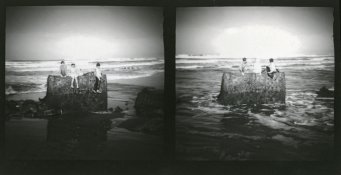
Sure! The smallest I have used have been from a Diana Camera...1.75" square, I believe. Platinum print and carbon print. Multiples of small negatives, also.
It is a matter of viewing distance as it relates to presentation. This image is two ajoining negatives from a Diana Camera. The film is out-dated Tech Pan, a high contrast film well suited for alt processes.
PS -- if you click on the image you should be able to reduce it to around life size -- about 4 inches long.
It is a matter of viewing distance as it relates to presentation. This image is two ajoining negatives from a Diana Camera. The film is out-dated Tech Pan, a high contrast film well suited for alt processes.
PS -- if you click on the image you should be able to reduce it to around life size -- about 4 inches long.
Attachments
Last edited:

Like Vaughn points out, any format can work. I sometimes used to make 35mm contact sheets on Van Dyke as an alternative to a normal contact sheet. But personally I find 35mm a bit small for usable contact prints, although it can be a nice artifact to have it in a tiny frame so you can hold it in your hand and admire it. However, I find 6x6 or 6x9cm is nicer for that.
Meyer Trioplan
Member
I've done some Cyanotypes from 35mm, but have yet to get results that I really like - most just seem to be a bit too ghostly and indistinct. I'll try some more as time allows, but I'm generally of the mindset that practically, a 6x9 is about the smallest I'd do.
My disclaimer is that I have tended to do subject matter that is either of a close up subject with distant bokeh or of a more detailed scene, neither of which really are prime for contact printing of any type on a 35mm negative.
My disclaimer is that I have tended to do subject matter that is either of a close up subject with distant bokeh or of a more detailed scene, neither of which really are prime for contact printing of any type on a 35mm negative.
If you're willing to scan the neg and digitally print a larger neg, then virtually any size will work. I find 4x5 is about as small of a negative as I like to use for printing without enlarging the negative first. But any size negative, even 110, will technically work. The question is, what are you gonna do with a print the size of your thumbnail?
Scanning and then printing your negatives also has the added advantage of being able to control the curves of the final print. I've done some alternative process straight from the negative, and sometimes it turns out OK. But usually for the best looking prints, you need to either adjust the curves digitally, or alter your development and exposure to gain the proper density curves, which is not only hard to do, but also makes the negative useless for pretty much anything other than the specific alternative process you are intending to use. For example, I once made a 4 color gum print this way, and it took me about 20 negatives and a month to find a workable exposure and development process to get a color curve that was even half way decent. With digitally printed negatives, I can usually nail everything on the first try (after calibrating my system to the process I intend to use).
Scanning and then printing your negatives also has the added advantage of being able to control the curves of the final print. I've done some alternative process straight from the negative, and sometimes it turns out OK. But usually for the best looking prints, you need to either adjust the curves digitally, or alter your development and exposure to gain the proper density curves, which is not only hard to do, but also makes the negative useless for pretty much anything other than the specific alternative process you are intending to use. For example, I once made a 4 color gum print this way, and it took me about 20 negatives and a month to find a workable exposure and development process to get a color curve that was even half way decent. With digitally printed negatives, I can usually nail everything on the first try (after calibrating my system to the process I intend to use).

I've done 6x7cm negatives as pt/pd prints that work just fine. I'm about to hang a show of 50+ 6x12cm palladium prints. 35mm COULD work, but they would have to be very graphical compositions to succeed - the viewing distance would be too short for detail-rich shots.
Vaughn
Subscriber
Photographically, with an enlarger, enlarge the 35mm neg onto sheet film (or litho film)to the size you want (this makes an inter-positive), then contact print that onto another sheet of film to create the negative. Or make a silver print the size you want and contact that onto sheet (or litho) film.
Or scan the neg and print out an inkjet enlarged negative for a hybrid route.
But images for small prints have to composed differently...detail will not carry the image...form needs to instead.
Or scan the neg and print out an inkjet enlarged negative for a hybrid route.
But images for small prints have to composed differently...detail will not carry the image...form needs to instead.
I've dabbled with interpositives on xray film for a bit some time ago. Develop, bleach, fog and redevelop. It worked, but it was a hassle to match the contrast to the process. The inkjet way is a bit quicker if you want to step up in size. But I've never personally made any digital negatives that I was truly happy with.
removed account4
Subscriber
- Joined
- Jun 21, 2003
- Messages
- 29,810
- Format
- Hybrid
In addition to what Vaughn said, you can also make a PAPER print the size you want ( enlarged on FB paper ) and then contact print THAT to another to make a negative. Then you would have to wax your print to make it semi translucent. If you go the hybrid route you can take the negative's file to a xerox shop and have them print it on overhead transparancy film or a paper xerox. If you use the paper you will have to wax it the overhead transparancy is ready to make prints with...How would I make a bigger neg from a 35mm one?

KenS
Member
Think about scanning your negatives and printing onto the frosted side of 8.5 x 11 "PIctorico" and using the resultant 'enlarged' negative for the 'alternative' print processes.
Ken
Ken

I printed 120 negs from my Holga as Kallitypes. I really like them.

Be careful about using T-Max 100 - it has a UV blocker built in, and defeats many of the Alternative processes.
I have a nice, almost detail free 6x9 cyanotype that shows this really well!
I have a nice, almost detail free 6x9 cyanotype that shows this really well!

Patrick Robert James
Member
- Joined
- Jul 31, 2012
- Messages
- 3,508
- Format
- 35mm RF
Back when I was young I had a Voigtlander Bessa II 6x9 camera. I made some really nice cyanotypes before digital made small prints obsolete. A 6x9 folder like a Bessa or any of the other simpler cheaper ones can be easily pocketed. The 6x9s are the sweet spot for size/portability if you want to stick with film.
Be careful about using T-Max 100 - it has a UV blocker built in, and defeats many of the Alternative processes.
I have a nice, almost detail free 6x9 cyanotype that shows this really well!

removed account4
Subscriber
- Joined
- Jun 21, 2003
- Messages
- 29,810
- Format
- Hybrid
Do I use glossy or matt paper to make a paper neg? What do you wax the print with?
I use matt paper, i hate glossy paper... To wax it well, here's the video I learned from James Harr on Flickr : https://www.flickr.com/groups/61907246@N00/discuss/72157624882653671/
I think traditionally people use bees was but I use grocery store GulfWax Paraffin .
Have Fun !
Prof_Pixel
Member
You need to match the digital negative to the printing process to be used. See http://glsmyth.com/articles/creating-the-digital-negative.pdf for a useful approach. (or Google 'Smyth digital negative' for more information.)Think about scanning your negatives and printing onto the frosted side of 8.5 x 11 "PIctorico" and using the resultant 'enlarged' negative for the 'alternative' print processes.
Ken

Take a few 35mm negs, lay them in a grid and have a bash at cyanotypes & see how you like 'em.
Here are some 6x6 negs. +/- 8 years ago. I came across them a few days ago and they are as nice as ever.
https://www.flickr.com/photos/txomin-leon-cedric/5424088745/in/album-72157625572621531/
https://www.flickr.com/photos/txomin-leon-cedric/5404449590/in/album-72157625572621531/
Here are some 6x6 negs. +/- 8 years ago. I came across them a few days ago and they are as nice as ever.
https://www.flickr.com/photos/txomin-leon-cedric/5424088745/in/album-72157625572621531/
https://www.flickr.com/photos/txomin-leon-cedric/5404449590/in/album-72157625572621531/
| Photrio.com contains affiliate links to products. We may receive a commission for purchases made through these links. To read our full affiliate disclosure statement please click Here. |
PHOTRIO PARTNERS EQUALLY FUNDING OUR COMMUNITY:  |