• Welcome to Photrio!
    Registration is fast and free. Join today to unlock search, see fewer ads, and access all forum features.
    Click here to sign up

What loupe is best for film?

PenStocks

A
PenStocks

  • 1
  • 0
  • 31
Landed Here

H
Landed Here

  • 4
  • 3
  • 46

Recent Classifieds

Forum statistics

Threads
201,833
Messages
2,830,868
Members
100,976
Latest member
Gorrunyo
Recent bookmarks
0

RattyMouse

Member
Allowing Ads
Joined
Oct 18, 2011
Messages
6,045
Location
Ann Arbor, Mi
Format
Multi Format
I need to buy a loop to help evaluate my negatives for sharpness and other irregularities. What level of magnification is needed to do this job well? I always assume that more is better but perhaps there is a point where magnification can become excessive. I'll be working mostly on 35mm and medium format film.

Thanks!
 

frank

Member
Allowing Ads
Joined
Dec 6, 2002
Messages
4,359
Location
Canada
Format
Multi Format
I don't own a good lupe, just some cheap ones. I find that looking through a 50mm lens works best. I also use a lens that came from a slide projector.
 

BMbikerider

Member
Allowing Ads
Joined
Jul 24, 2012
Messages
3,038
Location
UK
Format
35mm
I don't use one now, but I used to have an Olympus 35mm F2.8 lens which used to for the 'OM' camera series. Iy had a damaged diaphagm which I removed and this was as good as it gets. It would be possible to make some sort of frame negative carrier to attach to the front filter threads and fine focus being done with the actual lens focussing ring. Possibly a film carrier from an Epson flatbed scanner, say a V500 could be adapted.

At a push you could always use a 50mm enlarging lens hand held, this would be powerful enough to see any grain as well.
 

Mick Fagan

Subscriber
Allowing Ads
Joined
Sep 13, 2005
Messages
4,434
Location
Melbourne Au
Format
Multi Format
I have used many different magnifications, the best magnification range I have found for myself, was nearly always around the 4x magnification.

Using a lower magnification factor, often around 2x never seemed to be able to cut it. From about 6x and upwards, I have usually found the magnification to be a little too much.

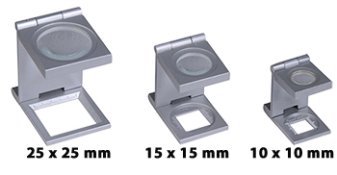
I have used linen testers, so called as they have a scale on the inside of their base that enables you to count the linen threads over a given length. These are remarkably small when folded, excellent at looking at linen threads, almost perfect for photography. They usually are available anywhere from 2x through to about 20x, with 5x almost being the universal standard one sees in industry. Will work on the back of a view camera with the ground glass screen, however it is possible to scratch the ground glass with the sharp corners. I have a few of these.

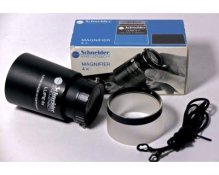
I have a Schneider 4x loupe, which I bought new, it really was an excellent choice and is still used whenever I am in the darkroom and enlarging. I use it for checking negatives from 135, 120 and 4x5”, either on the light box or suspended in my negative carriers. The ability to use either the clear bottom of the black opaque bottom is very handy. Although with great use I now find I use a little bit of tape to keep whatever bottom I am using stuck on. Works very well on the back of a view camera for focusing on the ground glass screen.

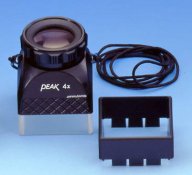
The Peak range of loupes are also excellent, I purchased one that is square and 4x mainly for use on the ground glass of my large format cameras. It too comes with a clear or opaque bottom half for different purposes. It is excellent and would be able to be used in the darkroom and later down the track if you go for large format, good for checking right into the corners of your ground glass screen.

For checking your negatives with a loupe, one usually has the negative either sitting on a light box, or held up to the light. When doing this it is advantageous to have a loupe with a fully black (opaque) bottom half. When checking contact prints, changing to a semi opaque bottom half allows side light to enter allowing you to see your contact images very well.

I would suggest anything from around 4x through to 6x would be the best overall compromise. I have used 8x and 10x loupes, but their magnification is such that you are working a bit too close to see as well as you can with lower magnification loupes.

Mick.

 

Attachments

  • Linen_tester.jpg
    Linen_tester.jpg
    30.9 KB · Views: 565
  • Schneider_4_by_loupe.jpg
    Schneider_4_by_loupe.jpg
    14.4 KB · Views: 726
  • Peak_4x_magnifier.jpg
    Peak_4x_magnifier.jpg
    15.8 KB · Views: 747
OP
OP
RattyMouse

RattyMouse

Member
Allowing Ads
Joined
Oct 18, 2011
Messages
6,045
Location
Ann Arbor, Mi
Format
Multi Format
Thanks Mick. Exactly the type of info and experience I was looking for. Much appreciated.
 

Ashfaque

Member
Allowing Ads
Joined
May 4, 2013
Messages
382
Location
Bangladesh & UK
Format
35mm
I am cheap. So I use a magnifying glass from my philately days with a Kaiser lightbox. As for best ones, Schneider and Peaks are pretty good. Silvestri Loupes are worth looking into as well.
 

Poisson Du Jour

Member
Allowing Ads
Joined
Jul 1, 2008
Messages
5,462
Location
.
Format
Digital
I am using an 8x APO and adjustable dioptric loupe by Schneider Kruznach, though at more than $800 it would get wiped from most people's bucket list on first sight. For me optical quality extends from reading glasses to lenses to filters and loupes. I would not ever use a cheap plastic loupe for critical evaluation right across the frame, unless free of distortion, chroma or astigmatism. Plastic ones cannot be this.

The earlier suggestion of using a lens is workable and may be the answer.

Sent from my LG-D855 using Tapatalk
 

MattKing

Moderator
Moderator
Allowing Ads
Joined
Apr 24, 2005
Messages
55,191
Location
Delta, BC Canada
Format
Medium Format
One practical concern is the field of view. If you want to be able to look at an entire 6x7 negative or slide, a loupe that makes it difficult to see outside of a 35mm frame without moving the loupe can be frustrating.
 

choiliefan

Member
Allowing Ads
Joined
Dec 27, 2013
Messages
1,362
Format
Medium Format
I recently purchased a used Mamiya 4X which works very well on the light box. It's also quite effective on the ground glass of my view camera...
 
OP
OP
RattyMouse

RattyMouse

Member
Allowing Ads
Joined
Oct 18, 2011
Messages
6,045
Location
Ann Arbor, Mi
Format
Multi Format
One practical concern is the field of view. If you want to be able to look at an entire 6x7 negative or slide, a loupe that makes it difficult to see outside of a 35mm frame without moving the loupe can be frustrating.

Sometimes after I see a scan from my film, it's not sharp. I want to be able to evaluate a negative to know if the image is in focus or not. If the image is not sharp, then there's no way I should expect a clear scan.
 

wiltw

Subscriber
Allowing Ads
Joined
Oct 4, 2008
Messages
6,702
Location
SF Bay area
Format
Multi Format
Conventional wisdom puts the optimum 135 format viewing loupe at about 5x, and the optimum medium format viewing loupe at about 3x. As power increases, lens diameter and field of view decrease. At 5 power (5X), field of view is about 1.5", the size of 135 neg.
But 8x might be used for critical evaulation of focus...after all, you blow up a 135 neg by about 8X to produce an 8x10" print.
 
Last edited by a moderator:
OP
OP
RattyMouse

RattyMouse

Member
Allowing Ads
Joined
Oct 18, 2011
Messages
6,045
Location
Ann Arbor, Mi
Format
Multi Format
Conventional wisdom puts the optimum 135 format viewing loupe at about 5x, and the optimum medium format viewing loupe at about 3x. But 8x might be used for critical evaulation of focus...after all, you blow up a 135 neg by about 8X to produce an 8x10" print.

Thank you.
 

PeterB

Member
Allowing Ads
Joined
Apr 3, 2005
Messages
644
Location
Sydney, Aust
Format
Medium Format
After reading all the replies again, I'm going to suggest one gets two loupes ! A x4 and a x10. This provides adequate field of view for 135 and MF plus one for critical focusing check if enlarging a 135 neg to 11x14"
 

Poisson Du Jour

Member
Allowing Ads
Joined
Jul 1, 2008
Messages
5,462
Location
.
Format
Digital
One loupé of say 8x or 10x will fully cover a 35mm frame. And, wiewing the entire frame in medium format is not a critical requisite as you are localising your examination point-to-point across the larger frame. Taking a quick look through a loupé of an apparent whole frame and then saying "good!" is a sure-fire way to miss something.
 

Vaughn

Subscriber
Allowing Ads
Joined
Dec 13, 2006
Messages
10,283
Location
Humboldt Co.
Format
Large Format
I have a Schneider 3x loupe (came with both clear and black "skirts"). Well made tool. Perfect size for 6x6 negatives and sufficient magnification for any of my LF negatives. I have a Peak 8x if I really need to check something out really close. But since I mostly contact print, the 3x is more than enough -- if I can't see something with the 3x, no one will see it in the print with their naked eye.

This one (but no longer made)... http://www.bhphotovideo.com/c/product/214582-REG/Schneider_08_034551_3x_Magnifier_for_6x7.html
 

whojammyflip

Subscriber
Joined
Dec 3, 2009
Messages
188
Location
Wellesbourne, UK
Format
35mm
I've used a cheap 10x, a Kenko Excelupe 8x and now currently use a Pentax 5.5x.

The Pentax seems to be the best in terms of magnification, and its got a giant base to it which means it can sit on top of a 645 negative with ease. However, its got more distortion than the Kenko. I dont see how a 50mm lens can work as well as this (i've tried it and it doesnt really cut it in my opinion).

For what its worth, I regret selling the Kenko lupe as the magnification gave a better indication of sharpness. I think Pentax made a zoom lupe, which covers less of the negative, but would be ideal for being able to check both sharpness and overall content of a negative.

Have a look on this pdf for lupes:
http://www.bhphotovideo.com/FrameWork/Product_Resources/SourceBookProPhoto/Section06Loupes.pdf

A quick scan of ebay finds both the Excelupe 8x and the Pentax 5.5x can be had or were recently for sale in Japan for around USD 70.
 
Last edited by a moderator:

Rich Ullsmith

Member
Allowing Ads
Joined
Jan 26, 2007
Messages
1,159
Format
Medium Format
The binocular loupes medical and dental offices used for much of recorded history, before digital. There is plenty of them out there, docs held onto them during the transition to digital, this is how I got mine. They produce a great 3d effect on color slides, you can make out the layers in the emulsion.

I have not looked but these probably can be found on ebay.
 

Rich Ullsmith

Member
Allowing Ads
Joined
Jan 26, 2007
Messages
1,159
Format
Medium Format
Forgot to mention, not the surgical loupes, but the xray viewing loupe.
 

Bill Burk

Subscriber
Allowing Ads
Joined
Feb 9, 2010
Messages
9,469
Format
4x5 Format
RattyMouse,

Don't know if you picked up a loupe yet... and no connection to seller... but this is a good choice... the standard to which others are compared.

(there was a url link here which no longer exists)
 
Photrio.com contains affiliate links to products. We may receive a commission for purchases made through these links.
To read our full affiliate disclosure statement please click Here.

PHOTRIO PARTNERS EQUALLY FUNDING OUR COMMUNITY:


Ilford ADOX Freestyle Photographic Stearman Press Weldon Color Lab Blue Moon Camera & Machine
Top Bottom