
• Welcome to Photrio!
    Registration is fast and free. Join today to unlock search, see fewer ads, and access all forum features.
    Click here to sign up

What is this strange bacteria on my PX 125?

Filling In

H
Filling In

  • 1
  • 2
  • 21
Painted Hills # 3.jpg

H
Painted Hills # 3.jpg

  • 4
  • 0
  • 74

Recent Classifieds

Forum statistics

Threads
203,208
Messages
2,851,381
Members
101,721
Latest member
rptn
Recent bookmarks
0

Hell-on-a-stick

Member
Allowing Ads
Joined
Sep 1, 2010
Messages
59
Format
Multi Format
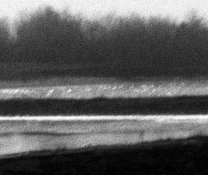
Recently, i was developing a roll of Kodak Plus-x 125 in Tmax Developer, and everything appeared normal until I full-sized my scans in Photoshop, in order to remove a bit of dust....then I noticed that there were strange 'grain-like' bacteria on each of the films. Its not readily noticeable otherwise...but this is the first time that I have seen this 'error' in my process, and I'd like to know where it comes from.
 

Attachments

  • neg725 copy2.jpg
    neg725 copy2.jpg
    214.2 KB · Views: 288
Yep. Reticulation. Monitor your temperatures closely as the others have said.

Peter Gomena
 
This would make a good textbook example of...

reticulation.
 
It's the bacteria that causes G.A.S.... :blink::blink:
 
I would agree reticulation. Keep all your chemical's temperature the same. The emulsion had a temperature shock during processing.
 
I would vote reticulation as well, however ...

Sometimes the scanning process adds artefacts that resemble other phenomena.

Can you examine your film under a strong magnifier or, even better, print one of the apparently affected negatives to see if the "bacteria" can be seen?
 
In one of Adreas Feininger's books, probably repeated in several, he talks about how to purposely create reticulation, and it looks exactly like this.

Hell-on-a-stick, care to share details of your processing temps??
 
In the days of Andreas Feininger the film emulsions were softer and far more subject to reticulation. Great care had to be taken to prevent the problem. I have not seen any as severe as this example in many years.
 
Well, my processing temps were 22c and my water was tempered for prewash at 24c....just to help the tank keep temps during development and get the 'blue koolaid' off the Px.
 
Thanks to all the replies...I guessed it was micro-reticulation of some kind....very strange though, my first answers to this were all about temp, but the negatives developed well, with no other problems...just the reticulation. Bad film?
 

Attachments

  • neg725 copy.jpg
    neg725 copy.jpg
    200.5 KB · Views: 114
  • neg717 copy.jpg
    neg717 copy.jpg
    226.5 KB · Views: 99
  • neg718 copy.jpg
    neg718 copy.jpg
    169.2 KB · Views: 110
What was the temperature of your wash water?
(I have never encountered faulty Kodak film)
 
Now I'm really puzzled. There's no way that could produce reticulation barring some strange fault.

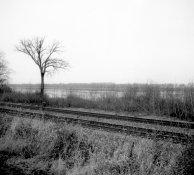
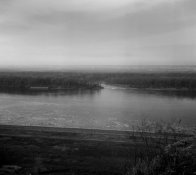
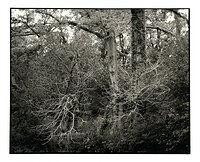
These are down scaled versions from the same 12exp roll. the first photo in this series is where the reticulation was viewed. The river scene was the first shot on the roll and when I 'full viewed' my scan (3200dpi) thats where I took the crop of the wierd reticulation. it is virtually invisible, until it is enlarged...but still very strange.
 
All chems were tempered at 21c, even the stop bath, though the fix may have been 2 degrees warmer due to the length of time it was in the bath. so between 22-24 c. My wash between dev and fix all came from the tempered bath...could have been as low as 18 c by the time i fixed...but probably more likely was 19-20c.
 
Still not answering the question. :smile: Let me try to ask more clearly.

When you develop film, there are a lot of steps.
1. Pre-wash
2. Develop
3. Stop
4. Fix
5. Wash

And, maybe:

6. Hypo clearing agent
7. Another wash

And finally:
8. Wetting agent
9. Hang to dry

All the liquids in each step of the process should ideally be the same temperature, or at least close, even steps 5 (and 7 if you use hypo clearing agent). The film is just as sensitive to reticulation by the wash water being cold as any of the chemicals being cold.

What is the temperature of the wash water at the end of your developing cycle? (step 5 [and step 7 if you use HCA]).

- Thomas
 
well, all my chemicals except for my Kodak Photoflo were tempered. my wash water, again, is tempered. most chems would have been between 19-24 celcius min and max. my dev, was directly 21c, as stated earlier. I believe that It must have been reticulation due to temperature, but I cannot see 'how' it happened. Its a first in 100's of rolls...so I thought I'd find out. Come to find, it was a fairly common problem, however, i can't seem to find where I made my misstep.
 
I've had cold photo-flo botch a batch of film. I find Tri-x sheet film developed in PMK to be susceptible to reticulation if process solution temps are not carefully monitored, right down to the rinse aid.

Peter Gomena
 
Thanks, Peter.
i guess i'll start adding my Photoflo to my winter temp-bath cycle. I am basically a do-it-yourself home developer, and I have learned quite a bit from members of Apug as well as other individuals outside this forum...I appreciate the advice!
 
These are down scaled versions from the same 12exp roll.

This is a long shot but 12 exp roll of Plus-X? Kodak hasn't made that in that length for quite a while, at least in US. (assuming you are talking about 35mm.... or are you talking about 12 exp of 6x6 on 120 film?)

Is this film a fresh roll??
 
Could there have been a spike in temp. with running water at some point, wash most likely? We've all been that shower when someone flushes. I had this happen (reticulation, not a cold shower) a few years ago with a normally quite reliable Jobo ATL at work. Some issue with the water supply in the building and the temp. jumped like mad. Some Tri-x 4x5 I was running got reticulated. I had a professor in college who made this his "look": Nudes in the woods shot on 35mm heavily reticulated and over enlarged.
 
For some reason I have it in my head that I read somewhere that reticulation can also be caused by, for want of a better description, chemical shock. Could the stop bath be too strong if indeed I did actually read something like this ?
 
Kodak gives the process range of temperature for PX films as 65 to 75 deg F. This film is quite resistant to reticulation but that is what the problem appears to be. Therefore, either a reticulating agent was present in the process, or the temperature went substantially out of control. There is no way around it unless you can show it with another roll with careful controls and careful observation.

This is a very unusual event for this venerable product.

PE
 
Photrio.com contains affiliate links to products. We may receive a commission for purchases made through these links.
To read our full affiliate disclosure statement please click Here.

PHOTRIO PARTNERS EQUALLY FUNDING OUR COMMUNITY:


Ilford ADOX Freestyle Photographic Stearman Press Weldon Color Lab Blue Moon Camera & Machine
Top Bottom