
• Welcome to Photrio!
    Registration is fast and free. Join today to unlock search, see fewer ads, and access all forum features.
    Click here to sign up

Weird negative feature

Recent Classifieds

Forum statistics

Threads
201,745
Messages
2,829,486
Members
100,924
Latest member
hilly
Recent bookmarks
0

FerruB

Member
Allowing Ads
Joined
Feb 20, 2017
Messages
89
Location
Manchester
Format
Medium Format
Hi guys,

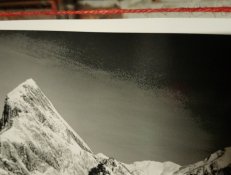
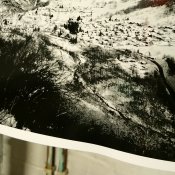
I've just been printing a neg which had some weird feature...overall the print looks fine and very sharp but if inspected closely...I don't know what is it, it looks like a bad digital processing. Any thoughts? I am only sure that the feature is already on the negative and are not an artefact due to enlargement. The strange feature is particularly evident in the sky, but it could be seen in other parts of the print/negative as well, like in the group of trees in the foreground.

Film is 120 Fuji Acros 100, processed as usual in Pyrocat HD....other negatives of the same roll are normal, they show some bromide drag but only marginally near the border. Print is 12x16.

Cheers,
Ferru
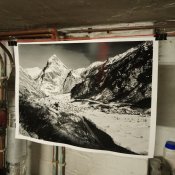
_20180506_212849_1.JPG _20180506_212820_1.JPG _20180506_212913.JPG

(sorry for the bad quality pictures taken with a crappy phone)
 

pentaxuser

Member
Joined
May 9, 2005
Messages
20,333
Location
Daventry, No
Format
35mm
I think you need to give us more information such as: are these defects in the negatives; are these 3 negatives linked sequentially. Once we can be sure if the defects are in the negatives then we can determine whether it is a film developing process problem or a print processing problem and start to take it from there

pentaxuser
 
OP
OP
FerruB

FerruB

Member
Allowing Ads
Joined
Feb 20, 2017
Messages
89
Location
Manchester
Format
Medium Format
The attached pictures are from the very same print, maybe was not clear. Other negs from the same roll seem to be fine, seem because the defect is barely visible on the negative - but definitely there when the neg is inspected with a loupe.
Ferru
 

Lachlan Young

Member
Allowing Ads
Joined
Dec 2, 2005
Messages
5,082
Location
Glasgow
Format
Multi Format
Did you make any other negatives of the same scene with the same processing? Generally, bromide drag is indicative of poor agitation technique. I have seen sort of similar almost pseudo-posterisation effects in areas of extremely fine detail (leaves, grass) on Tri-X at certain contrast grades, most notably on MGIV. Probably something specific & MTF/ characteristic curve related. I have seen it on multiple generations of TX and processing methods & it usually disappears after bumping the contrast up half a grade or so. It doesn't appear on the negative.
 

Wallendo

Subscriber
Allowing Ads
Joined
Mar 23, 2013
Messages
1,419
Location
North Carolina
Format
35mm
#3 appears to have "ghost trees" which suggests a double exposure. That wouldn't really explain the strange pattern on the edge of the clouds, however.
 

glbeas

Member
Allowing Ads
Joined
Sep 25, 2002
Messages
3,957
Location
Marietta, Ga. USA
Format
Multi Format
Without a closeup of the negative itself its hard to say. One possibility is reticulation of the emulsion but I have never seen it that apparent on medium format, only 35mm.
 
OP
OP
FerruB

FerruB

Member
Allowing Ads
Joined
Feb 20, 2017
Messages
89
Location
Manchester
Format
Medium Format
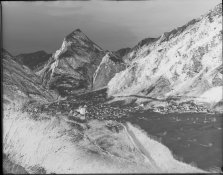
I normally use minimal agitation which sometimes produces some bromide drag along the edge only with Acros 100. But I never observed something like this. Attached a scan of the incriminated neg.

Print is a straight print on Ilford MGFB # 3, developed in Ansco 130.

Untitled.jpg
 

Lachlan Young

Member
Allowing Ads
Joined
Dec 2, 2005
Messages
5,082
Location
Glasgow
Format
Multi Format
I normally use minimal agitation which sometimes produces some bromide drag along the edge only with Acros 100. But I never observed something like this. Attached a scan of the incriminated neg.

Print is a straight print on Ilford MGFB # 3, developed in Ansco 130.

View attachment 200130

What sort of dilution are you using? My immediate thoughts are that it might be from insufficient developer, & that it's no longer providing compensation through local exhaustion, but is simply fully exhausting before it can develop completely. I think that insufficient agitation may also be part of the story too. What is your agitation regime?
 
Joined
Sep 10, 2002
Messages
3,671
Location
Eugene, Oregon
Format
4x5 Format
Seems to be in the negative. So, processing problem of some kind (minimal agitation may not be your friend here) or maybe the sky was like that?? Not much to do about it now though.

Best,

Doremus
 

pentaxuser

Member
Joined
May 9, 2005
Messages
20,333
Location
Daventry, No
Format
35mm
It may not be pertinent to the matter but there is a definite red area in the print on my screen which I cannot see as a corresponding defect in the negative. Apart from the "red"defect the print looks to be too high a contrast but that may be just my taste. If the rest of the negatives are fine and this negative looks fine to me but looks high contrast and lacking in any shadow detail then could it be that film processing was OK and for some reason this negative's exposure in the camera was just less than ideal. Having said that I think the print from the negative can be rescued by printing at a lower contrast

pentaxuser
 
OP
OP
FerruB

FerruB

Member
Allowing Ads
Joined
Feb 20, 2017
Messages
89
Location
Manchester
Format
Medium Format
What sort of dilution are you using? My immediate thoughts are that it might be from insufficient developer, & that it's no longer providing compensation through local exhaustion, but is simply fully exhausting before it can develop completely. I think that insufficient agitation may also be part of the story too. What is your agitation regime?

I am using 1+1+100 - first 90 seconds continuous agitation and than 10s every third minute. I am using this regime for the last year or two and I am obtaining good and consistent results with most films. If is due to local exhaustion I would expect stronger defects in high density area like in the snowy peak on the background, or?

The sky was mostly clear, just some light clouds. I used a orange filter.


It may not be pertinent to the matter but there is a definite red area in the print on my screen which I cannot see as a corresponding defect in the negative. Apart from the "red"defect the print looks to be too high a contrast but that may be just my taste. If the rest of the negatives are fine and this negative looks fine to me but looks high contrast and lacking in any shadow detail then could it be that film processing was OK and for some reason this negative's exposure in the camera was just less than ideal. Having said that I think the print from the negative can be rescued by printing at a lower contrast
pentaxuser

The red "defect" on the print is just a reflection of my safe light :wink: As said pictures are quite crappy and lighting in my darkroom is far from ideal. The print is indeed a bit contrasty and shadow are detailless. As you can imagine the scene had a quite broad range from dark shadow (made even darker by the orange filter) and bright white peaks. I exposed to keep as much details in the snowy foreground on the right. Still wondering if I like it enough to even attempt a rescue :smile:

Yes, it's definitely in the negative. Can it be that Pyrocat gave you uneven stain?
https://www.photrio.com/forum/threads/uneven-staining-happens-with-pyrocat-hd.52875/

The pyrocat batch is almost 2 years old, mixed from raw chemicals and kept in brown glass bottles. I developed last film yesterday and worked spotless.

Is it possible that low temperatures (lets say -10 degree) alternated the film? This wouldn't explain why only this neg was affected but is the only reason I can think at the moment.
 

Lachlan Young

Member
Allowing Ads
Joined
Dec 2, 2005
Messages
5,082
Location
Glasgow
Format
Multi Format
I am using 1+1+100 - first 90 seconds continuous agitation and than 10s every third minute. I am using this regime for the last year or two and I am obtaining good and consistent results with most films. If is due to local exhaustion I would expect stronger defects in high density area like in the snowy peak on the background, or?

The sky was mostly clear, just some light clouds. I used a orange filter.

That's barely even stand development - more like reduced agitation & it should not be producing that level of bromide drag with a developer like pyrocat. That said, there are some anecdotal reports that Acros can be a bit sensitive to agitation patterns & it may be that a low solvency developer just adds to this - I've tended to use ID-11/ D-76 1+1 (even 1+0...) with it & regular agitation (30s initial, 10s/ min) & it has been absolutely predictably consistent. The era it was designed in also suggests it was likely engineered for optimal balance of grain, sharpness, acutance etc when developed in a relatively solvent developer.
 

aleckurgan

Member
Allowing Ads
Joined
Oct 8, 2008
Messages
90
Location
Prague, CZ
Format
35mm
I have no experience with Pyrocat-HD, but with a general purpose (non staining) developer no agitation technique or level of dilution can produce this kind of posterization effect instead of smooth tonal transitions. I can get something similar with some papers in lith developer though. Bromide drags don't have hard edges either.
 
Last edited:
Photrio.com contains affiliate links to products. We may receive a commission for purchases made through these links.
To read our full affiliate disclosure statement please click Here.

PHOTRIO PARTNERS EQUALLY FUNDING OUR COMMUNITY:


Ilford ADOX Freestyle Photographic Stearman Press Weldon Color Lab Blue Moon Camera & Machine
Top Bottom