• Welcome to Photrio!
    Registration is fast and free. Join today to unlock search, see fewer ads, and access all forum features.
    Click here to sign up

Water flow meters for archival washers

Recent Classifieds

Forum statistics

Threads
203,291
Messages
2,852,469
Members
101,766
Latest member
Onetrick
Recent bookmarks
0
Just take a bucket of known size (e.g. 2 or 5 litre), open up the tap as you would for archival washing, and collect the water coming out of it in the bucket... Use a stopwatch to time how fast it fills up and you will know the flow rate in litres / second. Multiply that with your normal washing times, and you are done...

Or do you really need millilitre precision? :confused:
 
Just take a bucket of known size (e.g. 2 or 5 litre), open up the tap as you would for archival washing, and collect the water coming out of it in the bucket... Use a stopwatch to time how fast it fills up and you will know the flow rate in litres / second. Multiply that with your normal washing times, and you are done...

Or do you really need millilitre precision? :confused:

Marco,

If I install an accurate tap control which I can mark off at a known flow rate via the water in bucket method then yes, that is certainly an option.

Tom
 

Attachments

  • ArchivalWasher.jpg
    ArchivalWasher.jpg
    46 KB · Views: 130
Marco,

If I install an accurate tap control which I can mark off at a known flow rate via the water in bucket method then yes, that is certainly an option.

Tom

Tom, there is nothing wrong with such a flow meter, they will be highly accurate if properly calibrated. But I think it is overkill. A properly maintained modern municipal water supply is pressurized using large pumps (at least here in the Netherlands) and should deliver fairly constant results, although I realize there may be demand peaks influencing flow rate...

A normal tap has a metal thread that should give pretty consistent results if you count the number or "turns"... just try it out and see how repeatable it is over the course of a day. You can always go the "high-tech" :wink: option afterwards...
 
Tom, there is nothing wrong with such a flow meter, they will be highly accurate if properly calibrated. But I think it is overkill. A properly maintained modern municipal water supply is pressurized using large pumps (at least here in the Netherlands) and should deliver fairly constant results, although I realize there may be demand peaks influencing flow rate...

A normal tap has a metal thread that should give pretty consistent results if you count the number or "turns"... just try it out and see how repeatable it is over the course of a day. You can always go the "high-tech" :wink: option afterwards...

Marco,

There is the water pressure of the Nova tank itself to be taken into account.

Ralph,

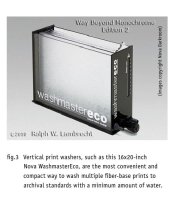
I have a Nova Academy 3 print washer (20x24")

Tom
 
Tom;

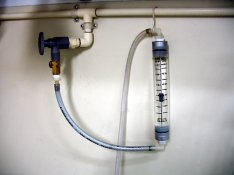
There are small ball flow meters that are very inexpensive that could be used. IDK any names OTOMH, but we used to have a full kit of these. They have a small knob that moves a conical needle in and out of a tapered conical chamber. The water pressure is adjusted by the distance of the needle and the ball floats on the incoming water and rises to indicate the rate of flow.

They are small, about 1/2 inch on each side and about 3" long. They have standard threaded connectors at each end for easy attachment to equipment. The only drawback is that these must be in a vertical position to work.

We had them on every tank of chemicals in our main testing labs so that they knew precise wash and replenishment rates, and this data was used to derive the data sheets you see posted on Kodak publications.

PE
 
Tom;

There are small ball flow meters that are very inexpensive that could be used. IDK any names OTOMH, but we used to have a full kit of these. They have a small knob that moves a conical needle in and out of a tapered conical chamber. The water pressure is adjusted by the distance of the needle and the ball floats on the incoming water and rises to indicate the rate of flow.

They are small, about 1/2 inch on each side and about 3" long. They have standard threaded connectors at each end for easy attachment to equipment. The only drawback is that these must be in a vertical position to work.

We had them on every tank of chemicals in our main testing labs so that they knew precise wash and replenishment rates, and this data was used to derive the data sheets you see posted on Kodak publications.

PE

Like this: http://uk.rs-online.com/web/search/searchBrowseAction.html?method=getProduct&R=3610199 ?

Tom
 
I don't know if this works for everyone, but my Gravity Works print washer has an exit hose, running from the bottom, and an overflow at the top. It has a click pincher on the exit hose to control the speed of the exit flow. The first time I used it, I set the pincher at several different clicks, measured the exit with a container, as suggested, then calculated the time to completely fill (or exchange) the water in the tank, and selected a click setting on the pincher that gives me several (I think 6, it's been awhile) changes of water in 45 minutes. I just use the click setting for #3, and adjust the supply so that I have just a dribble overflowing. My temp control valve has an unmeasured flow control, so this is easy.
 
Photrio.com contains affiliate links to products. We may receive a commission for purchases made through these links.
To read our full affiliate disclosure statement please click Here.

PHOTRIO PARTNERS EQUALLY FUNDING OUR COMMUNITY:


Ilford ADOX Freestyle Photographic Stearman Press Weldon Color Lab Blue Moon Camera & Machine
Top Bottom