• Welcome to Photrio!
    Registration is fast and free. Join today to unlock search, see fewer ads, and access all forum features.
    Click here to sign up

Vibrating film dry

Recent Classifieds

Forum statistics

Threads
201,745
Messages
2,829,486
Members
100,924
Latest member
hilly
Recent bookmarks
0

Ces1um

Member
Allowing Ads
Joined
Jan 12, 2015
Messages
1,410
Location
Nova Scotia, Canada
Format
Multi Format
I tried an experiment today but I'm not 100% sure how things will turn out. I have a model vibrator at work- it's a flat surface that vibrates at high frequency. After developing and washing my film I placed my film still on the reel onto the vibrator to remove/shake off the water from the film in an attempt to speed drying time and potentially minimize spots (I don't have any photo flo right now). The process certainly removed a large amount of water from the film within minutes and the film appeared free of water. It will be interesting when I scan it if the vibration has had any affect on the emulsion. I'm hoping that the film will be entirely dry by end of day so I can bring it home tonight. Either things will look good, or I'll have created some weird experimental lomo look.
 

RattyMouse

Member
Allowing Ads
Joined
Oct 18, 2011
Messages
6,045
Location
Ann Arbor, Mi
Format
Multi Format
I tried an experiment today but I'm not 100% sure how things will turn out. I have a model vibrator at work- it's a flat surface that vibrates at high frequency. After developing and washing my film I placed my film still on the reel onto the vibrator to remove/shake off the water from the film in an attempt to speed drying time and potentially minimize spots (I don't have any photo flo right now). The process certainly removed a large amount of water from the film within minutes and the film appeared free of water. It will be interesting when I scan it if the vibration has had any affect on the emulsion. I'm hoping that the film will be entirely dry by end of day so I can bring it home tonight. Either things will look good, or I'll have created some weird experimental lomo look.

Very interesting idea. I'll be following your results.
 

Rick A

Subscriber
Allowing Ads
Joined
Mar 31, 2009
Messages
10,030
Location
Laurel Highlands
Format
8x10 Format
I always shake the holy terrors outta my film while it's still on the reel to get excess water off. It helps. I've heard of people using salad spinners to remove said water, I'd give it a whirl but I don't have a salad spinner.
 
OP
OP
Ces1um

Ces1um

Member
Allowing Ads
Joined
Jan 12, 2015
Messages
1,410
Location
Nova Scotia, Canada
Format
Multi Format
Just to follow up, my film was completely dry to the touch within four hours. Relative humidity in the office today is running around 60%.
 

Rick A

Subscriber
Allowing Ads
Joined
Mar 31, 2009
Messages
10,030
Location
Laurel Highlands
Format
8x10 Format
Just to follow up, my film was completely dry to the touch within four hours. Relative humidity in the office today is running around 60%.
"Dry to the touch" still isn't dry enough to handle without fear of damaging the still soft emulsion. If you want to speed dry your film, add a cap full of 90%+ isopropyl alcohol to your final rinse. I mix Edwal LFN as per instructions, and add two cap fulls of 91% iso per one liter for final rinse, film dries to the touch in very short time.
 
OP
OP
Ces1um

Ces1um

Member
Allowing Ads
Joined
Jan 12, 2015
Messages
1,410
Location
Nova Scotia, Canada
Format
Multi Format
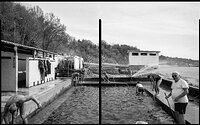
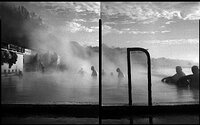
Well, I can't say that i see any water spots or damage to the film. See what you think. I've included a couple of photos, unretouched and raw from the scanner, dust in all it's glory. I think I'll continue to use this method to aid with drying my film. P30 developed at room temperature with ff No. 1 monobath. Exposed at box speed.

p30monobath001.jpgp30monobath021.jpg
 

AgX

Member
Allowing Ads
Joined
Apr 5, 2007
Messages
29,972
Location
Germany
Format
Multi Format
"Dry to the touch" still isn't dry enough to handle without fear of damaging the still soft emulsion. If you want to speed dry your film, add a cap full of 90%+ isopropyl alcohol to your final rinse. I mix Edwal LFN as per instructions, and add two cap fulls of 91% iso per one liter for final rinse, film dries to the touch in very short time.

What would be the effect of that tiny amount of alcohol?

The idea of using alcohol is to put the film into pure fast-evaporating solvent, thereby exchanging the water within the emulsion by that solvent (as much as diffusion allows).
Many solvents though attack the film base (or even the dyes clouds in colour films). Thus for classic b&w film the advise is to only use Ethanol or Isopropanol up to 70% solution.
 
Last edited:

AgX

Member
Allowing Ads
Joined
Apr 5, 2007
Messages
29,972
Location
Germany
Format
Multi Format
Drying by Vibration

How would that work?
I do not know of such principle in technics. The applied vibrating dryers are intended to get bulk goods into motion, letting warm air stream throuigh the created spaces or to heat the bulk goods up by the created friction heat.
Concerning film I only see the effect of shaking-off droplets


Drying by Ultrasound

There are experiments going on at the industry. As far as I know only with textiles. And it seems only to work by shaking-off droplets out of an existing layer of water, not inducing diffusion directly. Though by removing the fluid layer, diffusion is enhanced indirectly.
But I do not see that system effective on film that has been sqeezed already.
 
Last edited:

jim10219

Member
Allowing Ads
Joined
Jun 15, 2017
Messages
1,632
Location
Oklahoma
Format
4x5 Format
I could see it working. You’d increase the effective surface area and prevent any inertia in the water droplets which could speed drying. As long as the vibration wasn’t too violent and the film isn’t rubbing up on anything, I don’t see what it would hurt. It might work a lot better with a surfactant to break the surface tension of the water. That would allow the water to drip off a lot faster, almost like a lubricant for the tiny droplets.
 

AgX

Member
Allowing Ads
Joined
Apr 5, 2007
Messages
29,972
Location
Germany
Format
Multi Format
Yes, but then we would be on the level of using a centrifuge or squeezing the film.
 

Mr Bill

Member
Allowing Ads
Joined
Aug 22, 2006
Messages
1,524
Format
Multi Format
I appreciate that it's fun to play with things like this, but if you really want to speed things up it's been well established that blowing heated air against the film is pretty effective. In C-41 processing machines this is done in roughly 3 or 4 minutes, as I recall. (As I recall, some specs on air temperature and perhaps RH(?) are in the Kodak Z manual for Flexicolor, aka C-41).

If I were going to experiment with something like your "vibrator," I'd probably try some things like holding a piece of raw film next to it whilst shaking wet film, just to see if it picks up any tiny droplets of water. If you have something like an analytical balance available you could try weighing your wet film sample periodically to see how fast it's losing weight. (If the film is not losing weight, it's pretty clear that it's not getting drier.) Keep in mind that the back side of the film also has to be dried. Best of luck on the experiment.
 

tokam

Subscriber
Allowing Ads
Joined
Nov 7, 2008
Messages
596
Location
Sydney, Aust
Format
Multi Format
When hanging film from the shower rail I just give it a couple of light 'whips' to shake off excess water from the non-emulsion side of the film.
Any remaining water on this side is in tiny droplets, pin head size, which evaporate without leaving marks. The emulsion side, of course, has
an even layer of water which evaporates evenly and leaves no marks.

As Rick A says, when 'dry to the touch' the emulsion is still soft and can still take up dust or abrasion marks. Leave the film to dry properly. Examine the leader to assess proper dryness.
 
OP
OP
Ces1um

Ces1um

Member
Allowing Ads
Joined
Jan 12, 2015
Messages
1,410
Location
Nova Scotia, Canada
Format
Multi Format
@AgX I think everyone is overthinking this quite a bit. The vibrator does shake off droplets, yes. Does it have anything to do with diffusion, no. The point is you have a piece of film with water on it. The more you can shake off, the less water remains that has to dry off. Damp things dry quicker than soaking ringing wet things do. I also don't own or use a squeegee (I assume that's what you mean by film having been "squeezed"?- if not, please let me know)

@Mr Bill As for heated air- I have an X-ray processor which dries film exactly as you mentioned. Usually I use it to develop my film but unfortunately it's going to be decommissioned in a half year so it's time for me to investigate a new process. I did have a sheet of paper towel underneath the film which I used to see if the water was coming off. It was soaked through quickly and required replacement twice.

@tokam the idea behind this isn't to prove vibration can fully dry film, only that it can speed drying time by removing most of the water on the film. It still ends up hanging at my office for the full work day.

@jim10219 I agree, I also think a surfactant would help the water slide off while on the vibrator and would mean I'd either get even more off or I wouldn't have to spend as much time vibrating it (I spent about a minute doing that). Like I said in my post though, I didn't have any on hand.

At the end of the day the film did dry quicker. It was fully dry by the end of my work day (about 10 hours), but was dry to the touch and transportable within four hours. In the past if I'd developed in the morning it was still tacky to the touch at the end of the work day, necessitating leaving it there overnight. I also see no water spots (and remember, I didn't have any photoflo to use here) so for me, this seemed to be quite a successful test.

The one thing that did become painfully obvious to me is that I've been spoiled by my automatic processor and my skills loading a reel have really degraded.

 

Rick A

Subscriber
Allowing Ads
Joined
Mar 31, 2009
Messages
10,030
Location
Laurel Highlands
Format
8x10 Format
Bottom line here is it doesn't matter how you remove excess surface water from the film, except squeegeeing (why chance damage). What does matter is how fast the emulsion dries, which entails moisture leaching out of the swollen gelatin allowing it to harden. That is the variable, dependent on temperature and relative humidity. You can force it dry using heated air, or just moving dryer air across the film which I decided years ago to abandon, and use the method I use these days. My observation with speed drying is the surface of the emulsion hardens first, which leaves the gelati layer still swollen and susceptible to damage from handling too soon. Since I no longer am under any time constraints, have no deadlines to meet, I allow my film to dry slowly in a dust free location.
 

GLS

Member
Joined
Apr 29, 2018
Messages
1,729
Location
England
Format
Multi Format
What would be the effect of that tiny amount of alcohol?

The idea of using alcohol is to put the film into pure fast-evaporating solvent, thereby exchanging the water within the emulsion by that solvent (as much as diffusion allows).
Many solvents though attack the film base (or even the dyes clouds in colour films). Thus for classic b&w film the advise is to only use Ethanol or Isopropanol up to 70% solution.

Even a relatively small amount of IPA will lower the surface tension of the water enough that it will cause it to sheet off the film easier, and not form large droplets. In that respect it is in principle no different to other wetting agents; you just need more of it to achieve the same affect (although you get the benefit of no foaming with the former).
 

Wallendo

Subscriber
Allowing Ads
Joined
Mar 23, 2013
Messages
1,419
Location
North Carolina
Format
35mm
I find the technic interesting, not from the standpoint of decreasing drying speed, but wondering if this technic will reduce spotting on the negative.

In a normal drying environment, HOH molecules evaporate into the air, leaving behind surfactant or water contaminants. Photo-Flo or Ilfosol should address this, but the number of long threads on APUG/Photrio suggests that this is not always the case. I wonder if a regimen of using a surfactant and vibration would be useful for those of us who have drying issues despite trying all the remedies listed on this forum.

Addendum: The proposed mechanism for this is that vibrating the film would shake off the aqueous solution, not just the water molecules.
 
OP
OP
Ces1um

Ces1um

Member
Allowing Ads
Joined
Jan 12, 2015
Messages
1,410
Location
Nova Scotia, Canada
Format
Multi Format
I find the technic interesting, not from the standpoint of decreasing drying speed, but wondering if this technic will reduce spotting on the negative.

In a normal drying environment, HOH molecules evaporate into the air, leaving behind surfactant or water contaminants. Photo-Flo or Ilfosol should address this, but the number of long threads on APUG/Photrio suggests that this is not always the case. I wonder if a regimen of using a surfactant and vibration would be useful for those of us who have drying issues despite trying all the remedies listed on this forum.

Addendum: The proposed mechanism for this is that vibrating the film would shake off the aqueous solution, not just the water molecules.
I hadn't really thought about this but it does sound logical. Most of those contaminants would be dissolved/suspended in the water droplets. If you can rid yourself of these contaminants while still suspended in the water by vibrating it off, in theory you should have fewer spots. I'll run another roll through the process (which I have to shoot first) being a little more mindful when putting it on the reel. I'll post the results. I'll make sure to take a few photos of the sky - I find those shots really make spots/streaks/scratches really noticeable.
 

GLS

Member
Joined
Apr 29, 2018
Messages
1,729
Location
England
Format
Multi Format
I wonder if a regimen of using a surfactant and vibration would be useful for those of us who have drying issues despite trying all the remedies listed on this forum.

You can do a final rinse of the film with deionised water, discard, then use a second volume with the wetting agent in it. I have had no issues with residues following this procedure.

Of course, using deionised water as a matter of routine could be a problem for some people (I can get it for free at work).
 
Photrio.com contains affiliate links to products. We may receive a commission for purchases made through these links.
To read our full affiliate disclosure statement please click Here.

PHOTRIO PARTNERS EQUALLY FUNDING OUR COMMUNITY:


Ilford ADOX Freestyle Photographic Stearman Press Weldon Color Lab Blue Moon Camera & Machine
Top Bottom