• Welcome to Photrio!
    Registration is fast and free. Join today to unlock search, see fewer ads, and access all forum features.
    Click here to sign up

Using Rubylith

Recent Classifieds

Forum statistics

Threads
201,201
Messages
2,820,357
Members
100,581
Latest member
bountsy
Recent bookmarks
0

DonF

Member
Allowing Ads
Joined
Jul 19, 2016
Messages
285
Location
Saint Charles, Il
Format
Large Format
i ordered some Rubylith .005 thickness for making a dark box and also for some extra filtering on a red LED safelight. I know Rubylith is a thin film containing the red dye on a harder polyester backing, designed to be cut with a stencil knife.

I was wondering the best way to use the stuff. If I peel the film from the base, can it be applied to plexiglass or regular glass, or is it best to keep the film on the backing?

Best,

Don
 

jslabovitz

Member
Allowing Ads
Joined
Nov 27, 2007
Messages
63
Location
Shanghai, WV
Format
Medium Format
It's been 30 years since I cut a sheet of Rubylith, but as I recall, it was designed to be optically clear wherever the red film itself was cut out. It's kind of a disaster if you try to use the very thin red film apart from the thicker clear backing -- it doesn't really stand on its own, and easily gets bent or dusty (due to static electricity).

So I would just cut the whole sheet to the size you want, and use some sort of opaque tape to fasten it to the frame.
 

Bill Burk

Subscriber
Allowing Ads
Joined
Feb 9, 2010
Messages
9,455
Format
4x5 Format
Agree with everyone here... put the soft gelatin side against the plexiglass and leave the base on the outside, so you can clean it without damaging it. If you do damage it before installation, you can use pieces of the peeled-off rubylith to cover pinholes/scratches.
 
OP
OP

DonF

Member
Allowing Ads
Joined
Jul 19, 2016
Messages
285
Location
Saint Charles, Il
Format
Large Format
Thanks for the tips. I found a very few YouTube vids of artists cutting masks by hand. The dye layer looked pretty soft and flimsy as it was peeled away. Advice on using it often simply says “add a layer of Rubylith...”. Good to know it should stay on its backing and not be used “peel-and-stick”, at least for making window and safelight filters.

I have yet to find a red LED or LED bulb that doesn’t contain sufficient green components to fog graded and ore-flashed enlarger paper after 10 minutes, depending upon brightness and diffusion. A few threads here suggest an added layer of Rubylith extends those safe times significantly.

Best,

Don
 
OP
OP

DonF

Member
Allowing Ads
Joined
Jul 19, 2016
Messages
285
Location
Saint Charles, Il
Format
Large Format
Sunday evening project. I installed the red LED miniature bulb from Superbrightleds into an old Yankee safelight, but found it emitted a small amount of green by observing the light reflected off a CD surface. I bought some Rubylith masking film and used the old OC amber filter to trace a new filter. I used a store coffee cake container for material to cut a front support lens for more rigidity (thanks Dee!). All traces of green light are gone.

I gave a similar treatment to an LED tail light dual brightness safelight with a similar green spectral component issue.

Thanks for the tips!

Don
A47F3346-6A5D-4A38-9E2D-F701BFAB685B.jpeg
4B26FC75-31AE-423F-814F-0826DDCFC043.jpeg
C4A49947-D742-4E17-9C51-9F5E830F096A.jpeg
 
OP
OP

DonF

Member
Allowing Ads
Joined
Jul 19, 2016
Messages
285
Location
Saint Charles, Il
Format
Large Format
I tested the tail light LED assembly today with pre-flashed Arista Edu #2 glossy paper, which I believe is Foma Fomaspeed "Normal" contrast paper.

The Foma site shows the following curve for spectral sensitivity of the paper:

fomaspeed_graded_sensitivity.jpg


The safelight recommendations are:

Untitled.jpg


...and from another version:

Untitled2.jpg


The spectral curve of the LED diffused globe bulb used in the Yankee housing from Superbrightleds is:

E27-x8-G.jpg


The large blue arrow shows the longest wavelight to which the paper is advertised as being sensitive. The recommended safelight illumination is indicated by the black arrow.

I will assume that this is a fairly representative curve for "normal red" (not "photo red" or "deep red" LEDs), as I have no data on my 12 volt tail light.

Here is the tail light assembly, from Lowes:

https://www.lowes.com/pd/Reese-6-in-Oval-Sealed-Light-with-Chrome-Rim/50437648
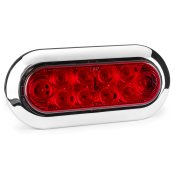
042899861096.jpg

It can be seen in the graph that there are small portions of the red LED output in the green region and below the recommended safelight wavelength. I can easily see these by viewing the off-axis diffracted reflection of the LED in the playable side of a CD.

Some tilting and adjustment of the CD is necessary to expand the spectrum to maximum size in the reflection, but the green is definitely there, indicating the need for additional filtering.

I can get up to 6 minutes exposure from the high setting of the tail-light with the Rubylith filter without fogging of pre-flashed Fomaspeed paper. That is double the recommended maximum exposure. The light is extremely bright and easily enough to read by. It is indirectly reflected from the white ceiling at a distance of 18 inches (light to ceiling) and 1.5 meter from ceiling to trays,.

At the low setting, representing the "running light" (non-brake light) brightness of the assembly, I can get 30 minutes of exposure without any trace of fog. The light is sufficiently bright to read by and a more "reasonable" level of illumination.

These results (with the Rubylith filtering) are several times better than obtained without the filter.

I have been unable to find any specs on the filter characteristics of Rubylith, but it clearly has a beneficial effect.

I also see NO signs of green with the CD test using Rubylith.

I hope this is of some use.

Regards,

Don

 
Last edited:
Photrio.com contains affiliate links to products. We may receive a commission for purchases made through these links.
To read our full affiliate disclosure statement please click Here.

PHOTRIO PARTNERS EQUALLY FUNDING OUR COMMUNITY:


Ilford ADOX Freestyle Photographic Stearman Press Weldon Color Lab Blue Moon Camera & Machine
Top Bottom