• Welcome to Photrio!
    Registration is fast and free. Join today to unlock search, see fewer ads, and access all forum features.
    Click here to sign up

Using "ortho lith"type film????

Recent Classifieds

Forum statistics

Threads
203,173
Messages
2,850,942
Members
101,713
Latest member
notlithe12
Recent bookmarks
1

zing

Member
Allowing Ads
Joined
Sep 29, 2007
Messages
13
Format
35mm
I was thinking about future experiments and I was wondering if anyone uses ortho lith films as a negative film in 4x5 view cameras or others?

What was your experience>?

I thought it could could possibly give interesting effects etc.

Thanks

zing
 
I've used it in pinhole cameras, and had students use it in pinhole cameras with 4x5 film holder backs. It was developed in regular (sprint) developer rather than the special AB stuff, and was still moderately contrasty, but worth trying.
 
If you want a full scale negative from lith flm, check out Jim Galli's development of it.
 
I grabbed a box of Kodalith some time ago and played; got a beautiful positive transparency by developing in dektol if I remember correctly - it was some time ago.
 
Rate at ISO3, no problems, bit contrasty but not impossible to print with. I develop APHS ortho litho film in ilford multigrade 1+9 for 30-40seconds by inspection. It's suppose to be more blue sensitive but I've not been able to shoot people with it yet, partly because I'm having to cut down my 8x10 film to fit in my 4x5 film holders which seems to be a little hard to do accurately for me. I should really buy a box of 4x5 outright.
 
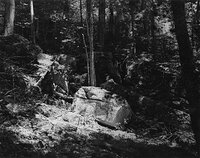
I shoot a lot of the stuff in 4X5 and 2 1/4 X 3 1/4. Develop in Rodinal 1:150 for about 7 min. with minimal agitation so the contrast doesn't build too fast. In my experience, dektol and HC110 and any other developer I have tried build contrast way too fast. Shoot at ISO 5. Watch it develop under a RED safelight. Absolutely grainless negs that appear rather thin, but print well. The shot "Roadside Lake" in my pics was shot on lith film.
 
I use Russian Tasma Ortho film in the 24x30 and 30x40cm cameras. Easy to develop by inspection in Ilford PQ Universal - or any other print developer. I dilute the developer quite a lot from paper strength, though.
 
LC-1 low contrast developer

I have not used lith film in camera but for making enlarged negatives. After a number of years using HC-110 (1:16 dilution from stock) I'm using LC-1 developer and getting fantastic results. It's a true low contrast developer which uses sodium bisulfite to lower the alkalinity and thus lower the action of the developer. It's much more consistent than heavily diluted developers (film or paper). However, it does need to be made from scratch.

-david


LC-1 developer: http://members.aol.com/fotodave/Articles/LC-1.html
 
I've used Freestyle's Arista branded lith film in my Toyo 45G. Development in Ilford Multigrade print developer diluted 1:40 gave good tonal range.
 
Thanks for all the replies!

Riccksplace, If you read this, your photograph was really great! I've never used rodinal. Was the one part out of the bottle or one part of stock mix?

I noticed there are 2 type pf the film available. One is half tone and the other I saw was continuous. I couldn't help but think only one type would work????

Thanks for all the advice~

zing
 
Indeed, I have used this film for your purpose. The most important thing to know is that it is "blue-sensitive" film. It will behave about like a panchromatic film with a blue filter.

The reasons to do this are pretty much: 1. Cost. 2. If you want a very slow film. 3. If you want a film that is blue sensitive without having to use filters. 4. If, for some reason, you need to or want to develop by inspection under a red light.

Also, purchase 3.9 x 4.9, not 4x5, from Freestyle to make it a whole lot easier. 4x5 will bow in the film holders and have to be cut down ever so much. 3.9 by 4.9 slides right in.

As for developers, David Soemarko's LC-1 formula will give you a regular-looking continuous tone negative (albeit blue sensitive, so dense skies). The color of the film will be a bit odd (yellowish-brown), but it prints like a normal neg.

My second best luck for continuous tone using litho film was Ilford or Kodak HC highly diluted, and used one shot. I started testing at my normal film dilution of 1:63, and ended up using something like 1:79 in the end. (I think Ilford's data sheet says to use 1:79 anyhow, so they were right on...although I tested with Kodak and their data sheet said nothing of it.)

Either one of these works fine for in camera stuff. If you are making interpos. and internegs for contact printing, however, the LC-1 formula is the much more controllable tool, as you can change the ratios of the three parts to control the contrast. With contact printing alternative processes, the making of the interpos. and interneg are pretty much the only way you have to control contrast from a given negative, so this is very important.

If you want me to post the LC-1 recipe, let me know. It is on page 45 or so of the Christopher James book. Cooking this stuff up is incredibly cheap and simple. Also, once you find the A:B:C ratio that you like, you can premix it and it will keep even better.

 
Last edited by a moderator:
Thanks for all the replies!

Riccksplace, If you read this, your photograph was really great! I've never used rodinal. Was the one part out of the bottle or one part of stock mix?

I noticed there are 2 type pf the film available. One is half tone and the other I saw was continuous. I couldn't help but think only one type would work????

Thanks for all the advice~

zing

1 part Rodinal out of the bottle, 150 parts water. Because the dillution is so weak, it exhausts fast. If you are souping lots of negs, change the developer often.
 
I use Russian Tasma Ortho film in the 24x30 and 30x40cm cameras. Easy to develop by inspection in Ilford PQ Universal - or any other print developer. I dilute the developer quite a lot from paper strength, though.

I'm also using Tasma film, but type 17 for aerial imaging, which is highly contrast almost as lith film. Developing it in FX-1 with low agitation (2-3 revolutions every 2 mins).
The result is here: http://www.flickr.com/photos/28444963@N06/2795599061/
 
Photrio.com contains affiliate links to products. We may receive a commission for purchases made through these links.
To read our full affiliate disclosure statement please click Here.

PHOTRIO PARTNERS EQUALLY FUNDING OUR COMMUNITY:


Ilford ADOX Freestyle Photographic Stearman Press Weldon Color Lab Blue Moon Camera & Machine
Top Bottom