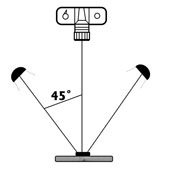
Most LED panels don't work very well. You get a grid pattern. Rim lighting bounces the LED's off a perimeter rim, and then diffuses them, so much better evenness. Mine are oval. Mid-quality (or top quality within the Savage brand itself), around $800 for the pair. I can't afford the real-deal pro studio types just for web applications or personal print cataloging. And if critical color were involved, I could aways directly exchange my Lowell hot lights; I designed it that way. So it's a hybrid system. But if you have extra space at the sides, you could obviously just set up the lights on individual stands rather than a dedicated arm system I like I did. But that makes it faster to operate and hold correct position; takes up less space too.
A couple facts of life about LED panels besides the potential pattern drawback to many varieties I already noted. The actual output color temperature is going to be different from the advertised BS version, at least for lighting below Hollywood-quality lighting expectations, which most film crews rent around here instead of outright buying it. Both my lights are the very same model, purchased at the same time, yet don't match each other at the pre-sets. Since they're variable color-temp as well as variable lumen, it's easy to adjust them to exact match using a color temp meter and standard light meter with gray card or gray disc. But neither comes up to the advertised 5500K Daylight standard, not even 5000K. But I got them both to match at 4800K, and only a modest amount of filtration over the camera lens, or in the program of the digital Nikon, can easily correct for that shortfall. That because most manufacturers just have installed this or that rated LED itself, or rather, mixed multiples of them, and don't bother to factor in the yellowing of the diffuser background and overlying plastic panel itself. The same is also true for most light boxes, unless you buy the very best.