
• Welcome to Photrio!
    Registration is fast and free. Join today to unlock search, see fewer ads, and access all forum features.
    Click here to sign up

Using CO2 to prevent oxidation

Ecstatic Roundabout

A
Ecstatic Roundabout

  • 0
  • 0
  • 30
MIT. 25:35

MIT. 25:35

  • 1
  • 0
  • 73

Recent Classifieds

Forum statistics

Threads
202,956
Messages
2,848,111
Members
101,553
Latest member
JasonGoh
Recent bookmarks
0

Dave Krueger

Member
Allowing Ads
Joined
Jul 30, 2006
Messages
714
Location
Huntsville, Alabama
Format
Multi Format
I've been wondering if anyone has ever tried using some kind of heavy gas to prevent chemical oxidation. Assuming a half full developer bottle, for example, I was thinking it might be possible to squirt some CO2 into the bottle before closing it. My theory is that the CO2, being heavier than air would create a layer over the chemical preventing it from reacting with oxygen in the air.

Maybe some other gas would be better. Freon or propane comes to mind, but CO2 seems to be the most commonly available and least dangerous...

Am I completely nuts? Should enter a treatment center? Smack my kneecap with a hammer whenever such a thought enters my head?
 
Several years ago one of the techs at Jobo (when they were in Michigan) told me that he used propane, the small 14 oz cylinders available at hardware stores for those small torches, for just the purpose you mention.
 
Dave;

Carbon Dioxide gas dissolves in water. It forms carbonic acid there which is not good for developers, and can also affect fixers to some extent. An inert gas that is not water soluable is best.

I use Nitrogen. Propane is dangerous, espeically if you have a static electricity spark in the lab.

PE
 
Nitrogen has been commonly used by many photographers for this purpose.
Propane seems quite dangerous to me when used in this manner.
 
Propane has the advantage of being readily available and heavier than air. On the down side, it stinks and the bottles can leak potentially killing you, your family, and a few neighbors. :sad:

Nitrogen would seem to be the obvious choice as being inert, but it's not heavier than air. Not sure how much of a difference that would make. It would essentially displace any oxygen in the bottle, so the weight may not be important.

So... Where does one get nitrogen? Is it expensive? Do you have to get it in bottles the size of a cruise missle? :tongue:
 
A lifetime supply of nitrogen is about $30, but the tank is expensive. So is the valve. You can rent them for a nominal fee. I own my own tank and valves.

Nitrogen is just about the same density as air, and so it will displace the air quite nicely over a solution.

PE
 
I store my chemicals in vacuum. Even if it's partial vacuum (250mm or 10 inch of mercury column height, which is achievable with inexpensive hand pump) the shelf life of developer is considerably longer than repeatedly used partially filled bottles.
 
The most commonly used "inert gas" for storing photochemicals is butane. It's sold as Tetenal Protectan. A good squirt from a lighter refill bottle does the same job at a fraction of the price.
 
Breathing in developer bottles

Fifty years ago it was common practice to breath into the developer bottle before we put the cork on it. I don't know if it was effective but we did it.

Wes Martinson
 
Time to refresh ...

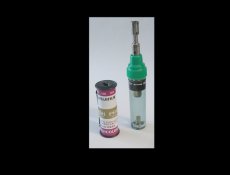
The best I've been able to find is butane, dispensed from a BernzOMatic "Mini - Torch". This little gem is refillable from inexpensive butane cylinders used in cirgarette lighters and butane candles, and of course, mini torches.
Dispensing the gas is efficiently done, without any fuss.

See attaached ...
 

Attachments

  • OLE1809a.jpg
    OLE1809a.jpg
    82.9 KB · Views: 189
Just use canned air or DustOff. It's not really air, but I get it Costco for $12 for 3 or 4 cans. I spray it in the container and close the lid. I have had Dektol last for weeks in a half full milk jug with this. It works great.
 
I guess not many people here know a cheap product called vacu-vin. This cheap hand pump and bottle stopper can remove much of the air, cutting the partial pressure of the air in the bottle to about 1/3 of the atmospheric pressure. This is very effective in keeping developer solutions in partially filled glass bottles than filling with inert gases unless complicated measures are taken to ensure complete replacement of air with the gas. Vacuum also removes air dissolved in the developer. Vacu-vin stoppers are actually more useful with developers than wines.

Vacu-vin stoppers fit most narrow mouth bottles of 500ml size. Larger bottles of this mouth size aren't very common, but you can always bring 1.5 liter wine bottles to a party and collect bottles afterward. (you don't have to drink them!)

There are also a few other inexpensive vacuum pumps, stoppers, canisters and bags sold for food storage. I've tried a few products, but in terms of the ability to remove air, vacuvin is at least as good as expensive models that use motorized vacuum pump. All of them go down to about 250-300mm Hg, which is actually pretty good for this application.

I also store some air-sensitive dry chemicals that I use for emulsion making (they are some dopants, chemical sensitizers and sensitizing dyes) in vacuum canisters.
 
The amount of propane that would be used to displace the air in even an empty gallon jug would be highly unlikely to do more than possibly flash momentarily. I have worked with combustible gases for years.
 
The amount of propane or butane that would be used to displace the air in even an empty gallon jug would be highly unlikely to do more than possibly flash momentarily. I have worked with combustible gases for years.
 
The amount of propane or butane that would be used to displace the air in even an empty gallon jug would be highly unlikely to do more than possibly flash momentarily. I have worked with combustible gases for years.

I have had the flammable gas in a 1 gallon bottle ignite due to static electricity and jet a flame about 3 - 5 feet long out of the top of the bottle. I'm just glad the glass didn't break and spray all over the lab.

PE
 
I have had the flammable gas in a 1 gallon bottle ignite due to static electricity and jet a flame about 3 - 5 feet long out of the top of the bottle. I'm just glad the glass didn't break and spray all over the lab.

PE

While I don't dispute the dangers of having a flamable gas around, I think the theory is that the chemical container would be considerably less than full of the gas. Since the gas is heavier than air, you would only need to squirt in enough to provide a layer over the liquid. Plus, the bottle would presumably have chemicals it in as well, reducing the volume.

I once had one of those 20 pound propane tanks spring a leak in my garage studio when I was doing a winter-time shoot using a propane heater for heat. The spare tank that sprung the leak was about ten feet from the heater, but the leak was bad enough to actually hear the hissing noise from the other side of the room. If it had started to leak ten or fifteen minutes earlier, we would have been upstairs taking a smoke break and the house would probably been levelled killing all of us. Needless to say, I don't keep those tanks in the garage anymore. I think it says that right on the tank (just like it says not to smoke right on the cigarettes I used to smoke). I know what you're thinking, but it's too late. My genes have already propagated.:tongue:
 
A lifetime supply of nitrogen is about $30, but the tank is expensive. So is the valve. You can rent them for a nominal fee. I own my own tank and valves.

Nitrogen is just about the same density as air, and so it will displace the air quite nicely over a solution.

PE

A balloon filling valve is cheap.

Also, breath doesn't work as oxygen is still present.
 
There is a product called Bloxygen that is sold for preserving partial cans of paints and varnishes. Their web site says it is a mixture of Nitrogen, Argon and CO2. They also state that it can be used with photo chemicals.
I've never used it, for photochemicals, or paints, but I think it would be preferable to fuel gases.

Info and source for bloxygen...
http://www.bloxygen.com/faq.html
http://www.woodcraft.com/family.aspx?FamilyID=3463
 
I have a stash of Beseler XDL spray from back in the "olden tymes" but Butane is cheap and easily available.
 
Carbon Dioxide in any fashion is a No No for developers and as far as I am concerned for most water based paints.

These products rely on being alkaline at a specific pH. The addition of carbon dioxide containing blankets just seems to me to be offputting.

PE
 
The true purist will use methane. Some believe that is the real derivation of the term "analog photography".
Just remember to hold the bottle at arm's length when re-opening the bottle.
 
What is wrong about Nitrogenium? It is used as a gas agitation in E-6 hanger processors because air oxidises the developers. Or is there a difference between agitation an conservation?:confused:
 
I guess not many people here know a cheap product called vacu-vin. This cheap hand pump and bottle stopper can remove much of the air, cutting the partial pressure of the air in the bottle to about 1/3 of the atmospheric pressure. This is very effective in keeping developer solutions in partially filled glass bottles than filling with inert gases unless complicated measures are taken to ensure complete replacement of air with the gas. Vacuum also removes air dissolved in the developer. Vacu-vin stoppers are actually more useful with developers than wines.

Vacu-vin stoppers fit most narrow mouth bottles of 500ml size. Larger bottles of this mouth size aren't very common, but you can always bring 1.5 liter wine bottles to a party and collect bottles afterward. (you don't have to drink them!)

I use this product for over 10 years, just when it was introduced on the wine market. It works very well, in fact the same effectivity as Tetenal Protectan which has a composition of Butane and Argon.
The only disadvantage which you already mentioned is that the opening of the used bottles have to be small and therefore you need for these kind of bottles a funel which I do not like so much. I prefer the H.D. Jobo plastic wide bottles and even better the Schott (glass) 1 Ltr. coated professional laboraty bottles.
Maybe we have to re-introduce the Vacuvin + suitable bottles and a funel in a nice X-Mas package in our delivery program again :smile: .

Best regards,

Robert
 
I always split concentrates and stock strength
chemistry into small full bottles. I never have less
than full bottles. Several dozen glass Boston Rounds
of various capacity equiped with Polyseal or Polycone
caps are in my collection. As sure a seal against air
entry as one might find.

They are a laboratory standard around the world
and not expensive. Dan
 
Photrio.com contains affiliate links to products. We may receive a commission for purchases made through these links.
To read our full affiliate disclosure statement please click Here.

PHOTRIO PARTNERS EQUALLY FUNDING OUR COMMUNITY:


Ilford ADOX Freestyle Photographic Stearman Press Weldon Color Lab Blue Moon Camera & Machine
Top Bottom