• Welcome to Photrio!
    Registration is fast and free. Join today to unlock search, see fewer ads, and access all forum features.
    Click here to sign up

Unusual image deterioration on my freshly-developed Acros 120

Recent Classifieds

Forum statistics

Threads
201,891
Messages
2,831,789
Members
101,010
Latest member
JuanSoto
Recent bookmarks
0

Trask

Subscriber
Allowing Ads
Joined
Oct 23, 2005
Messages
1,946
Location
Virginia (northern)
Format
35mm RF
I shot off a roll of Acros 120 in my Fujica GW670III, and developed it this evening in Obsidian Aqua -- not my first time using OA, but my first time using OA with Acros.

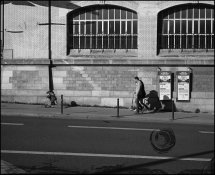
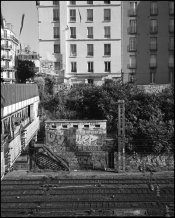
To my surprise and mystification, the negatives came out with strange longitudinal squiggles and some sort of weird round thing in the image -- see the two attached.

In the horizontal image, there's what looks like oil in the road, but it's actually the strange deterioration in the emulsion, and clearly you can see that round whatever it is. In the vertical image there are squiggles in the sky in the upper left. Note these are not linear, not scratches, vary in width.

Development regime was a longer version of Regular Rod's: initial pre-soak in water for three minutes with some agitation -- it poured out bright blue -- then OA with initial one minute of agitation then gentle agitation every two minutes thereafter. RR develops to 12 minutes, but I let the film stand in the developer from the agitation on minute 11 out to 15 min 30 seconds. Water bath stop, with the film sitting in that water for maybe 12 minutes as I went to eat a quick lunch, then fix for 8 minutes with intermittent agitation. Several lengthy water rinses, hypo clear, a few short rinses, into Photo-Flo and hang to dry. Yes, I then wiped the film with a Pec-Pad soaked in the Photo-Flo, as I done many times before without any alteration to the film.

I've developed a lot of film in the past 40+ years but I've never seen anything like this. That round thing reminds me of a bubble, but I was agitating the film every two minutes so it's not as if a bubble could sit on the film for a long time.

Has anyone seen something like this before, or have any thoughts as to what happened here? Note I bought this film from a seller -- could this be related to prior storage in some respect?
Walker by station002 copy.jpgBy the tracks003 copy.jpg
 

gone

Member
Allowing Ads
Joined
Jun 14, 2009
Messages
5,504
Location
gone
Format
Medium Format
It looks almost like the marks I was getting with Ultrafine film, which I stopped using after that experience. But since you developed and shot Acros, I am in the dark as well. Hopefully someone here can give you a lead. I never did find out what was going on w/ the Ultrafine (and I got the film numbers on it as well).
 

Jim Noel

Member
Allowing Ads
Joined
Mar 6, 2005
Messages
2,261
Format
Large Format
The vertical "streaks" sure look like emulsion has shrunk too rapidly and pulled apart which can happen when moved from developer to acid too quickly. Did you agitate in the water stop, or just let it sit while you ate lunch? If there was no agitation there is a possibility,however remote, that those small portions had no dilution of the developer at that stage and were essentially moved directly from developer to fixer. My belief is that thin emulsion films like Acros are more likely to display this phenomenon, but I have no proof of that, and have never experienced it with Acros.
The circle in the street is the real puzzler to me.
 

summicron1

Subscriber
Allowing Ads
Joined
Jul 28, 2010
Messages
2,920
Location
Ogden, Utah
Format
Multi Format
never heard of obsidian aqua, had to google and i see its a concoction of someone on photo.net. Nothing wrong with that if yu want to go to the trouble and so on, and like the results.

As to these negs --one wonders, you don't mention temperatures. The damage almost looks like the emulsion was floated off.
 
Joined
Sep 10, 2002
Messages
3,676
Location
Eugene, Oregon
Format
4x5 Format
I've had damage like this from handling film with contaminated fingers. In my case, I had a pinhole in one finger of my nitrile glove, which allowed fixer to be carried over to the next batch of film. I got round marks and lots of streaks that look exactly like what you have. I was handling 4x5 sheet film, however, not 120.

Could you somehow have got "fixer fingers" on your film?

Best,

Doremus
 

Rick A

Subscriber
Allowing Ads
Joined
Mar 31, 2009
Messages
10,032
Location
Laurel Highlands
Format
8x10 Format
Since I'm not familiar with the chems used to mix OA, I will ask if possibly they weren't dissolved completely? Maybe some other contaminate in the water stop attaching to the film emulsion? Not knowing type of reel used, kink marks and finger print from loading struggles?
 

Regular Rod

Member
Allowing Ads
Joined
Aug 6, 2012
Messages
665
Location
Derbyshire
Format
Medium Format
Whatever it is, it's a pity because both those photographs look like they would have been splendid images. The tones in the first one look particularly good...

It looks like some kind of contamination. Have you used the same batch of OA before? What were the results like? I'm uneasy about your stop bath regime. I never leave the film in the water like that as the developer will still be active, although with greatly reduced vigour. Instead I agitate and pour out within 10 seconds and if I think the colour of the discharge is still a bit too tinged I repeat the rinse with fresh water at the same 20 deg. C. Then I fix and wash using the ILFORD recommendations.

It's unimaginable that either film or developer is to blame here. It must be contamination that has somehow sneaked in there.
:confused:
RR
 

Richard S. (rich815)

Member
Allowing Ads
Joined
Jan 14, 2003
Messages
4,924
Location
San Francisco
Format
Multi Format
It's always best to develop another roll and see if it's not a one-time thing. I'd do it again without the long water stop bath.
 
OP
OP
Trask

Trask

Subscriber
Allowing Ads
Joined
Oct 23, 2005
Messages
1,946
Location
Virginia (northern)
Format
35mm RF
Thank you, everyone. I can rule out having "fixer fingers," and certainly I didn't touch the film surface where that round thing shows up. I don't think it's the fact that I had a long "water stop," and while I don't usually have such a long time in water at that step, I do think that any remaining Obsidian Aqua in the tank would have been so very diluted by that stop bath water than any development that continued would be almost nil -- and certainly not localized.

RR: OA is mixed one-shot from a concentrate (1 ml to 500ml H20) with carbonate bath (5ml to 500ml H20) -- so exhaustion unlikely. Luckily all these images were made in my neighborhood area so not difficult to repeat.

Having thought of all you said, I think that the primary culprit must be the overall time in liquid, perhaps leading to softening of the emulsion, exacerbated by too wide a spectrum of temperatures of the various liquids, and possibly the wiping of the film.

I was just going through some old negative scans and came across the attached from 5+ years ago, which I'd entirely forgetten (see attached image). This is Adox 100, shot in 35mm in a Konica IIIa camera, and developed in a metol/HQ developer. Note what looks like peeling emulsion at the bottom -- very similar to the photos I attached in my original post. So: different developer, different film manufacturer, different camera, possibly similar temperature swings. Per your advice, I'll shoot another roll of Acros 120 in the same camera to see if using a different developer in a more tightly controlled process yields different results.

A final thought: as much as I enjoy messing about with different films in different developers (as I have for years), the pleasure of so doing is starting to fade when weighed against knowing that I'm never quite sure what the images will look like because there are too many variables. Time to cool it with the testing and such, and try to narrow my tools to increase predictability.

Hammer Adox100 KIIIa 009.jpg
 

Jim Noel

Member
Allowing Ads
Joined
Mar 6, 2005
Messages
2,261
Format
Large Format
"Having thought of all you said, I think that the primary culprit must be the overall time in liquid, perhaps leading to softening of the emulsion, exacerbated by too wide a spectrum of temperatures of the various liquids, and possibly the wiping of the film."

I think you have answered your own question with this statement. Any one of these actions could cause one or more of the problems, and it they all took place, I'm surprosed you didn't have more damage. In other words,"Operator Error".
 

MartinP

Member
Allowing Ads
Joined
Jun 23, 2007
Messages
1,569
Location
Netherlands
Format
Medium Format
Is there actual emulsion missing from the film? It appears that the image is in place 'under' the damage. A picture of the negative would be helpful instead of a scan. If that is correct and there are no massive holes then I'd suggest that this looks like pressure damage to the film roll. Was it accidentally crushed in a pocket or transport package of some sort? Indications to support that might include that the frames affected are towards the end of the roll, and hence near the 'outside' of the finished roll.

Edit: For pressure damage after shooting then it may be seen on the last couple of frames, as described above, but for damage before shooting then it may be more likely seen at the beginning of the roll. Also, the added picture with the ferris-wheel doesn't have quite the same damage as seen in your first post (and of course it is a different roll, I realise that).
 
Last edited by a moderator:

Rick A

Subscriber
Allowing Ads
Joined
Mar 31, 2009
Messages
10,032
Location
Laurel Highlands
Format
8x10 Format
Thank you, everyone.


Having thought of all you said, I think that the primary culprit must be the overall time in liquid, perhaps leading to softening of the emulsion, exacerbated by too wide a spectrum of temperatures of the various liquids, and possibly the wiping of the film.


View attachment 98218

After rereading your post, I realized the problem. You have left the film in liquid for far too much time, then you WIPED it. There's the rub (pun intended) never ever, I repeat NEVER EVER wipe the danged film. Not with anything, not even your fingers, even if you dip them in photo-flo(or similar). Final rinse in rinse aid mixed with distilled water, or even plain distilled water, then shake off the excess liquid before unrolling to hang.
 
Photrio.com contains affiliate links to products. We may receive a commission for purchases made through these links.
To read our full affiliate disclosure statement please click Here.

PHOTRIO PARTNERS EQUALLY FUNDING OUR COMMUNITY:


Ilford ADOX Freestyle Photographic Stearman Press Weldon Color Lab Blue Moon Camera & Machine
Top Bottom