- Joined
- Dec 8, 2014
- Messages
- 4
Hello all.
A short while ago I bought a 135×100' roll of Ultrafine Xtreme 100ISO and a 120 sample pack of 4 400ISO and 4 100ISO.
Ive shot one of each 120 through my Ansco Shut-Shot Jr box camera and in my research of here and there and Flickr and such, it seems I like the looks that Xtol or Caffenol developers fetch the best.
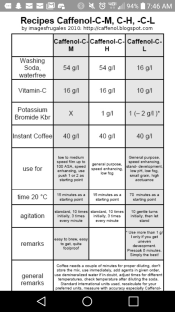
I'm partial to Caffenol because its cheap and I like tinkering and mixing it myself. I tried for Caffenol-CH/CL and semi-stand development for the low and slow reduced fog and grain and more even development that it's meant to offer.
I'm very very particular and technical with my measurements and calculations and put a very great deal of research into both. I'm confident that my calculations and measurements are correct or at least close enough for tolerances if not spot on. I can't be absolutely sure because I had to look up the compound mass/density of each compound used and carefully measure volumetrically due to a complete lack of any funds needed for purchasing a gram scale that measures to within 0.1-0.001g increments.
I made sure all compounds were as pure as possible and warmed them in the oven @170f for hours to ensure they hadn't absorbed any water from hygroscopy even though I store them in air tight glass containers. I then let them cool to ambient temperature before measuring and mixing.
I mixed the caffenol-CL/CH the night before and stored in an airtight amber glass container free of contaminants to allow it to cool to the ambient temperature of 68.5F/20.3C. I started film and paper processing with Caffenol, and how particular I am on proper storage, maintenance, control and handling I am, I've had batches of Caffenol last 6 months without any change in development results. I've used both ID11 and D76 batches that were stored for almost 2 years without any notable change in development results from the same storage methods. So I'm 100% confident that the chemicals did not sour or oxidize (kinda impossible when they're stored in a dark cupboard in amber glass with all air displaced and an airtight seal) over the course of 12 hours. The fixer was mixed fresh and stored in the same manner. I'm also 100% certain that there isn't an issue with the water contaminants because I use distilled water that I bring to a boil for 10-20minutes uncovered and then let cool while covered to help rid it of contaminants. I do this with all chemistry I mix because when it comes to chemistry, decontamination, control, and precision is everything.
After days and days of research it seemed the better process for a semi-stand development was a pre-soak for 3-5 minutes, agitations for 1st 30 seconds with 3 inversions at 1, 2, 4, 8, 16, and 30 minutes and then stand till completion. All examples and calculations I could find seemed to point to 55-60minute development time for 100ISO and 65-70minute development for 400ISO.
Standard development for these films in caffenol-CL would be 20 minutes and 30 minutes respectively.
I developed for the pre soak and time, rinsed thoroughly for 3minutes (I usually prefer to rinse for 30 seconds to 1 minute before using an acetic acid/distilled vinegar stop bath for 3 minutes before another 1 minute water rinse to ensure that development is stopped completely and no developer contaminates the fixer which would disrupt fixing times. Though I was out of distilled vinegar and can't afford any at the moment), then fixed for 9 minutes which should be plenty considering a leader test from a 135 leader clipping showed 5.4 minutes to be sufficient fixing.
I rinsed with clean water for 5 minutes and then used a hypoclearing/drying agent for 1 minute.
The results were depressing.
I discovered 2 things.
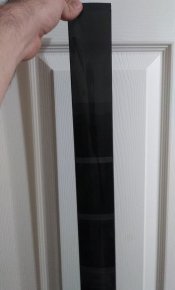
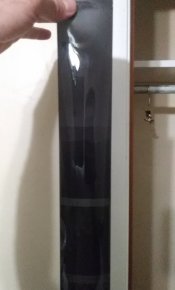
1- instantly I could see the the film base was WAY TOO DENSE. It appeared almost black. I could still see images though. After the film had completely dried it is now about half as dense and when held up to the light I can see the negative images which appear to be more or less correctly exposed AND processed judging by approximate density. However the base is still really dark.
2- it seems I'm an idiot and got the label colors mixed up. I accidentally processed the 400iso at 57 minutes including time to empty the tank and wash until no developer came out.
As of right now I dont have a means to scan them with.
I do have my older ID11 which yielded exceptional results when I last used it about 2-3 months ago and has been stored in the most optimum conditions possible.
My questions are... Does anyone have much experience with the Ultrafine films and especially with caffenol chemistries?
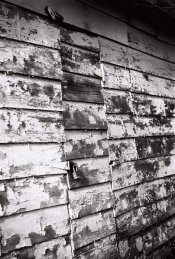
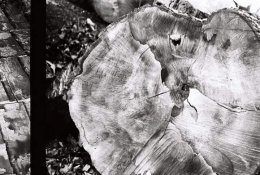
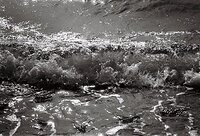
Does anyone have a photo or 2 of a properly exposed and processed nagative of this filmstock that I might be able to view for an example?
And... Should I make an attempt with the 100iso in the ID11.
From examples I've seen of photos from this filmstock it appears as though caffenol chemistries and Xtol does best with this film. D76 appears to have the same issues with most film which is GREAT contrast and latitude but with very very gritty film grain. Microphen seems to be very flat muted but with exceptionally low grain and ID11 seems to be an almost happy medium with nice smooth grain and good sharpness but lacking in the highlights. I didnt see too many examplez of these film stocks with HC110 or Rodenol or other such developers. But from what I could see it looked like Xtol and Caffenol would be the best all around. Fairly smooth acceptable grain, great sharpness, good contrast with good latitude. In highlights, midtones and shadows.
Any advice would be helpful. If I can manage to find a light table and take photos of the negatives and base with my digital or even phone I may do so if it would help.
I'm kinda sketchy about wasting another roll and proceeding with either the ID11 or the Caffenol-CL In the process of experimentation because I don't want to waste more money. Though at the moment I have no money or income to purchase any more appropriate chemistry with.
Thanks a million.
-AJ.
A short while ago I bought a 135×100' roll of Ultrafine Xtreme 100ISO and a 120 sample pack of 4 400ISO and 4 100ISO.
Ive shot one of each 120 through my Ansco Shut-Shot Jr box camera and in my research of here and there and Flickr and such, it seems I like the looks that Xtol or Caffenol developers fetch the best.
I'm partial to Caffenol because its cheap and I like tinkering and mixing it myself. I tried for Caffenol-CH/CL and semi-stand development for the low and slow reduced fog and grain and more even development that it's meant to offer.
I'm very very particular and technical with my measurements and calculations and put a very great deal of research into both. I'm confident that my calculations and measurements are correct or at least close enough for tolerances if not spot on. I can't be absolutely sure because I had to look up the compound mass/density of each compound used and carefully measure volumetrically due to a complete lack of any funds needed for purchasing a gram scale that measures to within 0.1-0.001g increments.
I made sure all compounds were as pure as possible and warmed them in the oven @170f for hours to ensure they hadn't absorbed any water from hygroscopy even though I store them in air tight glass containers. I then let them cool to ambient temperature before measuring and mixing.
I mixed the caffenol-CL/CH the night before and stored in an airtight amber glass container free of contaminants to allow it to cool to the ambient temperature of 68.5F/20.3C. I started film and paper processing with Caffenol, and how particular I am on proper storage, maintenance, control and handling I am, I've had batches of Caffenol last 6 months without any change in development results. I've used both ID11 and D76 batches that were stored for almost 2 years without any notable change in development results from the same storage methods. So I'm 100% confident that the chemicals did not sour or oxidize (kinda impossible when they're stored in a dark cupboard in amber glass with all air displaced and an airtight seal) over the course of 12 hours. The fixer was mixed fresh and stored in the same manner. I'm also 100% certain that there isn't an issue with the water contaminants because I use distilled water that I bring to a boil for 10-20minutes uncovered and then let cool while covered to help rid it of contaminants. I do this with all chemistry I mix because when it comes to chemistry, decontamination, control, and precision is everything.
After days and days of research it seemed the better process for a semi-stand development was a pre-soak for 3-5 minutes, agitations for 1st 30 seconds with 3 inversions at 1, 2, 4, 8, 16, and 30 minutes and then stand till completion. All examples and calculations I could find seemed to point to 55-60minute development time for 100ISO and 65-70minute development for 400ISO.
Standard development for these films in caffenol-CL would be 20 minutes and 30 minutes respectively.
I developed for the pre soak and time, rinsed thoroughly for 3minutes (I usually prefer to rinse for 30 seconds to 1 minute before using an acetic acid/distilled vinegar stop bath for 3 minutes before another 1 minute water rinse to ensure that development is stopped completely and no developer contaminates the fixer which would disrupt fixing times. Though I was out of distilled vinegar and can't afford any at the moment), then fixed for 9 minutes which should be plenty considering a leader test from a 135 leader clipping showed 5.4 minutes to be sufficient fixing.
I rinsed with clean water for 5 minutes and then used a hypoclearing/drying agent for 1 minute.
The results were depressing.
I discovered 2 things.
1- instantly I could see the the film base was WAY TOO DENSE. It appeared almost black. I could still see images though. After the film had completely dried it is now about half as dense and when held up to the light I can see the negative images which appear to be more or less correctly exposed AND processed judging by approximate density. However the base is still really dark.
2- it seems I'm an idiot and got the label colors mixed up. I accidentally processed the 400iso at 57 minutes including time to empty the tank and wash until no developer came out.
As of right now I dont have a means to scan them with.
I do have my older ID11 which yielded exceptional results when I last used it about 2-3 months ago and has been stored in the most optimum conditions possible.
My questions are... Does anyone have much experience with the Ultrafine films and especially with caffenol chemistries?
Does anyone have a photo or 2 of a properly exposed and processed nagative of this filmstock that I might be able to view for an example?
And... Should I make an attempt with the 100iso in the ID11.
From examples I've seen of photos from this filmstock it appears as though caffenol chemistries and Xtol does best with this film. D76 appears to have the same issues with most film which is GREAT contrast and latitude but with very very gritty film grain. Microphen seems to be very flat muted but with exceptionally low grain and ID11 seems to be an almost happy medium with nice smooth grain and good sharpness but lacking in the highlights. I didnt see too many examplez of these film stocks with HC110 or Rodenol or other such developers. But from what I could see it looked like Xtol and Caffenol would be the best all around. Fairly smooth acceptable grain, great sharpness, good contrast with good latitude. In highlights, midtones and shadows.
Any advice would be helpful. If I can manage to find a light table and take photos of the negatives and base with my digital or even phone I may do so if it would help.
I'm kinda sketchy about wasting another roll and proceeding with either the ID11 or the Caffenol-CL In the process of experimentation because I don't want to waste more money. Though at the moment I have no money or income to purchase any more appropriate chemistry with.
Thanks a million.
-AJ.