
Greetings all. I've been reading here, there and everywhere about tube processing. I have a daylight tank for my 4x5 film a paterson, it's ok but.... I also have tray processed when it was a small qty. But what is this tube processing. I've read about jobo's, pvc tubes, ets and think the term is getting multiple uses. Is tube processing nothing more then a jobo tank or is there some home made variation using pvc pipe?
-
Welcome to Photrio!Registration is fast and free. Join today to unlock search, see fewer ads, and access all forum features.Click here to sign up
You are using an out of date browser. It may not display this or other websites correctly.
You should upgrade or use an alternative browser.
You should upgrade or use an alternative browser.
Tube processing...what is it?
-
A
- Thread starter philm
- Start date

Recent Classifieds
-
Want to Buy WTB: 4x5 field camera, wooden, simple
- Started by Dan Daniel
-
Found Looking for a good spot meter
- Started by Premier
-
Want to Buy View Camera Shutter
- Started by Beevo
-
For Sale Sam Abell - The Photographic Life
- Started by Rayt
-
For Sale Expired Film: Kodak, Agfa, Ilford and Fuji 4x5/5x7
- Started by Jammoh
Forum statistics
Tubes
When I started developing 4x5, I did quite a bit of research on how to develop the film. My investigations led me to tube processing. If you'll go to the view camera store website and search for btzs tubes, you'll get the basic idea.
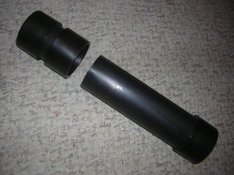
I use a 1.5 inch diameter ABS (black plastic) tube, cut down to about 4.5 inches long with a cap on one end and a male threaded adapter on the other.
The film gets rolled up, emulsion side in, and inserted into the tube. Some folks use a piece of fiberglass window screen between the film and tube to allow easier removal of the wet film from the tube.
A cap (containing your developer) is then threaded onto the tube, the whole thing is turned horizontally and put into a temperature controlled water bath, which allows you to "log roll" the tubes and get even distribution of the developer on the film.
When the development time is done, you turn off the lights, turn the tube with the cap down, remove it and put the tube in the stop bath. Then remove film and fix.
Look at this picture and I think you'll get the idea.
I heartily recommend the tubes, but just like anything they take a little practice to get used to.
I am sure others will explain this better than I did. Do some google searches and you'll find a ton of info on how to do this.
Regards,
Russell
When I started developing 4x5, I did quite a bit of research on how to develop the film. My investigations led me to tube processing. If you'll go to the view camera store website and search for btzs tubes, you'll get the basic idea.
I use a 1.5 inch diameter ABS (black plastic) tube, cut down to about 4.5 inches long with a cap on one end and a male threaded adapter on the other.
The film gets rolled up, emulsion side in, and inserted into the tube. Some folks use a piece of fiberglass window screen between the film and tube to allow easier removal of the wet film from the tube.
A cap (containing your developer) is then threaded onto the tube, the whole thing is turned horizontally and put into a temperature controlled water bath, which allows you to "log roll" the tubes and get even distribution of the developer on the film.
When the development time is done, you turn off the lights, turn the tube with the cap down, remove it and put the tube in the stop bath. Then remove film and fix.
Look at this picture and I think you'll get the idea.
I heartily recommend the tubes, but just like anything they take a little practice to get used to.
I am sure others will explain this better than I did. Do some google searches and you'll find a ton of info on how to do this.
Regards,
Russell
Attachments

I use home made PVC tubes for developing 4x5 and 8x10 as well as for carrying both exposed and unexposed film on trips. It's light tight, rugged, waterproof and ... cheap (just like me  )
)
Here's how I made my 4x5 tubes :
http://www3.sympatico.ca/oldrad/Photo/Tubes/FilmDevTube.html
cheers eh?
EDIT ::
According to the techs at Ilford, the lights do not need to be off once you have completed the developer stage. Apparently the film is more than sufficiently desensitised after the developer bath that the amount of light it receives while changing fluids will not affect it at all. I have followed this advice since I read it and have not seen any problems.
)Here's how I made my 4x5 tubes :
http://www3.sympatico.ca/oldrad/Photo/Tubes/FilmDevTube.html
cheers eh?
EDIT ::
When the development time is done, you turn off the lights, turn the tube with the cap down, remove it and put the tube in the stop bath. Then remove film and fix.
According to the techs at Ilford, the lights do not need to be off once you have completed the developer stage. Apparently the film is more than sufficiently desensitised after the developer bath that the amount of light it receives while changing fluids will not affect it at all. I have followed this advice since I read it and have not seen any problems.

Very nice. I love McGuyveris'm.
What size (pvcs thickness) would one need for 8x10 tubes?
Eric,
I'm embarrassed to say that I didn't know that there was more than one thickness :confused: . I simply bought whatever the plumbing department had .
.
cheers eh?
I'm embarrassed to say that I didn't know that there was more than one thickness :confused: . I simply bought whatever the plumbing department had
.cheers eh?
Eric,
I'm embarrassed to say that I didn't know that there was more than one thickness :confused: . I simply bought whatever the plumbing department had
cheers eh?
I knew that would be confusing. I meant what diameter tubes would one need for 8x10? (not the thickness of the pvc itself)
My engrish sucks

I used 3" tubes to make my 8x10 tubes. They work perfectly. One piece of advice, cut them just short enough so that the film doesn't have room to move around. This will prevent one corner from sneaking up and scratching the other side of the film. Take care when removing them or you can get the same effect. For 4x5 film tubes I used 1.5" tubes. Best. Shawn
I knew that would be confusing. I meant what diameter tubes would one need for 8x10? (not the thickness of the pvc itself)
My engrish sucks
J&C was selling 8X10 tubes that were welding rod holders. Here is a link that may help:
http://www.rodguard.net/products.htm
I think they can also be found at the Home Depot.
The tubes I have are about 14" long with the cap on.
I have been using these for 8X10 with no problems. The sides of these tubes have ridges and it seems that the chemistry can get to the back of the film and prevent incomplete removal of the dyes.

I have made and used tubes. I was wondering if anybody had found a way to make a light tight valve, that would allow the process to proceed in daylight after loading, rather than the having to go dark at the transition of each step. That would greatly enhance my feelings toward tubes, as I have otherwise been pleased with the process and results. I especially like how economical they are on chems.
I have made and used tubes. I was wondering if anybody had found a way to make a light tight valve, that would allow the process to proceed in daylight after loading, rather than the having to go dark at the transition of each step. That would greatly enhance my feelings toward tubes, as I have otherwise been pleased with the process and results. I especially like how economical they are on chems.
The instructions for the BTZS tubes say that after development (working in dim room light (or safelight) you remove the cap and plunge the open-ended tube into a tray of stop bath and rotate the tube to wet the film.
To quote:
"If you can open a tube and get it into the stop bath within 2 or 3 seconds there is no danger of fogging the film perceptibilty if the room illumination is dim and indirect."
I have tried this and have not seen any problems.
I am still afraid to remove the film and fix in trays with the dim lights..

I have made and used tubes. I was wondering if anybody had found a way to make a light tight valve, that would allow the process to proceed in daylight after loading, rather than the having to go dark at the transition of each step. That would greatly enhance my feelings toward tubes, as I have otherwise been pleased with the process and results. I especially like how economical they are on chems.
JBrunner,
Please try my suggestion of abandoning the total darkness idea after the developer stage. The suggestion came from an Ilford UK tech on the original Ilford website forum many years ago.
I'll make you a deal
... try loading in darkness, then when switching from dev to stop to fix, leave the lights on. If it ruins your test sheet, I'll buy you another and coffee to boot .EDIT ::
I do dev, stop and fix all in the tube. When I split the tubes to change fluids, I stand the film tube up with the open end down on a towel. While it is standing there, I dump the previous step liquid out of the cap and pour the new liquid for the next step into the cap. Then I screw the film tube onto the cap, rotate to horizontal and start rolling to agitate. The film is exposed to daylight for a second or less. I only go to a tray at the very end for the wash step. I use D-D23, so I have four steps in my process.
cheers eh?
According to the techs at Ilford, the lights do not need to be off once you have completed the developer stage. Apparently the film is more than sufficiently desensitised after the developer bath that the amount of light it receives while changing fluids will not affect it at all. I have followed this advice since I read it and have not seen any problems.
Yes, I saw that, but I am a chicken when it comes to light and unfixed film. Maybe I'll try it with the saflight on once!!
I do have another question for you tubers. Do you fix your film in your tubes? Maybe this should be a separate post?
The instructions for the BTZS tubes say that after development (working in dim room light (or safelight) you remove the cap and plunge the open-ended tube into a tray of stop bath and rotate the tube to wet the film.
To quote:
"If you can open a tube and get it into the stop bath within 2 or 3 seconds there is no danger of fogging the film perceptibilty if the room illumination is dim and indirect."
I have tried this and have not seen any problems.
I am still afraid to remove the film and fix in trays with the dim lights..
I guess in theory, once the development is stopped, it would need to go back into the developer to affect the negative. If that's the case, why do we carry on in darkness, after the stop? IDK, but somebody here does. Have I been mucking around like a bat, when tray developing, when I didn't need to half the time?
I knew that would be confusing. I meant what diameter tubes would one need for 8x10? (not the thickness of the pvc itself)
My engrish sucks
"Sok eh
?My Engrish c'nest pas tres buenos most o' the time too eh?

cheers eh?
Yes, I saw that, but I am a chicken when it comes to light and unfixed film. Maybe I'll try it with the saflight on once!!
I do have another question for you tubers. Do you fix your film in your tubes? Maybe this should be a separate post?
I remove the film after the stop and fix in a tray. I don't have that many extra caps. If I did, I would leave them and fix in the tubes. One of my main reason for using tubes is that I always seem to scratch negs in trays.
I guess in theory, once the development is stopped, it would need to go back into the developer to affect the negative. If that's the case, why do we carry on in darkness, after the stop? IDK, but somebody here does. Have I been mucking around like a bat, when tray developing, when I didn't need to half the time?
Just remember, the film is still inside the tube (open ended) when it is in the stop bath tray. I don't know the answers either, just that using Phil Davis instructions seem to work.
Here's the Ilford thread for those who are curious :
http://www.ilfordphoto.com/photocommunity/forums/theforum/topic.asp?TOPIC_ID=6005
cheers eh?
http://www.ilfordphoto.com/photocommunity/forums/theforum/topic.asp?TOPIC_ID=6005
cheers eh?
Just remember, the film is still inside the tube (open ended) when it is in the stop bath tray. I don't know the answers either, just that using Phil Davis instructions seem to work.
I'm thinking that with normal developing times the few seconds of super dim exposure (subdued light, and the film in the tube) before the stop isn't enough time to develop the film further enough to show any fogging. I believe you guys, and I'll try it.
Here's the Ilford thread for those who are curious :
http://www.ilfordphoto.com/photocommunity/forums/theforum/topic.asp?TOPIC_ID=6005
cheers eh?
Thanks for the link John. I printed out your method of using the tubes...Simplicity!
You can also use Bessler, Unicolor, or Illord color film drums with a motor base. I most often deep tanks most of the time as I shoot 50 to 100 sheets of 4X5 at a time, but when I shoot just a few sheets I use a film durm. I can fit 2 4X5 in a Bessler tank with out any problems.

I guess in theory, once the development is stopped, it would need to go back into the developer to affect the negative. If that's the case, why do we carry on in darkness, after the stop? IDK, but somebody here does. Have I been mucking around like a bat, when tray developing, when I didn't need to half the time?
Oddly, I inadvertently tested this very scenario recently.
Using a Nikor 4x5 tank I developed correctly, then stopped using normally diluted acetic acid. Was interrupted and the stop was left in the tank. Returned a bit later and, mistakenly thinking I was actually done fixing, opened the tank to normal room light.
The uncleared sheets I saw were obviously distressing. But I thought for a moment and decided no harm should have been done, since any newly exposed emulsion should only be reduced by returning the films to the alkaline developer.
So I just closed the tank and continued on with normal fixing. When finished, the negatives came out fine, as far as I could tell. Only the expected original in-camera exposures seemed to have been developed.
Ken
I have never tried tube processing. For those of you who use it, how do you handle processing a larger run of sheets, say 20-30 sheets of film? The BTZS system includes only 6 tubes. do you dry them somehow, reload, and repeat? do you buy/make 30 tubes? Thanks.
After processing a few 8x10 sheets last night using "emulsion down" method on viewcamera.com, my sheets were fine. No scratches. I've scratched before with the emulsion up way. I wanted to use some 8x10 tubes but I'll try a few more batches with emulsion down technique. If I scratch some more, I'll give the big tubes a try. Tray processing 8x10 does take up a lot of space on the bottom of my shower though.
A cap (containing your developer) is then threaded onto the tube, the whole thing is turned horizontally and put into a temperature controlled water bath, which allows you to "log roll" the tubes and get even distribution of the developer on the film.
Russell
How critical is the consistency of the "log rolling" for even development? If you are processing 6 tubes at a time, it seems like it would be hard to have tight agitation control. Do you get even development and consistent contrast results?
How critical is the consistency of the "log rolling" for even development? If you are processing 6 tubes at a time, it seems like it would be hard to have tight agitation control. Do you get even development and consistent contrast results?
I roll in a tray filled with enough water that the tubes float. The wobble induced by rolling the floating tube completely randomizes the agitation. I have never had uneven or streaked development using this method.
| Photrio.com contains affiliate links to products. We may receive a commission for purchases made through these links. To read our full affiliate disclosure statement please click Here. |
PHOTRIO PARTNERS EQUALLY FUNDING OUR COMMUNITY:  |