• Welcome to Photrio!
    Registration is fast and free. Join today to unlock search, see fewer ads, and access all forum features.
    Click here to sign up

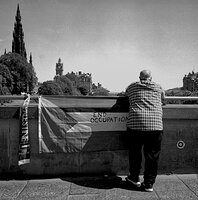
TRI-X exposed at 100ASA

Recent Classifieds

Forum statistics

Threads
202,817
Messages
2,845,870
Members
101,544
Latest member
Juergen Lossau
Recent bookmarks
1

thefizz

Member
Allowing Ads
Joined
Dec 8, 2004
Messages
2,353
Location
Ireland
Format
Medium Format
I mistakenly exposed a 120 roll of TRI-X at 100ASA. Has anybody got developing info for this situation using Rodinal. I did bracket my shots so a solution for 100ASA or even 200ASA should get me some printable negs.

Peter
 
During 40 years of commercial photography I routinely over-exposed Tri-X like this to improve shadow detail and get important objects out of the negative's toe. Especially with dark products like fur coats, leather wallets and farm animals. The only drawback is slightly increased grain.

Some will automatically advise you to reduce development to lower density in the highlights. But since less development means lower contrast, you will be stuck with the additional problem of flat, gray negatives.

Tri-X has enough silver and a sufficiently wide density range that the highlights will not block up with two stops extra exposure (as they will with Tmax, etc.) So use your normal development and enjoy some decent shadow detail for a change.

Short answer: it's not a problem.
 
John, so that's how you took that picture of the black cat in a coal mine! I had always wondered how it was done. tim
 
What I'd suggest is to pull the development one stop, not two -- many folks routinely shoot Tri-X at EI 200 with normal processing, with very good results, and a pull of one stop won't give the kind of "flat, gray negatives" John alluded to.

To do that, ideally shoot a test roll of unimportant images in similar lighting at EI 100, and develop that before committing your important roll. Then, use whatever time you'd normally use for Rodinal with Tri-X, but reduce it by 25-30% from normal. If that gives a time shorter than five minutes (I don't think it will, but I'm not as familiar with Rodinal as I am with HC-110), increase dilution to lengthen the processing time.
 
John Cook said:
During 40 years of commercial photography I routinely over-exposed Tri-X like this to improve shadow detail and get important objects out of the negative's toe. Especially with dark products like fur coats, leather wallets and farm animals. The only drawback is slightly increased grain.

Some will automatically advise you to reduce development to lower density in the highlights. But since less development means lower contrast, you will be stuck with the additional problem of flat, gray negatives.

Tri-X has enough silver and a sufficiently wide density range that the highlights will not block up with two stops extra exposure (as they will with Tmax, etc.) So use your normal development and enjoy some decent shadow detail for a change.

Short answer: it's not a problem.

I too routinely expose TriX at 200 ISO to ensure good shadow detail. The advice given by John, is IMO absolutely sound for film will record up to 14 stops of contrast. The only point that I would make that differs slightly from John's advice would be to consider the contrast range of the subject you photographed and if it were above 5 stops I would reduce development by 20 to 25% for I believe the resultant reduction in film contrast would not have a significant affect when making the final print.
 
I would develop in Microdol X diluted 1:3. I use a speed of 250-320 with the diluted developer. Of course Tri-X is so good I think you will get usable negatives regardless of developer used.
 
Photrio.com contains affiliate links to products. We may receive a commission for purchases made through these links.
To read our full affiliate disclosure statement please click Here.

PHOTRIO PARTNERS EQUALLY FUNDING OUR COMMUNITY:



Ilford ADOX Freestyle Photographic Stearman Press Weldon Color Lab Blue Moon Camera & Machine
Top Bottom