• Welcome to Photrio!
    Registration is fast and free. Join today to unlock search, see fewer ads, and access all forum features.
    Click here to sign up

Track Lighting for B&W Prints

Puddle

Puddle

  • 2
  • 2
  • 70

Recent Classifieds

Forum statistics

Threads
202,728
Messages
2,844,710
Members
101,487
Latest member
Bmattei
Recent bookmarks
0

brian steinberger

Member
Allowing Ads
Joined
Jan 5, 2007
Messages
3,067
Location
Pennsylvania
Format
Med. Format RF
I am fortunate enough to have a room in my house that I am going to designate as my "gallery." I want to put up track lighting and was wondering if anyone can give me any tips on doing so. I have a few questions:

1. How far out from the wall should the track be? I have 8' ceilings.

2. Are tracks and lights from big box stores of decent quality? I looked at Home Depot and "Hampton Bay" track lighting has pretty good reviews.

3. What kind of lights do I want? Appears halogen are the most common. The lights I'm looking at are GU10-60 50w bulbs. I also heard these get hot. Is this a problem? The track lighting will not be the main lighting in the room, so they will only be on when enjoying my photos, but could still be on for an hour or more.
 
Track lighting is a vast topic. It all depends on how much money you want to spend. Ideally, you should get bulbs that are colour balanced. Shoot for a 3500K or the neighbourhood. Make sure you understand what colour balancing is. You should colour correct all your prints using the same colour temperature everywhere. Also be aware that these bulbs has a usable life, and working bulb is not equal to good bulb. Eventually the colour will get warmer and they need to be replaced. Lastly, unless you are planning to sell prints for thousands (at least hundreds) of dollars, then all of the above is pretty much worthless. Oh, and get a good colour meter, something like a Sekonic C-500 and regularly check your bulbs for colour shifts.
 
Look into better lighting bulbs, bit more expensive but the colour temp is a bit cooler .

I am fortunate enough to have a room in my house that I am going to designate as my "gallery." I want to put up track lighting and was wondering if anyone can give me any tips on doing so. I have a few questions:

1. How far out from the wall should the track be? I have 8' ceilings.

2. Are tracks and lights from big box stores of decent quality? I looked at Home Depot and "Hampton Bay" track lighting has pretty good reviews.

3. What kind of lights do I want? Appears halogen are the most common. The lights I'm looking at are GU10-60 50w bulbs. I also heard these get hot. Is this a problem? The track lighting will not be the main lighting in the room, so they will only be on when enjoying my photos, but could still be on for an hour or more.
 
I use mini heads with 50 watt halogen full spectrum light.
 
I have had a lot of advice lately about these new LED bulbs, though pricey , they are longer lasting, and the colour tempeture is closer to daylight, or less yellow than my halogen lights now.

Put on a dimmer they are boasting to save energy costs over the long haul, I have thirty lights in my room and I believe (looking at my Toronto Hydro bill, they suck a lot of power , and they force me
to air condition the room as they get really hot.

But in the winter I must admit the room is quite cool.

I will post later the range of bulbs my buddy who has done a lot of LED lighting research recommends, he is out of town but soon to be back.
 
We recently converted to LED at the gallery (Vermont Center for Photography).
I don't have the specific bulb we used but they are made by GE and replace the standard screw-base reflector floods. I can find out the specifics if anyone is interested.

Here's a photo of the current show that may give you an idea of what the lighting is like;

attachment.php


Note that some of the heads are set to illuminate the works shown on the big table here. For most shows they are on artwork on the walls, so the wall lighting is not as even as it is usually.

These are big-box store track lights, there are some track light suppliers like Juno that have fancier heads, but you don't want people looking at the lights anyway.
 

Attachments

  • bookshow.jpg
    bookshow.jpg
    49.1 KB · Views: 272
Last edited by a moderator:
Looks like a nice space - I am interested in which bulbs you used and do you have dimmers on the lights?

QUOTE=bdial;1953777617]We recently converted to LED at the gallery (Vermont Center for Photography).
I don't have the specific bulb we used but they are made by GE and replace the standard screw-base reflector floods. I can find out the specifics if anyone is interested.

Here's a photo of the current show that may give you an idea of what the lighting is like;

attachment.php


Note that some of the heads are set to illuminate the works shown on the big table here. For most shows they are on artwork on the walls, so the wall lighting is not as even as it is usually.

These are big-box store track lights, there are some track light suppliers like Juno that have fancier heads, but you don't want people looking at the lights anyway.[/QUOTE]
 
LED lighting is still so-so unless you are content with relatively warm color temperatures and around $35 per bulb. The better types are not
available yet for simple track lighting applications. The good news is that there is a lot of industrial interest in making rapid progress in terms of quality LED display lighting, since CFL's are a wretched interim bellyflop technology, and halogens are hot and high in UV. With all such products you have to distinguish between professional architectural applications, which tend to come with good quality and accurate specs, and home center items, which are marketed with a lot of BS and have terribly short bulb longevity. Some companies (like GE) have a distinct bifurcation in this respect. I'd be interested in something in the 4000K range with a very high CRI, which is a nice compromise between daylight and traditional tungsten.
 
Placement of the stuff is important too. If the lights get too close to the wall ("wall washer" style) it emphasizes every anomaly in surface textures, and may even cast shadows from deep framing or matting (or frames tilted forward). But if the ceiling is fairly low, moving the lights too far from the wall could even risk casting shadows of viewers on the work. And then there is the issue of reflections off the glass. I was at a majot international watercolor show last year where they had hung over-and-under to accommodate a bunch of work and it was difficult to find a viewpoint that wasn't either way off to the side or blasting reflections of the lights into one's eyes.

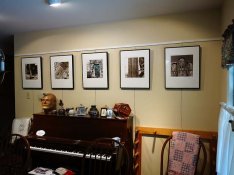
I have some track lights, mini-halogen jobbies of "Portfolio" brand from Lowe's, illuminating work down both sides of a hallway here. The hallway is basically too narrow (but it seemed like a good idea at the start). As such, the beam width of the lights is a bit narrow and it's difficult to get even illumination, just a big series of compromises! I have a hanging rig on a wall in the dining room that has three old style "eyeball" type recessed lights with PAR30(?) reflector floods that hit the wall (originally installed to hit the music stand on the piano) that isn't too bad an arrangement.

A quick shot (in mixed light since it's daytime ... )
161058873.jpg

(Alas, were I as well off as the guy across the creek who added about a 2000 square foot addition to his $1M house to display his art collection . . . )
 
Last edited by a moderator:
Thanks guys for all the responses! The only experience I've had with LED lighting was in a ceiling fan and the light was disgusting IMO. I actually returned the fan simply for that reason. The light was greenish in color and very dim.

How is CFL lighting? Does it take a few minutes to get to maximun brightness? If so, that's not going to work. I hate that.

Halogen still sounds like the best bet for me. I see some halogen track lights have UV covers over them to omit the UV light. I also frame my photos with UV glass so that should not be a problem. But with my low ceilings I'm hoping heat is not a problem.
 
Placement of the stuff is important too. If the lights get too close to the wall ("wall washer" style) it emphasizes every anomaly in surface textures, and may even cast shadows from deep framing or matting (or frames tilted forward). But if the ceiling is fairly low, moving the lights too far from the wall could even risk casting shadows of viewers on the work. And then there is the issue of reflections off the glass. I was at a majot international watercolor show last year where they had hung over-and-under to accommodate a bunch of work and it was difficult to find a viewpoint that wasn't either way off to the side or blasting reflections of the lights into one's eyes.

I have some track lights, mini-halogen jobbies of "Portfolio" brand from Lowe's, illuminating work down both sides of a hallway here. The hallway is basically too narrow (but it seemed like a good idea at the start). As such, the beam width of the lights is a bit narrow and it's difficult to get even illumination, just a big series of compromises! I have a hanging rig on a wall in the dining room that has three old style "eyeball" type recessed lights with PAR30(?) reflector floods that hit the wall (originally installed to hit the music stand on the piano) that isn't too bad an arrangement.

A quick shot (in mixed light since it's daytime ... )
View attachment 114879

(Alas, were I as well off as the guy across the creek who added about a 2000 square foot addition to his $1M house to display his art collection . . . )

Dave, this looks great! I'm also interested in putting a track down my skinny hallway as well. Just curious, what watt bulbs are those?
 
Dave, this looks great! I'm also interested in putting a track down my skinny hallway as well. Just curious, what watt bulbs are those?

Well that shot is the aforementioned dining room wall. Those are the old fashioned PAR-something or other 75 watt indoor reflector type floods. So there is nothing cool or energy efficient about them, but the light spread is pretty good.

The lights I used in the hallway are a small fixture about 4 inches long and 2.5 inch diameter that take a 50W halogen bulb with a "GU10" base -- that's two grooved cylindrical pins out of the bottom that sort of bayonet into a socket. Something like this. My beef with the ones I have is they are more like a spot pattern than a flood and really too narrow for the short distance involved. I'm not sure what other options there may be (these bulbs came with the track heads). Of course to put, say, eight of those on one track with a dimmer also means the dimmer needs to be happy handling 400 watts, which some are not. There do appear to be some LED equivalents -- at about eight or ten times the price. :blink: (I've never indulged!)

I was being lazy, hating to pull wiring through the walls and ceilings of this place, so I ran the track down the center of the hallway and used a crazy fitting that mounted on the former central light fixture box and straddles the track to feed it from the center. The hallway is not much over a yard wide, so lighting-wise it would likely have been better to mount two tracks, one down each side, with the lights shining nearly the full width of the hallway -- but that involved more work and more money -- and I'm lazy! :whistling: That's 16 feet of track and eight heads; not enough heads given the light patterns, but I can't go much more using halogens without risking the dimmer.
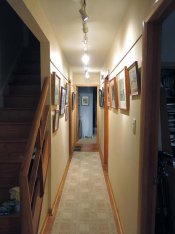

OK -- only since you asked ...
An approximation of what the hallway looks like:
161060553.jpg

It doesn't work all that well, but at least some of the framed work is out of the storage piles!

I myself will no longer touch CFLs. In my experience they have very seldom lived up to their claims (not that the LEDs are perfect either).
 
I'm in the process of building my new studio. I have set up a print viewing area consisting of a 4x8' steel sheet to which magnets can be used to hold prints. The illumination is provided by a two circuit track. One circuit uses standard PAR 30 halogen narrow floods and the second circuit uses museum grade, PAR 30 LED 3000k, 93 CRI 20 degree spot lights. As it's a two circuit track I can switch between the two light sources or combine them. Both are dimmable.

The halogen lights are for viewing under what is the most ubiquitous lighting source used in the home and galleries. The LED lights I use are a vastly more accurate light source and these types of bulbs are being used more and more in museums and higher end locations. They are about $45 a bulb but they last a very long time and have switchable lenses. They are also a much better light source than the halogens for viewing prints.

here's a link for the LED bulbs

http://lumicrest.com/product/par30/
 
I am making a magnet wall as well and having it lit by different sources. including the LED.
QUOTE=Early Riser;1953778276]I'm in the process of building my new studio. I have set up a print viewing area consisting of a 4x8' steel sheet to which magnets can be used to hold prints. The illumination is provided by a two circuit track. One circuit uses standard PAR 30 halogen narrow floods and the second circuit uses museum grade, PAR 30 LED 3000k, 93 CRI 20 degree spot lights. As it's a two circuit track I can switch between the two light sources or combine them. Both are dimmable.

The halogen lights are for viewing under what is the most ubiquitous lighting source used in the home and galleries. The LED lights I use are a vastly more accurate light source and these types of bulbs are being used more and more in museums and higher end locations. They are about $45 a bulb but they last a very long time and have switchable lenses. They are also a much better light source than the halogens for viewing prints.

here's a link for the LED bulbs

http://lumicrest.com/product/par30/[/QUOTE]
 
With an 8' ceiling, you'll need to consider shadows from viewers on the prints, especially with small prints where you tend to stand closer to the print.
 
LED lighting seems to be evolving at a very rapid pace. Halogen actually puts out quite a bit of UV which isn't good for artwork of any kind.
If you can get 12V or 24V LED lighting wiring put in which only has one transformer then the cost per bulb becomes much much cheaper becasue each bulb doesn't have transformer in the back of it.

Do your research...
 
Photrio.com contains affiliate links to products. We may receive a commission for purchases made through these links.
To read our full affiliate disclosure statement please click Here.

PHOTRIO PARTNERS EQUALLY FUNDING OUR COMMUNITY:


Ilford ADOX Freestyle Photographic Stearman Press Weldon Color Lab Blue Moon Camera & Machine
Top Bottom