• Welcome to Photrio!
    Registration is fast and free. Join today to unlock search, see fewer ads, and access all forum features.
    Click here to sign up

TMX

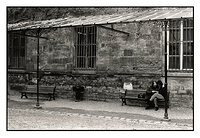
Amour - Paris

A
Amour - Paris

  • 0
  • 0
  • 37
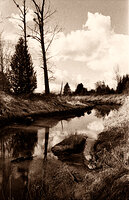
Bend in the river

H
Bend in the river

  • 2
  • 0
  • 55

Recent Classifieds

Forum statistics

Threads
203,235
Messages
2,851,836
Members
101,738
Latest member
parkeradam
Recent bookmarks
2

mhanc

Member
Allowing Ads
Joined
Sep 5, 2008
Messages
329
Location
NY
Format
Multi Format
There is a nice thread currently active about TMY-2 and Tri-X. It seems a lot of folks really, really like TMY-2 [as well as Tri-X].

(there was a url link here which no longer exists)

This got me to thinking: what about TMX? I have never tried it nor have I really seen it discussed or mentioned very much at all. So I searched the archives for "TMX" which returned nothing and "TMX100" which returned 36 threads, none of them really about the film specifically.

Then I searched the APUG gallery for TMX and TMX100. A whopping total of 204 images were found since May 2004. That's only 50 per year! Many of the TMX photographs were excellent, so the film is capable of fine results.

So, it appears that not many people are using the film. Can this be true? What gives?

I shoot two films TMY-2 and Adox CHS 100. I like them both - a lot. But, again, I was wondering about TMX. Could it be as good a 100 iso film as TMY-2 is a 400 iso film? It certainly seems so from the gallery images.

Now I am REALLY curious - and am putting in an order for a few rolls next time I and buying film.
 
TMX is a very fine grained film capable of very high resolution. It's got excellent reciprocity characteristics and a long straight line curve, so you can under or overexpose and still have a nice printable neg, or if you have a scene with a very wide brightness range, you can get it all on film and have something to work with at the printing stage.

Not everyone likes the look of TMX. The spectral sensitivity of TMX and TMY look a bit like B&W video or digital B&W straight from the camera--in a sense more linear than traditional films, but it looks less like a classic B&W look. Sometimes that works, and under some lighting conditions it doesn't matter, but not everyone cares for it.

TMX in its current version also has a UV absorbent layer (at one time it didn't), which makes it unappealing for most alternative processes, which are UV sensitive, because the prints will require excessively long exposures, and the same is true for silver chloride contact printing, which isn't as UV sensitive as most handcoated processes, but is more UV sensitive than enlarging papers.

Contact printing doesn't benefit so much from ultra-fine grain, so there's less reason for people who contact print to use TMX, though the reciprocity characteristics can be good for LF shooters who tend to shoot under conditions demanding long exposure times, when TMX may become faster than some 400 speed films.

While I still had old TMX without the UV layer, I liked it mainly for scenes that had a very wide brightness range, like this one--

http://www.echonyc.com/~goldfarb/photo/imviaduct.htm

When I used to shoot headshots in the 1990s, I also liked TMX, because with strobes the spectral sensitivity issues seemed less prominent, and the 35mm negs enlarged nicely to 8x10"--

3shot.jpg
 
Last edited by a moderator:
Used it as my main film in 4x5 when I was making silver gelatin prints...usually 16x20 prints. Most of my work uses 30 seconds or longer exposures. Can't use it now with its anti-UV layer as I use primarily alt. photographic processes now.

Vaughn
 
Let's talk small format land and TMX for a second. A man has got to ask himself one question, "are you willing to use a tripod... Well, are you?"

I think that's one reason that there is so much activity right now around TMY. Historically for tripod free photography there has always been Tri-X and HP5+, but all of a sudden Kodak is challenging everyone to take another look at T-Grain film at to 400 speed level. My view of the landscape is that the scanners already like what they see and now the analog only folks are trying to see where it might fit in.

In my view, for small format work, TMX will always have the tripod problem. LF photographers don't have this problem and I think that is where you see TMX having a lot of use, at least on the boards. This is just one mans opinion.

Denis K
 
i bought a ton of tmx up until 9/01
i had a HUGE job i stocked up for, but
after 9/11 m client bailed and left me with
a boatload of 4x5 film .. (which i use primarily
for habs/haer archival site documentations) .
i still have a bunch of boxes of tmx left from my purchase
that i use as much as possible and i enjoy using it quite a bit.
i don't do straight as an arrow processing, mostly i process my film
i dilute print developer, or coffee developer mixed with print developer and it
has never failed me. i for documentary/work stuff i still process in normal developer
- i use sprint film developer ... i have never complained about my natural light negatives made by
tmx any format,
if i used a flash, and it was 35mm ... i am not fond of that, i have had enough trouble that i switched film.
i had too many rolls i had trouble printing when i did newspaper work in the 90s ...
 
Good Evening, mhanc,

TMX is my favorite film in 35mm, 120, and 4 x 5 whenever its speed rating allows. I find it extremely responsive to changes in development times to fit lighting conditions. Others complain, of course, that it is finicky and difficult to deal with; since I've always been finicky about developer dilution, developer temperature, and developing time, I simply find that it's a very flexible and easily controlled film. If I need more speed, I'll usually go to TMY (also good stuff), but TMX is the first thing I reach for, perhaps mainly because I don't much care for graininess.

Konical
 
Load up TMX in a 35mm with a 2.8 or faster lens up to 100mm or so in focal length. Set the ISO to 50 or 64. Go out on the street and shoot. Process in DK60a 1:3 for about 8 1/2 minutes. For me, thats as close as I'm likely to get to having Panatomic-X still around. If you've ever shot 35mm handheld with ISO 25, 32, or 64 speed film, you know you don't always have to have a tripod with slow film. And yes, I still have about 40 feet of Panatomic-X to compare the TMX to.
 
I like and use both TMX and TMY in 120 and 4x5; I have four boxes of TMX Readyloads and a pro pack of 120 left in the freezer. I haven't decided whether I'm going to order more when that's gone.

David G's comments sum it up well for me; I like TMX when I don't mind the slower speed, have controlled lighting, or have reciprocity concerns (rare). I don't
much like the contrasty look of the film in bright daylight, though in more mixed lighting conditions it is very nice. Overall, though, I like TMY's tonality better, and its grain is still quite unobtrusive. For my usual uses, TMY is more versatile. It does pretty much everything well.

I'm really working hard to trim down my welter of different films to a smaller lineup that is versatile but simple. Definitely TMY in both sizes; probably a bit of 320TXP or 400TX. TMX? Dunno yet.
 
I like TMX mainly because of its resolution and that I end up with negatives that are usually very easy to print. They look a lot like TMY and TMY-2 prints, actually.
So once in a while I load the 35mm with TMX, because I can make fairly large prints before it starts to fall apart. 11x14 is certainly not a problem, and since I love the lenses of my 35mm Pentax system, I'm glad I can use it in this way.
I also use the odd roll of TMX for pinhole work. ISO 50-100 means that my pinhole camera needs about 2s exposure on a normal day, and this is manageable with a manual shutter. ISO 400 would mean I'd have to shoot at 1/2s, which is more difficult. How do you count half a Mississippi? :D

Prints from TMX and TMY look coherent side by side. That's the main thing for me.

- Thomas
 
I'd have to shoot at 1/2s, which is more difficult. How do you count half a Mississippi? :D

You start by counting off in seconds using a watch or a metronome and you subdivide the seconds in your mind in four or eight parts. Musicians do this all the time and have to coordinate their movements so that the notes start and stop with a precision on the order of a few thousandths of a second. With a little practice, it's not hard to time 1/4 s using a cable release more accurately and consistently than your average 40 year old leaf shutter can with its own timing mechanism.
 
I like TMX. I shot a lot of it recently in my XPan and in MF also.

A few years ago, I processed it in TMax developer which was great -- hard to see the grain at all when printing. It was really smooth, and I found lately I like the slightly sharper edge I get with Rodinal...either way the tonality was nice.

For personal work -- anything from landscapes to street to travel -- it's a quality dependable film I really like.
 
TMX is the highest resolution and finest grain pictorial film available. It has a very linear response so it catches a terrific amount of highlight detail. The linear response makes it ideal for Zone system techniques where scene contrast is accommodated by manipulating development and exposure rather than paper contrast grade.

It requires careful development technique as, with no shoulder, it is easy to drive the highlight detail well beyond the range of the printing paper if the film is over developed or over agitated.

In 35mm it can produce close to (but not equal to) Technical Pan quality when developed with Microdol-X 1:3. Microdol-X is a low cost developer when used 1:3, a 1 gallon stock packet yields 4 gallons of working strength developer for $9.95.

As far as speed, I am used to shooting at ASA 25 hand held. I have only one roll of K25 left, the Ektar 25 is long gone, so I am down to depleting my freezer-full of Tech Pan. I come from the days when cameras meant for family snapshots came with f1.7 lenses because they were expected to work with regular Kodachrome film. With an f1.4 lens and a steady hand ASA 25 is no liability - I can take pictures indoors in room lighting. TMX, at ASA 100, is my fast, low-light/action film.

If I had to pick a film to use for the rest of my life it would be TMX.

Why do people post more about Efke and Lucky? I suppose there is just so much more to complain about. Virtue makes for boring conversation - sin, vice and corruption make for much more interesting gossip. Perfection looks just so, so ... "glassy", don't you know -- it's like looking through a pain of glass and the film becomes invisible.

But if you like to take really fine pictures, and don't think ghastly film characteristics make for high art, then TMX is the best film there is.
 
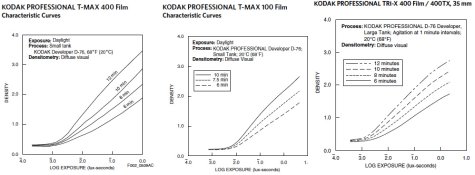
The Curves

I attached the characteristics curve. You can see the highlights developing a shoulder for Tri-X, while both TMX and TMY are straight as nails once you're off the toe.

- Thomas
 

Attachments

  • Characteristics_Kodak-films.jpg
    Characteristics_Kodak-films.jpg
    141.1 KB · Views: 156
Over the years I've used a lot of Tmax100 in 5x4, my preferred film was APX100 which I found interchangeable with Tmax100 but a stop faster. Since Agfa dropped sheet film I moved totally to Tmax.

I didn't use Tmax400 in LF because I find it's too fast, I actually prefer longer exposures with my lenses stoped down well.

Having said that I switched to Ilford Delta 100 2 years ago because I was finding it increasingly difficult to find Tmax 120 films while travelling and so now use mainly Ilford films.

Ian
 
thanks everyone for all the detailed, insightful and practical information. while we all know evaluating a film is personal and subjective as well as dependent upon many other variables in one's process, it is really nice to hear other's experience.

seems like TMX is somewhat a well kept secret. from what i read here, there are characteristics which are unattractive to some; however, there are many others that should be attractive to everyone. it also seems like in the hands of skilled photographers, like those here, it is capable of great results -- but that could be said about any film...
 
seems like TMX is somewhat a well kept secret.

It is a staple of commercial photography - but commercial photography and APUG don't have all that much intersection.

As commercial photography is now heavily digital (like, surprise) the usage of TMX isn't what it used to be.
 
Last edited by a moderator:
TMX in its current version also has a UV absorbent layer (at one time it didn't), which makes it unappealing for most alternative processes, which are UV sensitive, because the prints will require excessively long exposures, and the same is true for silver chloride contact printing, which isn't as UV sensitive as most handcoated processes, but is more UV sensitive than enlarging papers.

I used a box of 4x5 and found it quite impressive... until I tried printing on silver chloride. Really an excellent film but basically ruined for those of us using UV sensitive materials, or for those who plan on trying them at some point.
 
They should have called it TMax 50
 
Photrio.com contains affiliate links to products. We may receive a commission for purchases made through these links.
To read our full affiliate disclosure statement please click Here.

PHOTRIO PARTNERS EQUALLY FUNDING OUR COMMUNITY:


Ilford ADOX Freestyle Photographic Stearman Press Weldon Color Lab Blue Moon Camera & Machine
Top Bottom