
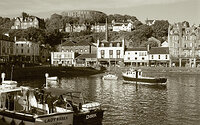
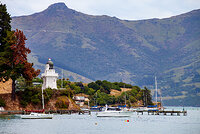
I find "straight" printing a very useful tool and a great way to visualize and discuss how the scene and film and paper interact. The "straight" process though is not an unmanipulated process.
By putting a polarizer or skylight filter in front of the lens we are changing the response of the film to the scene, we get to see beyond the surface of the water or glass or past the "flare" that is blocking our view. Using a red filter is no different in method or degree, it is only different in the "choice" of "which" manipulation we choose to use.
If we choose Delta 100 at 100 over Tri-X at 3200, we are manipulating the texture and detail of the scene.
Change the f-stop and we change how/what we focus the viewers eyes on in the scene. Shoot in a "Pictorial manner" instead of an "f-64" manner and you focus the viewers attention differently again.
Choosing - or + or normal development for our film manipulates how much of the film's curve will "straight" print on to a certain paper.
Manipulate the papers development regime and again you have had the opportunity to change the look without dodging and burning.
My point here here is simply that straight photography is a great technical term but not one that should be used to suggest a "reality" of some sort.
Heck just composing a shot is cherry picking. Turn the camera left or right a few degrees and you can change that reality from the success of a robber baron to the plight of a homeless child.
Photography is, and always has been, a subjective endeavor.
One photographer in his book refers to "straight" as an unmanipulated print. This is in reference to a work print, and just before he goes through extensive dodging and burning of an example print.
I would say then, that my definition of a "straight print" or "straight photograph" would also have to be "Unmanipulated".
He also states early on, referring to Fine Prints . . . "the emotionally satisfying print values are almost never direct transcriptions of the negative values. If they are, the print may be informative, but often no more than that."
I find "straight prints" to be extremely valuable, especially as far as historical records are concerned. These images are time capsules of what was in front of the lens the instant the shutter-release was depressed. In my opinion if the photographer has manipulated the print values within the picture to express his/her vision for the picture, then this is not a "straight print" or "straight photograph".
