Full Text (cont....)
Having looked at a traditional way of creating permanent colour prints firmly routed in the past I was keen to pick up where I left off with Adam Lowe and learn more about the unique digital flat bed printer that he had created at his workshop, Factum Arte. So I flew out to see him.
Originally a painter, Adam is a man of great ambition, knowledge, passion and energy.
The scale and scope of the projects he has been involved in since moving from London 10 years ago is quite staggering, whether it be in the creation of prints and sculptures for the leading contemporary artists such as Marc Quinn, Jeff Wall and Anish Kapoor, to the building of an exact facsimile of the tomb of Tutankhamun. With over 40 employees, Factum Arte consists of a team of artists, conservators and technicians devoted to masterminding projects and solving problems and has gained a reputation for the uncompromising nature of its work and its obsessive commitment to pushing the boundaries that usually separate technology and craft skills.
Initially speaking to Adam I asked him what the motivation was behind the creation of a printer capable of printing multiple layers in perfect registration .
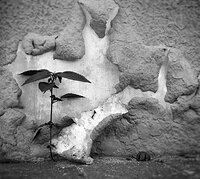
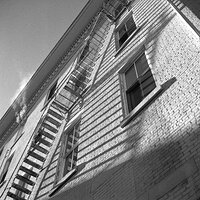
‘One of the main reasons came about as a result of my close working relationship with the photographer Boris Savelev, one of Russia’s greatest photographers who we had worked extensively at Permaprint. Boris’s images are the most challenging to print as a lot of the image information is in the shadows. At a certain point it became clear to me that we were never going to get the results that he wanted using traditional photographic methods i.e. pigment transfer printing. Digital printing was changing in leaps and bounds and really what I wanted to do was concentrate on surface, surface recording to eventually make a digital printer that could overprint in perfect registration.’
Adam went onto describe the long period of research and development that he and his engineer Dwight Perry spent in building this unique printer, shown in Figure 4. Many large format digital printers were bought, taken to bits and then rebuilt, put on liner guides and reprogrammed.
Alongside the development of the printer was the task of finding a suitable substrate that could take many layers of pigment. Adam decided to use ‘Gesso’, commonly used by artists as a primer for coating wooden painting panels, this was then coated onto aluminium, shown in Figure 5. Mixing and applying gesso is an art form in itself and although the final recipe used was relatively simple it took a considerable time of testing to find the right mix.
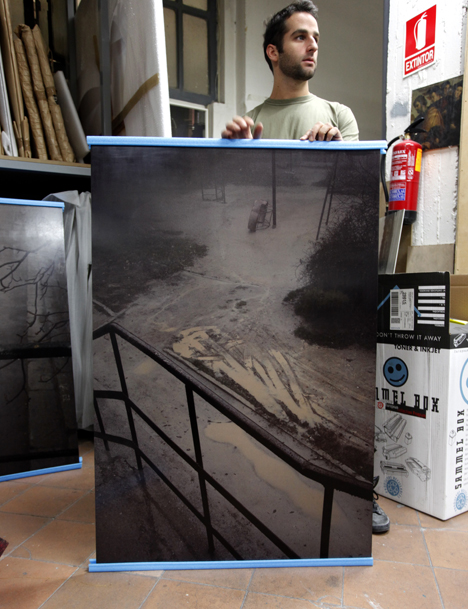
With a suitable substrate found further lengthy experimentation was needed to understand how to effectively print using multiple layers with a digital printer, a task that requires a very different sensibility from normal photographic printing. Initially Boris prepares the files in Photoshop specifically for the layering process, the first layer normally looks flat, but they are trying not to lose any information in any of the tonal layers at all. On average each print requires 4-5 layers, taking one and a half hours to print per layer, an example is shown in figures 6 and 7.
Speaking to Adam and Rafa Rachewsky (a technician who also works closely with Boris at the printing stage), I found there to be no clear formula in the preparation of image files for multi-layer pigment printing as each image requires a different approach. I found this with my own experience with platinum multi-layer printing, it takes time and experimentation and after a while it becomes intuitive rather than something you can teach.
Once Boris is happy with the look and feel of the print it is polished with a transparent wax. This both protects and gives depth to the surface. It is not a uniform gloss like on a Cibachrome nor a satin, it has the sheen of manually applied wax. The final image is clearly photographic but seems to have acquired the character and presence of a painting, hardly surprising as it is just pigment, binder and wax on a gesso surface.
I asked Adam what he regarded as the main advantages multi layer printing has over a single layered approach to digital printing:
‘One of the problems of digital printers is that it’s a one off printing process and what we really wanted to do was what’s possible in Photoshop in the act of printing. The main advantages of overprinting the same area several times helps control the intensity of the image and depth of layers and shadows which is simply not possible using a single layered print. By building up layers we can get blacks that can have a colossal amount of detail, which is especially important with Boris’s work. When you look at some of the images they seem to have the quality of a painting by Anthony Lopez or some kind of realist painting tradition.’
I went onto ask how the results compared with the pigment transfer prints and other photographic processes.
‘The results are many times better than the pigment transfer prints and other print process’s we have tried over the last 15 years. To give an example, one of Boris’s favourite images ‘Dirty Window’ (Shown in figure 8) taken on a pedestrian overpass has been printed as a C- type but the uniformity of the surface could never create the physical sensation of the dirt on the glass or establish a difference between the dirty glass and the silvery light seen between the two sheets of glass. For the first time, Boris has been able to work on the file and bring out all the details seen through the glass. This image was made like a painting, drawing out small details in different layers. The use of pigment and gesso enhances this ambiguity.’
I was interested to know from Adam what the future holds for multi-layer printing at Factum Arte?
‘The current printer can print 110 x 240 cms, We are now looking to increase the size and we are also looking into UV cured inks. While I am not convinced that the UV cured printers can give the quality and character of image we require I am sure they will in the future and they seem to have many advantages.
Away from the colour printing we are also developing a variety of 3 D scanners – both laser and white light scanners. I really want to develop a third axis for the printer so we can print perfectly on relief surfaces. There is a great deal of development and research going on at present in Factum Arte.’
Meeting Adam was a real eye-opener into the future of multi-layered colour printing. The prints they have created for Boris and other artists have quality to them unlike any other colour photographic printing process I have seen and have to be viewed in person to fully appreciate them. Boris obsessively strives to create a print that is exactly as he saw it when he pressed the shutter of his camera, working with Adam and his team of staff at Factum Arte they have succeeded in achieving this goal with multi-layered pigment prints on gesso. I intend on following the progress of this important workshop over the coming years.
To find out more about Factum Arte, visit
www.factum-arte.com
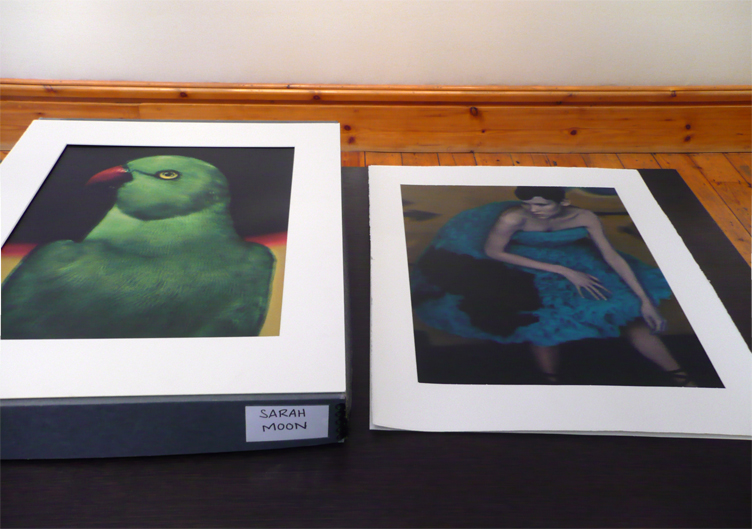
To view either Sarah Moon’s or Boris Savelev prints visit
www.michaelhoppengallery.com