• Welcome to Photrio!
    Registration is fast and free. Join today to unlock search, see fewer ads, and access all forum features.
    Click here to sign up

The Mortensen method for landscapes

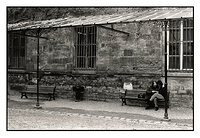
Amour - Paris

A
Amour - Paris

  • 0
  • 0
  • 39
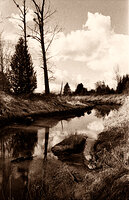
Bend in the river

H
Bend in the river

  • 2
  • 0
  • 58

Recent Classifieds

Forum statistics

Threads
203,235
Messages
2,851,848
Members
101,740
Latest member
Andrewford
Recent bookmarks
0

Alan Johnson

Subscriber
Allowing Ads
Joined
Nov 16, 2004
Messages
3,429
Here I am not referring to Mortensen's portraiture or models or disputes,but to his method applied to landscapes.My summary of an article by J. Lowry, Amateur Photographer, March 12 1952:
(1) Aim. A relatively increased range of tones is given to the highlights,at some sacrifice of the shadows.
(2) Materials. Fine grain film only,really fine grain developer.
(3) Exposure. For landscapes tilt the exposure meter upwards,assuming the sky is to be included in the view.
(4) Development. To finality.The article mentions 5x normal time.
(5) General. Avoid subjects with large shadow areas.Also, in summer, June, July, August, the lighting may be too contrasty for this method unless diffuse.
I will try this on an unimportant film.Just wondered if there are any comments on this landscape procedure.
 
All that development will give a pretty grainy neg. He probably used large format where it did not matter as much and had odler style films.

I would not recomment it with todays films. Nothing lost if you take a sheet and try or just use 6 exposures on the front end of a roll. Cut off 12" in the dark and give it a try.
 
i'm suprised there isn't anything more on detail about developing the negative. he would use weak developers when developing till completion ( not all the time though, from my readings he used all sorts of formulas including his 'supersoup' ). if you want to explore one of his techniques you can try diluting something like pyrocat hd at 1:1:200, work out your total time, say tri-x at 400 for around 40 minutes. then you do 5 inversions per minute for 1/4 of the total time ( 10 min ) and then let it rest for 40 minutes. you will rarely get bromide streaking this way but i suspect that Mortensen was willing to live with the risk of streaking ( he advised bracketing and backups ) for the sakes of the look he was getting. from memory rodinal at 1:200 around similar times resulted in a similar result - a little more local contrast within a longscale negative. you have to fine tune and experiment. hope this helps.

ps he used any format. there's one picture where he used 35mm. the grain contributed to the look.
also, regarding the metering, his extended development helps bump up the Eİ. these techniques really come into their own in non-contrasty situations.
 
Last edited by a moderator:
Film - Essentially any current film will have a finer grain structure than those of the 50's. I would use any 100-125 speed film with which you are familiar.

Total development does work with current conventional grain films. It is very similar to the current trend of Stand Development. Developer choice is very important. I learned to use total development in the 1930's. The lab in which I learned it used only D-23 which was never replaced in the year plus I worked there. The used developer helped in the re-plating of silver on the highlights which is a characteristic of the process.

I still keep a batch of well used D-23 solely for use when total development is needed.
With FP-4+ I commonly use a total of three hours development time. in a tray I agitate constantly for the first minute then cover the tray with a second black one and let it sit for one hour. A second agitation similar to the first at that point. after 30 more minutes I agitate it for the final time. At the end of three hours I complete the processing.

This development process is not necessary or advantageous unless the subject is very flat on a day of flat lighting.
 
In reading this it seems like good advice for the beginner for capturing good detail on film in tricky landscape subjects. Some thoughts item by item follow.

(1) Aim. A relatively increased range of tones is given to the highlights,at some sacrifice of the shadows.

Sounds to me like he is going based on an average metering.

(2) Materials. Fine grain film only,really fine grain developer.

As mentioned above, modern emulsions have, by nature, a finer grain than their fifty year old counterpart.

(3) Exposure. For landscapes tilt the exposure meter upwards,assuming the sky is to be included in the view.

Personally, while composing, if I see the sky will be in the subject area I always include it into me meter regimen.

(4) Development. To finality.The article mentions 5x normal time.

I don't see where this might be necessary in order to acheive a good negative. Personally, that is. I know what I have captured on the film and how I will process it beforehand.

(5) General. Avoid subjects with large shadow areas.Also, in summer, June, July, August, the lighting may be too contrasty for this method unless diffuse.

That's what contraction/expansion are for. I have not done with it much, have not yet had the need, or so I thought.

I suppose these would be good guidelines for a beginning photographer but with any practice and accumulation of skill these guidelines could be quickly outgrown.
 
Interesting. His negatives indoors were made to feature skin tones, so I suppose that exposure method carries over to landscapes - emphasis on the high values and not much concern about the shadows.

In "The Negative" he gives a good deal of explanation about the differences in cameras - large format gives detail, medium format yields definition, and small cameras (smaller than 2x3) give depth of field. He also says too many folks worry too much about grain.
juan
 
I recently thought about Mortensen when reading other threads here concerning how to establish EI and where to place the photograph on the film's characteristic curve. The gist of what I have learned recently, is that modern films have a longer straight portion of the curve than prior films and it is desirable, if possible, to include the entire subject brightness range on the straight portion of the film curve. Then, if needed, achieve compression of the shadows and highlights with the toe and shoulder of the paper. The films that Mortensen used were more S- shaped and had more prominent toe and shoulder. This would present different challenges than today's films. His solution seemed to be to shift the exposure downwards and increase development to maximize contrast in the highlight areas. I am not sure that using his methodology on today's films would have exactly the same effect as on the films he used.
 
tilting tilting the meter towards the sky gives underexposure for the rest of the scene,
and over development by 5x gives a nice dense negative.
it makes perfect sense to me ...
expose for highlights.
this methodology works very well for exposing paper negatives too

one of the things that makes photography fun is that
there are many different ways to expose film process it and later print it.
there is not one correct way, although many people will suggest there are too many incorrect ways.


have fun !
 
"The films that Mortensen used were more S- shaped and had more prominent toe and shoulder. This would present different challenges than today's films."

Not necessarily true. If he used Super XX, which i believe he did as did a great many photographers, it had an extremely long straight line curve with essentially no shoulder.
 
Jim, you may be correct and it has been some time since I read his books. I do not know what films he used, but I seem to recall that his description of his methodology rested on his observations about the S shaped nature of the film's characteristic curve and the problem of losing contrast in the highlights because of the shoulder. I have to wonder if given the abilities or limitations of sensitometry at that time if his understanding matched what was really going on. He certainly stimulated a lot of controversy with Ansel Adams and the f 64 group who had a different approach and different way of explaining things. In the end, they may have all been saying the same things.
 
If stand or semi-stand doesn't give you better negs, at the very least from personal experience it makes things easier, and you get consistently decent negs. Rodinal 1:200 for 2 hrs, agitated for 30 sec. initially then let stand. So far in 35mm and 120 I have developed Tri-X, Plus-X, HP5, FP4, Delta 3200, Foma, and a couple of others this way (and pushed/pulled Tri-X as well). From what I understand it develops any film to completion, so you don't have to worry about different times for different films.
 
I don't really think dilute developers is the way to go as it decreases highlight contrast.
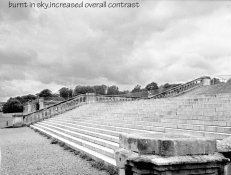
Anyhow I made a test using 400 T-max film and neat Xtol.Pointing the meter at the cloudy bright sky gave 1/300s f18,no filter.Development in Xtol was 5x recommended,agitation 30s then 10s at 3 equal intervals in the remaining time.(29m68F).The result is attached.
a.1/300 f18 gives good shake-free depth of field for hand-held medium format.This is a result of modern film tech and not possible in Mortensen's day.
b.The grain is just about acceptable for 7x enlargements I make IMO.
c.The sky still needs burning in and a high contrast was needed for printing,Mortensen's method does not make this any easier.
 

Attachments

  • mortensen-2.jpg
    mortensen-2.jpg
    283 KB · Views: 165
Photrio.com contains affiliate links to products. We may receive a commission for purchases made through these links.
To read our full affiliate disclosure statement please click Here.

PHOTRIO PARTNERS EQUALLY FUNDING OUR COMMUNITY:


Ilford ADOX Freestyle Photographic Stearman Press Weldon Color Lab Blue Moon Camera & Machine
Top Bottom