
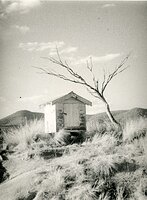
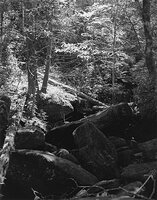

So, recently I went out to a location and upon arrival realised "Oh no, my camera battery's dead.". When this happens, my camera defaults to 1/500th of a second. I didn't let this stop me and still (I think) made some decent photographs. Go me!
For one of these photographs, however, I absolutely needed a shutter speed longer than 1/500th. I thought, haha! Given the subject is static, I can just make sure my camera stays still, and fire the shutter 10 times over... that should give me a 1/50th exposure, right? I've since developed the negs and it seems to have.
I was wondering if, how, reciprocity failure would've affected this exposure. I feel like I may have lost details in the shadows as not enough photons would've hit the medium in the darker areas in time within a single 1/500th exposure to have a permanent effect, and by the time I made the next 1/500th exposure (a couple of seconds later having carefully recocked the shutter without moving the camera), some of the previous exposure's effect would have been lost; whereas with an actual 1/50th exposure it would've been fine because the film would've been exposed to light continuously for the whole 1/50th of a second?
This seems to already be known as the intermittency effect? Apparently it's easier to demonstrate in printing, using test strips.
If you make a test strip just exposing the paper to plain light (no negative in the way), and pick out an exposure that gives you a highlight, if you then take that same time and expose another piece of paper as a continual exposure, it'll end up denser than the test strip. This technique is described here [LINK] but I don't agree entirely with the reasoning for it. I trust enlarger manufacturers actually make sure their enlargers put out 3 seconds' worth of light when you tell it to expose for 3 seconds.
A google book preview seems to provide some better information on the effect; Basic Photographic Materials and Processes by Nanette L. Salvaggio [LINK] (see: "Intermittency Effect" on p.374).
For one of these photographs, however, I absolutely needed a shutter speed longer than 1/500th. I thought, haha! Given the subject is static, I can just make sure my camera stays still, and fire the shutter 10 times over... that should give me a 1/50th exposure, right? I've since developed the negs and it seems to have.
I was wondering if, how, reciprocity failure would've affected this exposure. I feel like I may have lost details in the shadows as not enough photons would've hit the medium in the darker areas in time within a single 1/500th exposure to have a permanent effect, and by the time I made the next 1/500th exposure (a couple of seconds later having carefully recocked the shutter without moving the camera), some of the previous exposure's effect would have been lost; whereas with an actual 1/50th exposure it would've been fine because the film would've been exposed to light continuously for the whole 1/50th of a second?
This seems to already be known as the intermittency effect? Apparently it's easier to demonstrate in printing, using test strips.
If you make a test strip just exposing the paper to plain light (no negative in the way), and pick out an exposure that gives you a highlight, if you then take that same time and expose another piece of paper as a continual exposure, it'll end up denser than the test strip. This technique is described here [LINK] but I don't agree entirely with the reasoning for it. I trust enlarger manufacturers actually make sure their enlargers put out 3 seconds' worth of light when you tell it to expose for 3 seconds.
A google book preview seems to provide some better information on the effect; Basic Photographic Materials and Processes by Nanette L. Salvaggio [LINK] (see: "Intermittency Effect" on p.374).

