
-
Welcome to Photrio!Registration is fast and free. Join today to unlock search, see fewer ads, and access all forum features.Click here to sign up
You are using an out of date browser. It may not display this or other websites correctly.
You should upgrade or use an alternative browser.
You should upgrade or use an alternative browser.
Tech Pan at 400 ISO
-
A
- Thread starter thefizz
- Start date

Recent Classifieds
-
For Sale Oleson Brightscreen MPD For Hasselblad
- Started by chuckroast
-
For Sale Nice M3 Double Stroke--recent CLA
- Started by Timothy Hyde
-
For Sale Rodenstock Grandagon 75mm f 6.8 multi-coated
- Started by Franswa
-
For Sale Mamiya TLR C33 with 65mm f 3.5 Lens - $295
- Started by J Durr
-
For Sale FS: Sinar P 8x10 Rear Standard Bearer
- Started by B.S.Kumar
Forum statistics
- Joined
- Jun 21, 2003
- Messages
- 29,832
- Format
- Hybrid
hi peter
the only times i shot tech pan i shot it asa 200 and processed it in print developer
it gave me grainless pure black and white ( like kodalith ) negatives.
i wish i could make a suggestion, maybe develop by inspection print developer like dektol.
1 stop difference is not going too much of a difference when shooting high contrast negatives,
just don't expect any mid tones ...
i wish i had the tech notes that kodak suggested as a starting point when shooting at high asa
... kodak suggests 3 mins at asa 200, so maybe 50% more it since you pushed the film by an additional stop ..
http://www.kodak.com/global/en/professional/support/techPubs/p255/p255.jhtml#06
good luck!
john
the only times i shot tech pan i shot it asa 200 and processed it in print developer
it gave me grainless pure black and white ( like kodalith ) negatives.
i wish i could make a suggestion, maybe develop by inspection print developer like dektol.
1 stop difference is not going too much of a difference when shooting high contrast negatives,
just don't expect any mid tones ...
i wish i had the tech notes that kodak suggested as a starting point when shooting at high asa
... kodak suggests 3 mins at asa 200, so maybe 50% more it since you pushed the film by an additional stop ..
http://www.kodak.com/global/en/professional/support/techPubs/p255/p255.jhtml#06
good luck!
john
Last edited by a moderator:

In my tests with T-max film, the T-max developer yielded better toe density for the same relative gamma compared to dilute Rodinal, so I would use the T-max developer. However, in this case, there won't be much sensitized silver there to develop. Your will have recorded like zone V and up on the film.
Last edited by a moderator:

No hope Peter, it needs a very soft working developer and over exposure to use as a camera film for continuous tone.
So just soup in a strong dev and expect two tones black & maybe white
Ian
So just soup in a strong dev and expect two tones black & maybe white
Ian
Not true actually... Im not sure of the details but I knew a guy in Brisbane who used to shoot TP at 1600 all the time as an astrophotographer. He said that it was common knowledge for astrologers to use TP and expose the film itself to Hydrogen (of Helium -its been a long time), which would in some way effect the film and allow the development to continue as though it were exposed at 25...
Now Im hoping that there is someone on here who can fill in the rather large detail gaps here...
Joe
Now Im hoping that there is someone on here who can fill in the rather large detail gaps here...
Joe
Joe, those doping techniques didn't give 7 stops increase in film speed, if they had then they would have been widespread.
Welcome to APUG BTW.
Ian
Welcome to APUG BTW.
Ian

No hope Peter, it needs a very soft working developer and over exposure to use as a camera film for continuous tone.
So just soup in a strong dev and expect two tones black & maybe white
Ian
well - I allways exposed my tec pan as 100iso, and developed in Tetenal Neofin Doku for 6min, and they were perfect....
So I suspect that it could be done with 400 iso also..
the downside o fthis is naturally, that neofin Doku doesn't seem to be made any more...
(I have some left, but not a lot, I'm afraid..)
so there is always hope..
I rather suspect that all the variations in shutter speeds, meter calibration etc etc of your equipment is the opposite of mine
This is one reason why we all use different EI's and Dev times. But Tech pan isn't a forgiving film it has no latitude, so Peter will be lucky to get anything printable. But knowing the luck of the Irish
Ian
This is one reason why we all use different EI's and Dev times. But Tech pan isn't a forgiving film it has no latitude, so Peter will be lucky to get anything printable. But knowing the luck of the Irish
Ian
Not true actually... Im not sure of the details but I knew a guy in Brisbane who used to shoot TP at 1600 all the time as an astrophotographer. He said that it was common knowledge for astrologers to use TP and expose the film itself to Hydrogen (of Helium -its been a long time), which would in some way effect the film and allow the development to continue as though it were exposed at 25...
Now Im hoping that there is someone on here who can fill in the rather large detail gaps here...
Joe
I hypersensitize Tech Pan by heating it in a small temperature controlled vacuum chamber in a Metalurgical Forming Gas atmosphere.
I place the film in the chamber (on a SS reel), heat the chamber, pump the air out with a vacuum pump; then backfill the chamber with Metalurgical Forming Gas (consisting typically of 8% hydrogen and 92% nitrogen or 10% Hydrogen and 90% Nitrogen) - - I buy my Forming Gas at a welding supply store.
You need to do this BEFORE exposing the film.
No way that you will get 7 stops speed increase - but it will help you deal with Reciprocity Failure and allow you to make very long exposures
Last edited by a moderator:
Fizz, can you re-take the photos? That might be the way to go.

This may not be the best idea but worth a thought. If you post exposed the film (off the roll) to give you a base fog level of .05 to .10; that should develop more detail. The negatives would probably have low contrast unless you experimented with developing times or print your images on a paper like Multigrade to make a hard print.
Sounds complicated, but in reality it is probably easier than a controlled pre-exposure to light, right?
Gas Hypering is the preferred way of dealing with reciprocity failure with long exposure astro-photography.
Pre-exposure of the film can give an honest film speed boost and it is the only procedure that I have found effective to use for boosting my film speed when I'm out in the field.
When I use this procedure to boost my effective film speed, I pre-expose to a Kodak gray card or to open sky.
OP
OP

Fizz, can you re-take the photos? That might be the way to go.
No chance, they are not so important but I'd still like to salvage them if possible.
Thanks to everyone for all the replies.
Peter

I would subject it to Rodinal 1+100 for 1 or 2 hours
since this has become an experiment form now on anything you get will be a treat
since this has become an experiment form now on anything you get will be a treat
No chance, they are not so important but I'd still like to salvage them if possible.
Thanks to everyone for all the replies.
Peter
Sounds complicated, but in reality it is probably easier than a controlled pre-exposure to light, right?
Gas hypering is not the same as flashing the film.
I wonder if you could use Acufine? Let's suppose your Tech Pan was an EI of 25. Going to EI 400 would be a 4-stop push. I've pushed TX 4 stops in Acufine. I know it's not the same film, but worthy of contemplation.
I hypersensitize Tech Pan by heating it in a small temperature controlled vacuum chamber in a Metalurgical Forming Gas atmosphere.
I place the film in the chamber (on a SS reel), heat the chamber, pump the air out with a vacuum pump; then backfill the chamber with Metalurgical Forming Gas (consisting typically of 8% hydrogen and 92% nitrogen or 10% Hydrogen and 90% Nitrogen) - - I buy my Forming Gas at a welding supply store.
This probably beyond the scope of most photographers. Sounds mighty interesting though.
As others have said, Tech Pan is very unforgiving, and with a base ISO of around 25, it's possible that there is no image on the emulsion.
However, I'd probably do as the others suggest and overdevelop it a significant amount. The worst that happens is that it doesn't work.
This probably beyond the scope of most photographers. Sounds mighty interesting though.
As others have said, Tech Pan is very unforgiving, and with a base ISO of around 25, it's possible that there is no image on the emulsion.
However, I'd probably do as the others suggest and overdevelop it a significant amount. The worst that happens is that it doesn't work.
Here is another hypersensitization technique that I found on the internet but have not tested:
http://mypeoplepc.com/members/patminton/astrometric_observatory/id16.html
"Hypersensitizing film with an Ammonia-Alcohol Solution"
"The required materials are a quart of isopropyl rubbing alcohol - any above 30% concentration is OK. You also need a quart of clear household cleaning ammonia solution - any concentration is OK. Both of these can be found in almost any grocery store for two dollars or less total (1 quart of mix can easily hyper 10-20 rolls). You also need a 35 mm roll film developing tank (if hypering a 35mm roll), and a hand held hair dryer with an off or low heat setting. It also helps if the developing tank can be turned upside down without leaking - you should be able to shake it strongly. It also helps to have a spare film spool handy with tape on it in case you cant reuse the old one.
The procedure is to add 2 fluid ounces of ammonia to 16 fl oz of alcohol and shake for a few seconds. This is the ammonia-alcohol (AA) hypering solution. Use it near 68 deg. F. In a dark room, load the tank with the film. Now turn on the lights and pour the AA solution into the tank, agitate well for 4 minutes, and pour off the solution. Now turn off the lights. Remove the spool and rap it hard against some paper towels to remove most of any clinging drops. Blow-dry the film while still on the spool with the hair dryer or other small strong fan. Insure that the heater element is off, or only dimly visible to prevent light fogging (especially with red-sensitive film). Rotate the spool in all directions while drying -give extra time blowing into both open ends - the top and bottom of the spool. Depending on your local humidity, dry for 2 to 3 minutes then feel the end of the film with both sides of your dry lips. If the film sticks to your lips, it is still moist. If moist, continue for another minute and repeat the test. When the film end is dry, remove the whole roll and test the middle and other end. If still moist in some areas, blow it for half a minute while holding the film by the ends or edges - tricky - but it can be done. Next time, extend the initial drying on the spool by this extra amount.
With the film now dry and sensitized, load it back onto the film spool - be sure to tape down the inside end or it will pull off when you get to the end of the roll - and please make sure the emulsion is wound facing the core of the spool !
Here are suggestions for easier use and problems:
Process half a roll of newly hypered film to see how it looks. Try to use the film in a day or two. You might try exposing every other frame on a white card to check uniformity. If the emulsion base density is too dark, you can reduce the soak time, reduce the ammonia added, or do it when it is cooler. You might also reduce the developing time if you are doing the processing. If the film has spots or splotches, you can reduce the time it is wet by using more heat or a stronger fan, add a drop or two of photoflo to reduce the liquids surface tension; and try to be more careful handling the film. When I hypered my 2415 film I discovered the solution had turned color, so it may be dissolving the anti-halation backing. Beware - AA hypering is cheap and quick, but it is extreme !!!"
This procedure is probably worth testing on a "don't care" short roll of 35mm film.
- Joined
- Jun 21, 2003
- Messages
- 29,832
- Format
- Hybrid
sorry to bring up paper in this...
but do you think hypering with either gas or an aa solution
will do anything with paper (instead of film) ..
thanks + sorry if i hijacked the thread
john
but do you think hypering with either gas or an aa solution
will do anything with paper (instead of film) ..
thanks + sorry if i hijacked the thread
john
OP
OP
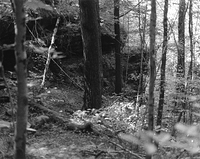
Well I deceided to chance a sort of semi stand development a few weeks back and the negs didn't turn out too bad at all. I finally got a chance to do a quick print.
I used Rodinal 1:100 for 35 minutes with agitation once each minute for the first five minutes and once every five minutes after that.
I printed at grade 2 with three stops burning in of the sky. The scan is a bit darker than the print.
Peter
I used Rodinal 1:100 for 35 minutes with agitation once each minute for the first five minutes and once every five minutes after that.
I printed at grade 2 with three stops burning in of the sky. The scan is a bit darker than the print.
Peter
Attachments

Nice...
Came out better than I would have guessed. Good work. If you wanted to play with a trial blast of intensification on a couple of negs....just for the experience, it will be reversible, too....
Came out better than I would have guessed. Good work. If you wanted to play with a trial blast of intensification on a couple of negs....just for the experience, it will be reversible, too....
| Photrio.com contains affiliate links to products. We may receive a commission for purchases made through these links. To read our full affiliate disclosure statement please click Here. |
PHOTRIO PARTNERS EQUALLY FUNDING OUR COMMUNITY:  |