• Welcome to Photrio!
    Registration is fast and free. Join today to unlock search, see fewer ads, and access all forum features.
    Click here to sign up

T-Max New 400, Rodinal 1:100

Forum statistics

Threads
203,268
Messages
2,852,151
Members
101,753
Latest member
Janek201
Recent bookmarks
0

2F/2F

Member
Allowing Ads
Joined
Apr 29, 2008
Messages
8,031
Location
Los Angeles,
Format
Multi Format
I am simply wondering if anyone here on APUG has some pix done this way, so I can see examples of this technique.

I am talking about standard agitation at 1:100, not standing development.

Thank you in advance.
 
I began testing this combo for N times last night. Negs are still hanging at home, I'll make my first prints tonight. Will be sure to report back here.

FYI, I am currently testing 4x5 developed in a 6 sheet slosher tray with standard agitation.
 
Thanks, Shawn.

I am using 35mm, and I want sharp, gritty grain, but normal-to-high contrast. I will be making extreme crops, but I don't want mushy grain, like with Tri-X. I want something more "wiry".
 
Last edited by a moderator:
Well, I'm making contact prints so I also want nice sharp grain and normal to high contrast (with decent density) so it sounds like we are looking for the same thing from the film - just to use in different ways.

I will also be testing this with 120 TMY as soon as I receive a couple of new reels. I'm basically abandoning my semi-stand/min ag development in favor of a more standard development - though still at high dilutions.

Anyway, as I said, I'll post all results here and check back for your and others' thoughts/results. Shawn
 
Yes. We want the same thing. Our level of enlargement will simply be MUCH different. I will probably be making 15x15 or 20x20 enlargements from areas as small as 1/2x1/2 inch....so 30x to 40x enlargements.

I normally use Delta 3200 for this, but wanted to try something new, and hopefully get more contrast and more sharpness, while still having an intense "wash" of grain.
 
Printed test negs last night on grade 2ish paper. Seem to have the iso nailed down at 200. I need to increase development times a bit, couldn't find an info for starting times so I just made a semi-educated guess... Got within the ballpark anyway. Will make more negs and test prints this week. I'm thinking the N time at 1:100 is going to end up being around 14 to 16 minutes. Will report back with more complete info as I finish testing.

Shawn
 
Been doing some more testing. I was a little under in my last guess, looks like my N time (iso 200) is going to settle around 16 to 18 minutes. I should have this part dialed in by the end of the weekend. I've been shooting both N+ and N- exposures as well so once I nail down this N time they should be fairly easy to figure out.

Have you had a chance to do any testing yet, 2F/2F?
 
I have done many rolls of TMY in Rodinal 100:1. The HD curve is very different than TMY in T-max dev in my processing system. More grain. Impression of more sharpness in some conditions, some loss of speed.
 
Hi, Shawn. Will probably develop this Saturday, and try enlargements Sunday. I will try 20 - 25 minutes and see what happens, since I am looking for more contrast than normal, and I don't want to print a huge enlargement through a high filter.

Ic-racer: sounds good to me! The lower speed will help add contrast, and the sharp grain is what I want.
 
Hi, Shawn. Will probably develop this Saturday, and try enlargements Sunday. I will try 20 - 25 minutes and see what happens, since I am looking for more contrast than normal, and I don't want to print a huge enlargement through a high filter.

Cool. Good luck and let us know the results. Shawn
 
I've been playing a lot w/ TMY-2 in Rodinal. It's a neat combo, def capable of what you're looking for.

I might suggest 1+50 (or even 1+25) to keep the grain more pronounced and the contrast more aggressive, 1+100 might be too gentle w/ this film, even at those enlargements.

These are some of my examples of the combo, from my first tests w/ it. Obviously you can't tell much at these sizes, but I can assure the grain is very sharp, tight, and uniform. Incredibly sharp combo. Given the samples, and for the reason of the qualities mentioned, you can see I'm liking it for portraits of men.

http://graememitchell.com/blog/wp-content/uploads/2010/01/alex_steckly_dec09_1.jpg

http://graememitchell.com/blog/wp-content/uploads/2010/01/john_kehm_dec09.jpg

http://graememitchell.com/blog/wp-content/uploads/2010/01/ian_mitchell_dec09.jpg
 
Graeme,

Thanks....but those are downright SLICK compared to what I want. Not a touch of grain in them that I can see at those enlargements. Higher dilutions will increase the sharpness of the grain, and as as long as I agitate in the same ratio to total development time, I will achieve roughly the same contrast index.

I may do my two-bath approach with these particular negs, and save the "real testing" for some other rolls. I do a highly-diluted reduced agitation technique at first, followed by 50% of a normal developing time at a more standard dilution. I have just not done it with T-Max, so was looking for examples.
 
Graeme,

Thanks....but those are downright SLICK compared to what I want. Not a touch of grain in them that I can see at those enlargements. Higher dilutions will increase the sharpness of the grain, and as as long as I agitate in the same ratio to total development time, I will achieve roughly the same contrast index.

I may do my two-bath approach with these particular negs, and save the "real testing" for some other rolls. I do a highly-diluted reduced agitation technique at first, followed by 50% of a normal developing time at a more standard dilution. I have just not done it with T-Max, so was looking for examples.

Yeah, they're not examples of what you want, true, but just examples of the combo.

Btw, Rodinal, in my small experiences, works different in this regards than many other developers. The higher the dilution, the less grain. Seriously. I don't know why, and I could be wrong, but I get WAY more grain at 1+25 than I do at even 1+50.

Agitation also plays a part in it. Less frequent agitation, less grain. More frequent, more. Developing to around the same CI. But I think you probably know this as it's oft discussed.

Anyway, I've yet to try TMY-2 at 1+25, but that, w/ maybe a 1 stop push and a bit overdeveloped should give you something at the enlargments you're talking...

Or maybe it still won't be enough...it is a scary film in how little grain it builds.

I wonder about Dektol.
 
Here is an HD plot showing my experience with T-max film using two different developers. This may not be typical of what others observe because I used rotray processing with 7 or 8 changes of dilute 1:100 Rodinal developer during the process.
The way the highlights are depressed (but still pointing upward and not rolled off like on the shoulder) makes images especially of snow and high contrast scenes very easy and fun to print. Almost like some built-in contrast masking.
rodinalvstmaxdeveoper.jpg
 
A little more testing last night. Keeping in mind my goal is moderately dense, contrasty negatives for contact printing.

Based on what I've done so far.

TMY2 @ 200 in Rodinal 1:100 (15ml of rodinal in 1500ml of distilled water)
2 minute presoak.
6 sheets of 4x5 in a slosher tray (reducing number of sheets in the same amount of developer changes things!)
Gentle agitation for first minute then for just a second or two every 30 seconds.

N = 17min 1:100

I have also done some N- and N+ experimentation for which I simply change dilutions.

N- = 17 @ 1:125
N-2 = 17 @ 1:150
N+ = 17 @ 1:75

I will almost certainly make adjustments as I continue using this combo but I have made numerous prints to come up with this data. More printing tonight, I'll be sure to post additional findings as I progress.

Certainly appreciate the insight everyone has shared so far! I have also worked out the same type of system with FP4+, if anyone needs that info let me know.

ALL AT 70f!!!
 
Last edited by a moderator:
This may not be typical of what others observe because I used rotray processing with 7 or 8 changes of dilute 1:100 Rodinal developer during the process.
[/IMG]

I would be quite interested in hearing more about your experience with Rodinal in rotary processing - as well as this method of 7 or 8 changes during processing! Are you using a jobo?
 
Nice work, Shawn. There's nothing like testing for yourself.

So you use dilution entirely to change contrast? Interesting concept. I use agitation and subsequently time and leave the developer alone.

Is it all at 68*F?

- Thomas

.
 
Thanks, Thomas! Forgot to include the all important TEMP!?! Everything is done at 70f.

Right now I keep everything the same and solely change dilutions to alter contrast. Worked great for me with FP4+ for all last spring and summer. I then began a new round of experimentation with semi-stand.... which I found to be a bit too fussy, cumbersome and unpredictable for me. I'm now returning to this method as it has yielded the best, most consistent and predictable results for me to date. I did want the extra speed of TMY2 thus the new tests instead of returning to FP4+.

I've read quite a bit about df cardwell's system - to which you are referring I believe. It makes a lot of sense. I just don't feel I'm quite ready for that just yet. Maybe after another year or so of really working my current method and allowing it to become somewhat intuitive I'll take another look at his article. All the best. Shawn
 
Shawn,

I really think there is no reason to fix what isn't broken. Whatever gives you the results you want is good enough.

My results with agitation as variable are very good, the best I've ever had, and I'm very pleased with it. So I'm not fixing my approach either... :smile:

Back to TMY-2 and Rodinal. From results I've seen it's a great combination. Rodinal is a fairly slow working, but very powerful developer capable of incredible densities, contrast, and sharpness. The grain really is crisp, gives great texture. And TMY-2 is an exceptional film.

- Thomas

..
 
I hear ya, Thomas. I've about had my fill of testing for awhile... =) Time to get out there and start making work!

I was a bit fascinated with the idea of control over certain parts of the neg in cardwell's article. I just don't think I have my head wrapped around the entire curves --> to scene --> brain -->to paper --> thing... plus learning to meter based on midtones. Really fascinating for a dork like me. As I said, once I really have this dialed in I may play around a bit...

Couldn't agree more on the TMY2/Rodinal combo! Hope you're well! Shawn
 
Here is an HD plot showing my experience with T-max film using two different developers. This may not be typical of what others observe because I used rotray processing with 7 or 8 changes of dilute 1:100 Rodinal developer during the process.
The way the highlights are depressed (but still pointing upward and not rolled off like on the shoulder) makes images especially of snow and high contrast scenes very easy and fun to print. Almost like some built-in contrast masking.
rodinalvstmaxdeveoper.jpg

Agree, the highlights w/ this combo are something else. Sparkely and crisp. But i've learned to careful w/ skin tones for this very reason. They don't get that flat, glowy, mids pushed up on the shoulder look...actually I've been unable to find a way to get that w/ TMY-2 at all.
 
Thanks for the link. That's one hell of a setup you have there! Very cool, interesting read. Hopefully we'll run into each other at another gathering before to long. All the best. Shawn
 
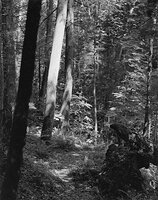
One of the better prints (technically) from the latest round of testing. Details:
TMY2 @ 200
Orange filter
1/2" @ f32
17min in Rodinal 1:100 4x5 slosher tray
Lodima, amidol, selenium toned.

Sunny day with some crazy clouds roaming about. Have full detail in the the blacks on the neg if you wanted to go get them - print has strong blacks with a hint of detail. The white weeds in the foreground are held on the print. Not much dodging and burning - maybe 4 simple steps.
 

Attachments

  • forestrhythyms2600hc.jpg
    forestrhythyms2600hc.jpg
    330.3 KB · Views: 226
Last edited by a moderator:
Thanks for the link. That's one hell of a setup you have there! Very cool, interesting read. Hopefully we'll run into each other at another gathering before to long. All the best. Shawn

Seems like it would be about time for John to start a new thread for the next gathering but I have not heard anything yet.
 
Last edited by a moderator:
Photrio.com contains affiliate links to products. We may receive a commission for purchases made through these links.
To read our full affiliate disclosure statement please click Here.

PHOTRIO PARTNERS EQUALLY FUNDING OUR COMMUNITY:


Ilford ADOX Freestyle Photographic Stearman Press Weldon Color Lab Blue Moon Camera & Machine
Top Bottom