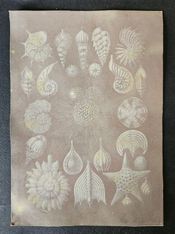
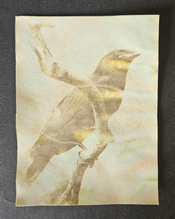
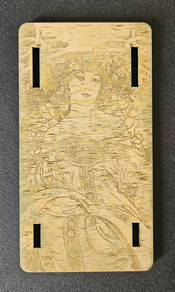
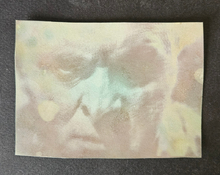
the process relies on the in-situ synthesis of a Cu(I) coordination compound which in the dark decomposes into Cu(I) oxide while under the action of light proceeds to reduce to Cu(0)
The Cu(I) oxide, which we deliberately produce by pre-treating with NaHCO3, is light sensitive itself, it makes more sense to me that this is the source of light sensitivity here.
On top of that, the copper/ascorbate solution acts as a
physical developer which plates out more copper on the seeds created by illumination. This is why the previous image develops on the cover sheet, and also why the image appears copper colored rather than black like finely divided copper, the grains grow quite large that way.
By pre-treating with bromide/chloride you switch out which light sensitive copper salt provides the initial seeds, but the physical steps stay the same so I'd argue it's mostly the same process.
You can expose cuprous halides with white light as well but it takes much longer than with UV to which these are directly sensitive. Part of this ist that the small amount of UV in the white light gradually increases the halides' sensitivity to lower wavelengths. This is nonlinear and therefore affects contrast, so UV is better as a starting point at least.
IMO halides were much nicer to work with, unlike them the oxide sticks everywhere (the halides form immediately whilst the oxide takes some time especially at low temperatures, therefore the precursor has time to travel) and is weirdly sensitive to air bubbles. As a disclaimer, I only played around a little and did not make any productive prints with this process.
With bromide/UV I was able to nicely see the physical development, after exposing for a few seconds to a light gray the image developed under ambient light within 2 minutes or so.
IIRC I had also doubled or tripled the amount of CuSO4 in the sensitizing solution.
Btw in case you missed that thread,
this process can be further modified by using the (slightly soluble) CuCl as both the light sensitive element and copper reservoir for the physical development. This makes it slower to develop but suitable for enlarging.
I will try it all. The sizing, the washing of the negative, and the addition of halides. Then I will report.
I'm looking forward to it!