• Welcome to Photrio!
    Registration is fast and free. Join today to unlock search, see fewer ads, and access all forum features.
    Click here to sign up

Substituting Potassium Dichromate for Ammonium Dichromate?

IMG_1285.jpeg

D
IMG_1285.jpeg

  • 0
  • 0
  • 17
Man in market place

A
Man in market place

  • 0
  • 0
  • 45

Forum statistics

Threads
203,124
Messages
2,850,151
Members
101,684
Latest member
Deepfins
Recent bookmarks
1
Sorry, my cyanotype reference books and articles are not right in fornt of me; they are at home.

I beleive if you account for the atomic weight differences of the potassium versus the ammonium you will be fine; it is really the dichromate ion that we are looking for when it comes to contrast adjustments with this process.

I cannot recall if there is a longevity of the stock solution issue that favours the use of one over the other.
 
Thanks Mike.

Before I posted my question I did a search and found a response to a similar question, but not on the Cyanotype formula, by Sandy King where he stated it was ok to substitute recommending substituting 117 parts of Potassium for 100 parts of Ammonium. I just got off the phone with B&S (it's Dick Sullivan's formula) and they said it was OK to substitute.

Thomas
 
I beleive if you account for the atomic weight differences of the potassium versus the ammonium you will be fine; it is really the dichromate ion that we are looking for when it comes to contrast adjustments with this process.

I cannot recall if there is a longevity of the stock solution issue that favours the use of one over the other.

Good idea!

Since the potassium, K2 is more than twice the weight of the ammonium (NH4)2, I increased the amount of possasium from .8gm to 1.25gm to keep on the safe (i.e., lite) side. It should work out:whistling:

Thomas
 
As a follow-up it would have been more correct if I had used the ratio of mole weight of Potassium Dichromate to Ammonium Dichromate rather than the ratio of Potassium to Ammonium present in each. That would have brought the ammount of Potasium Dichromate to add to 1gm and not the 1.25gm that I actually added. It's been a long time since I worked chemistry problems:D But I'm still within the ballpark.)

Thomas
 
Fun with chemistry!
 
Watch out! I have had severe skin reactions to sodium dichromate, but never to potassium or ammonium dichromate ! I had not had such reactions to anything since 1974, when I reacted to isopropyl methacrylate, but not to Isopropyl acrylate.
Wierd,
Bill
 
I'm hooked!

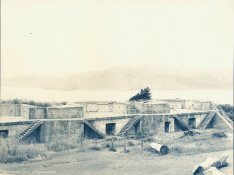
Coastal Defense

6330898222_cf91b75be0_z.jpg

Toyo 810G.

Thomas
 
I'd say maybe a little light, and the contrast seems a bit off to my eye, but it's really good for a first (?) try. Where is it? Doesn't look like any I've seen on the OR/WA coast.

--Greg
 
One of the challenges of mixing traditional and cyanotype prints is that cyanotype usually needs a longer scale negative. I get good punchy cyanotype prints from negs in the Dr of 1.5 to 1.8.

With cyanotype experiments and new papers or sensitizers or sizings I always print a 1/2" x4" 1/2 stop series step wedge. It actually is taped to the side of contact frame glass, so that it is there ready to go. Slide the neg to expose first time next to it, and slide it into the UV box.
 
I'd say maybe a little light, and the contrast seems a bit off to my eye, but it's really good for a first (?) try. Where is it? Doesn't look like any I've seen on the OR/WA coast.
--Greg

Thanks Greg. It’s Battery Cranston constructed in 1897 to guard the entrance to the Golden Gate and can be found a hundred or so meters behind the Golden Gate Bridge on the ocean facing side. I shot the image a couple of months ago on an overcast and foggy day. Fog covers the top of the image down to and including the top of the Marin Headlands visible across the bay in the distance. This was my 2d try (the first is posted below) exposed immediately after the 1st below. I had to crop a small portion off the bottom due to a registration snafu. I awaiting a 11x14 contact frame as my 8x10 frame is perfect for 4x5 but too small for 8x10.

Thomas

One of the challenges of mixing traditional and cyanotype prints is that cyanotype usually needs a longer scale negative. I get good punchy cyanotype prints from negs in the Dr of 1.5 to 1.8.

With cyanotype experiments and new papers or sensitizers or sizings I always print a 1/2" x4" 1/2 stop series step wedge. It actually is taped to the side of contact frame glass, so that it is there ready to go. Slide the neg to expose first time next to it, and slide it into the UV box.

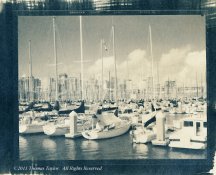
Thanks Mike. A step wedge is on my wish list. I placed a AA battery on the top left of the frame of the image below (the small circle). After about 30 minutes in the sun there was no change in the blue color so I assumed it had enough exposure. I had to tilt the framed for the 2d image and therefore couldn't use the battery but exposed it for 30 minutes as well.

6330141357_3c19554c49_z.jpg

Thomas
 
Man...I guess I have carbon on the brain...I was seeing dichromate, and I thought those were carbon prints. Now that you explain the taking conditions, the first image makes a lot more sense. Like the second one, too.

This is traditional cyanotype? The results look quite dark, and slightly green. Maybe just a camera/scanner/monitor thing?

I really should get back to cyanotypes...

--Greg
 
It may or may not be a significant factor in this case, but generally speaking if you substitute an ammonium ion in place of a sodium ion it will shift the acid/base properties of the solution toward the acidic side. The reason is that the ammonium ion (NH4+) is the "conjugate acid" of the weak base, ammonia (NH3). Therefore, the ammonium ion is slightly acidic, whereas sodium ion has almost no effect on the acid/base properties of a solution.
 
Photrio.com contains affiliate links to products. We may receive a commission for purchases made through these links.
To read our full affiliate disclosure statement please click Here.

PHOTRIO PARTNERS EQUALLY FUNDING OUR COMMUNITY:



Ilford ADOX Freestyle Photographic Stearman Press Weldon Color Lab Blue Moon Camera & Machine
Top Bottom