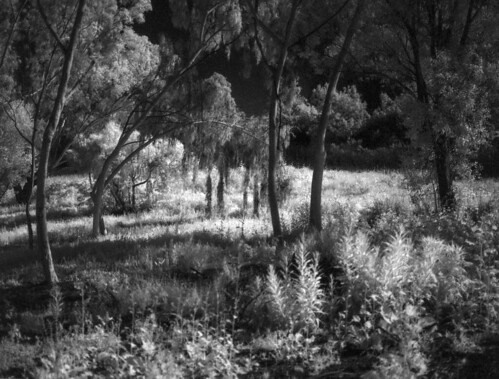
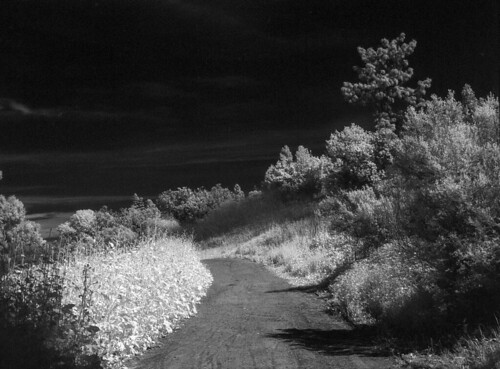
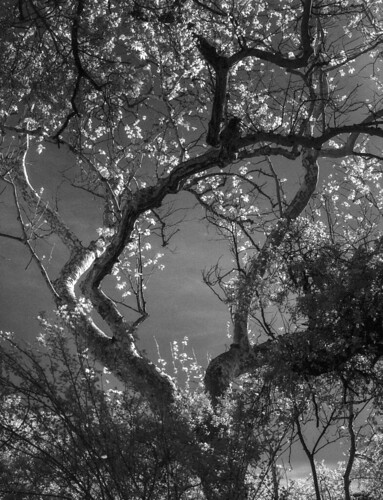
Gary - the 1:50 dilution is working reasonably well for you. Being in the northern hemisphere, our IR sunlight is still not as fierce.
A 740nm cut off filter is inherently going to lead to a more contrasty image, compared to a 715nm cut off filter or a B+W 092 type. A Red 29 is easier to use if uncertain, since there will always be some image density formed below the cut off wavelength, reducing the contrast - as you've realised, Konica Infrared is expressive for infrared, even with lower near infrared cut off wavelengths. Classically, the film responded with mild infrared characteristics even with orange filtration.
If you wished to go to the more diluted end, exposing the base ISO at 1 stop slower than Konica's recommendation for sunny f11 conditions, then Rodinal 1:70 dilution at 21C for 8 minutes works, if your film expired in the 2004 end date range. The contrast is tamed by shooting below ISO16 instead of the nominal ISO32 in conjunction with diluting the developer further.
The semi-stand principle is probably fine - since the reduced agitation principle is important as an element in reducing the contrast control further - although do examine your negatives for uneven edge effects. The easiest way to surmount this challenge, is to use a larger volume of working diluted solution, beyond 360ml for a 1x35mm roll, or 500ml for a 120 roll, and agitating only by an alternating encircling and gentle piston method twice during the development time after the first minute.
When 1:100 dilutions of Rodinal are used, the problem of base fog expression becomes too great to control the highlight densities, as a result of the longer times. A little odd as a ratio, although 1:70 dilution works very well; for 5x rolls of 120, this works out as 35mm neat Rodinal [Original - not R09] in 2,500ml water.
Kind regards,
RJ