
• Welcome to Photrio!
    Registration is fast and free. Join today to unlock search, see fewer ads, and access all forum features.
    Click here to sign up

Square or Rect. Frame?

Somewhere...

D
Somewhere...

  • 1
  • 1
  • 17
Iriana

H
Iriana

  • 5
  • 1
  • 76

Forum statistics

Threads
202,734
Messages
2,844,819
Members
101,491
Latest member
imperio galardi
Recent bookmarks
0

bvy

Member
Allowing Ads
Joined
Jul 22, 2009
Messages
3,280
Location
Pittsburgh
Format
Multi Format
I'm trying to frame an image for an upcoming juried show. It's a square frame from my Holga, and I was planning to make a 12x12 C print. I've "staged" several options using American Frame's online tool, but nothing looks quite right. I tried a 16x16 square frame, but it looks just too square (if that makes sense). I thought that offsetting it to the top of a rectangular frame (say 16x20) might work better, but now I'm not so sure. Should I center it vertically in a 16x20 frame? I know this is subjective, but maybe hearing what other people prefer for square images would help. The requirements are a black metal or wood frame, and a white, off-white or black mat without ridiculously large borders.

Here's the image:
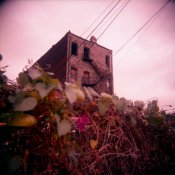
0133-12.jpg

Thanks in advance.
 
This is a square picture and should be framed as such, with about a 20% white border.
 
When I've done this, on the vertically oriented 16x20 mat: let the left, right and top borders around the image be equal, leaving extra mat space below the image. But I see the advantage of just going with the square frame. Some might say all the extra space on the 16x20 mat is pretentious...
 
Last edited by a moderator:
I frame 10.5 inch squares (11x11 nominal) in a vertical 16x20 frame "optically centered." But looking at that for 12x12, optically centered or not, I find the sides too narrow. I would probably use an 18x20 or 18 x 22 frame.

Russel Cottrell has a page about the topic with an interactive display. He's updated it since I last saw it, and the final frame drawing seems a bit weird (breaks in the corners), but the basics work. Vertical centering tends to make the top border seem top heavy. Top and sides equal can make the bottom border overly heavy, depending on the specific dimensions. Optical centering places the print just slightly above the vertical center to place a bit of weight on the bottom. I have framed a couple of my shots square, but prefer the vertical rectangle.

(there was a url link here which no longer exists)
 
Last edited by a moderator:
First, I think a 12" wide print is too big for a 16" wide frame. Counting overlap, you're looking at 2.25" borders. If it was me, I'd reduce the print size slightly and aim for a 3" border.

As to the shape of the frame, I prefer the optical center approach aesthetically. But I think that a square frame sometimes stands out in a display.
 
For decades Hasselblad advertized that square was the perfect shape for a photograph or print. Who are we to argue with Hasselblad?
 
Normally I would recommend a 20x24 frame, vertical, probably 4 to 5 inches of mat on the top. Nice and formal, plenty of breathing space for the image. But the image is not very 'formal', being a Holga image. So this is one of the rare instances I would say a sq mat would be okay...maybe 18x18. To each their own, of course!
 
I have mounted square images in both square and rectangular frames. I like the rectangular better most of the time. For the rectanglar frames I leave a lot more border below than above the image. My wife is a printmaker and does my matting and framing for me and she has told be that is how I like it for enough years that I know do believe that is how I like it best :smile:
 
I always crop or not crop on the basis of the subject regardless of the actual negative shape.

For centuries artists have used the golden ratio to determine the most pleasant shape for a picture. I have seen very few pictures/paintings that work for me as a square. Even the ancient Greeks knew this when they designed the acropolis.
 
Last edited by a moderator:
I'm trying to frame an image for an upcoming juried show. It's a square frame from my Holga, and I was planning to make a 12x12 C print. I've "staged" several options using American Frame's online tool, but nothing looks quite right. I tried a 16x16 square frame, but it looks just too square (if that makes sense). I thought that offsetting it to the top of a rectangular frame (say 16x20) might work better, but now I'm not so sure. Should I center it vertically in a 16x20 frame? I know this is subjective, but maybe hearing what other people prefer for square images would help. The requirements are a black metal or wood frame, and a white, off-white or black mat without ridiculously large borders.

If, as you've indicated, you haven't printed it yet, you might consider cropping it to a less square aspect ratio. In that respect, a more favorable composition might include getting rid of the bottom 20% of the picture, while keeping your "holga vignetting" at the top, for a 4:5. That would solve your problem, allowing it to repose more naturally in a classic landscape orientation for framing.

I do indeed agree with your sentiments about "too square". The show requirement that matting be conservative is telling, in an Eggleston kind of way, and from my perspective that sort of huge frame / small picture style certainly does take the edge off the square. I so rarely come across compositions that absolutely favor equal dimensions, that when I do, I will force them to other aspect ratios as a pragmatic presentation choice (see Cropping a Negative). It's your canvas, your art, your choice.
 
If you need a jury to tell you if your work is good, then for you all is lost.
 
If you need a jury to tell you if your work is good, then for you all is lost.
Some people want to get their work viewed by the public. To do so, more often than not, they'll need to be juried. They jury not to be told that their work is good, but to have an opportunity to exhibit it.
Jury requirements can vary. It's best to inquire with the specific competition for their jury requirements.
 
Love the square -- take a different visual language than rectangles (as do panoramic formats). Some folks prefer not to learn another language.
 
Some folks prefer not to learn another language.

If you are trying to communicate with your audience another language may not be the best choice.
 
If you are trying to communicate with your audience another language may not be the best choice.

The majority of people are fluent in no visual language. I have always had a strong educational element to my work and life. How can ya learn 'em if you don't show 'em?!

Guess we have stretched that analogy to its breaking point...
 
Last edited by a moderator:
Love the square -- take a different visual language than rectangles (as do panoramic formats). Some folks prefer not to learn another language.

Vaughn be nice, some people are not able to learn another language. :laugh:
 
Humm, I often like square format images but I crop my 6x6 to rectangles or leave square depending in the image. I've always had my square images mounted, matted and (only one so far) framed square. The idea of putting a square image in a rectangular frame honestly never occurred to me. I'll have to think about that one and look at some examples.

For some images the square works perfectly. It can also just depend on the visual elements present. It seems to me that good composition is often about being able to frame a pleasing image while excluding distractions and visual irrelevancies. So it just depends on the scene. I happily crop to suit and don't expect the world to always match the image shape of the camera I'm using.


Sent from my iPhone using Tapatalk
 
Generally when one shoots in a rectangular format the composition fits the rectangular format.
Generally when one shoots in a square format the composition fits the square format.
The OP's photograph was composed for a square format and therefore will usually be best presented in a square format unless something needs to be cropped out.

Formulaic proportions are one size fits all solutions and therefore rarely fit any solution. Hence always changing a square composition to a rectangular one or a rectangular composition to a square one as a standard approach is more of a lack of understanding composition or total lack of imagination and original thought.
 
Photrio.com contains affiliate links to products. We may receive a commission for purchases made through these links.
To read our full affiliate disclosure statement please click Here.

PHOTRIO PARTNERS EQUALLY FUNDING OUR COMMUNITY:


Ilford ADOX Freestyle Photographic Stearman Press Weldon Color Lab Blue Moon Camera & Machine
Top Bottom
