
Split-grade printing & the dry down effect
This is a fairly unthought through thought, but I throw it open to the denizens of printing for any feedback/repudiation/thoughts etc - all welcome, even negative concerns!
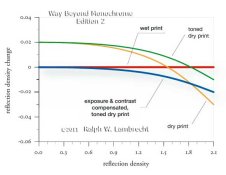
Accepting that dry-down does occur (fibre paper) and that it seems to mainly be evident (or most evidient) in the lighter tones of a print. When the value is applied to all the exposure this leads to a lightening of the dark tones, due to the reduced exposure - which can be brought back by selenium toning or adding contrast to the print over & above the test print indication.
If the dry-down value is applied to the soft grade 0 print exposure to account for the visible dry-down darkening, yet no dry-down value is applied to the hard grade 5 print exposure - might this retain the contrast/depth of black on a final print that was indicated on the test print?
Probably not very well explained, wil try to clarify if required but any thoughts on this as a viable printing process?
Sim2.
*thinking*
This is a fairly unthought through thought, but I throw it open to the denizens of printing for any feedback/repudiation/thoughts etc - all welcome, even negative concerns!
Accepting that dry-down does occur (fibre paper) and that it seems to mainly be evident (or most evidient) in the lighter tones of a print. When the value is applied to all the exposure this leads to a lightening of the dark tones, due to the reduced exposure - which can be brought back by selenium toning or adding contrast to the print over & above the test print indication.
If the dry-down value is applied to the soft grade 0 print exposure to account for the visible dry-down darkening, yet no dry-down value is applied to the hard grade 5 print exposure - might this retain the contrast/depth of black on a final print that was indicated on the test print?
Probably not very well explained, wil try to clarify if required but any thoughts on this as a viable printing process?
Sim2.
*thinking*