Practically any method of film speed determination, if it is meticulously followed, will be sufficient for comparing relative film speeds. Its a completely different matter if you want to produce precise and accurate speeds. Throughout photographic history film speed determination has changed both in method and concept. Attached is a paper, Emulsion Speed Rating Systems that has a nice historic over view of monochrome speeds.
Today, there remain two camps. In their purest forms there are the popular amateur method of in camera testing such as the Zone System method, and the sensitometric method of the ISO standard. Obviously, the more scientific ISO standard has to be considered the standard from which to compare, but few people have the equipment capable of adhering to it. This begs the question whether it is even possible using what is available on a commercial level to achieve anything close enough to actual speeds to even make speed testing worthwhile? Now, film speed, EI, and exposure are not the same thing.
Lets look at some of the technical issues and assumptions that should be considered.
Concepts and Assumptions
Film speed is determined by the exposure required to produce a point of density on the film curve that is then divided into a constant. The use of a constant means that the actual point of density or exposure value isnt intrinsically important in and of itself. One consideration for the determination of a specific aim point of density is for it to be an easily found point (ever wonder why 0.10 just happens to be such a round number and in logarithmic thirds?). But more importantly it has to have a relationship with the important defining aspects of the material and how they relate to the averaged meter exposure. With black and white film, its the shadow. With transparency film, its the mid-point.
What is the assumption of the shadow exposure? All film speeds are based on the statistically average set of conditions. Basically, its Sunny 16 and a 7 1/3 stop luminance range. As the film speed has to relate to the exposure meter and its placement of the exposure, its necessary to first know what that is and its relationship to the speed point and shadow placement (which arent necessarily the same thing). The exposure meter will want to make a midtone exposure of 8 / ISO. The constant used in the B&W film speed equation is 0.8. You can calculate the value of the exposure require for a given film speed as 0.8 / ISO.
As you can see the difference between the metered exposure and the exposure at the speed point is 10x or 1.0 log-H. Thats 3 1/3 stops. The highlight falls just a hair over 3 stops above the metered exposure. That only comes to 6 1/3 stops which leaves an extra stop left over. That stop goes on the shadow side. While the speed point falls 3 1/3 stops below the meter exposure, the average shadow falls 4 1/3 stop. Why are they not the same.
Two reasons. The density of 0.10 is only a point of reference. Under the processing parameters stated in the film standard, speed point of 0.10 falls almost exactly one stop above the minimal point of exposure that will produce a quality print. This point is known as the first excellent print point. From the standpoint of quality, its important to know where the minimum is and by defining the absolute minimum point you know where base is to work from. The actually density isnt important as density was found not to be the determining factor in the perception of image quality but the gradient of the shadow area was. This point is the minimum useful gradient and is part of the Fractional Gradient Method which is described in the attached paper. The minimum gradient as defined in the Fractional Gradient Method has been found to be the best method of film speed determination because it produces a highest rate of quality images over the greatest range of film types.
The second reason is that while film testing is done using a flare free method, flare exists with the use of a camera. Average flare is around 1 stop to 1 1/3 stops. Flare effectively increases the exposure to the shadows by at least one stop, effectively making the film one stop faster than it would be with out flare. Flare brings the shadow exposure from the 4 1/3 stops down from the metered exposure to 3 1/3 stops which brings it up around the 0.10 density point. Flare also gives a one stop safety factor not only with errors in the camera exposure, but it guarantees that even under low flare conditions, the exposure wouldnt drop down below the minimum gradient point.
Technical issues
To be able to accurately determine the film speed, you need to know the actual value of the exposure and thats not easy. The only way is to use a sensitometer and even then there are issues as to the best type (I once had a loud disagreement with a low level tech at Kodak because I was using an intermittent sensitometer and he refused to accept the results). A sensitometer has a known repeatable exposure. Film speed can be calculated from that.
Testing with a camera has a number of issues. The f/stop is a mathematical value and do not take into account light loss due to absorption and reflection of the lens elements. True stops or T/stops are determined using an optical bench. Its standard for motion picture lenses to be calibrated for T/stops not so much for accuracy but for consistency between shots. Shutter speeds can vary between the setting as well as between different shutter types. In Zone System testing, one approach is to use a single shutter speed and then make a series of exposures changing the f/stop at 1/3 stop increments . How accurate can that those increments be as most 35mm and many medium format cameras dont have 1/3 stop indications? Even if they do, how precise are they or can the operator be?
According to Zone System testing, Zone I is four stops down from Zone V. As meters dont see in percentages, Im not going to claim the meter sees 18% or any percentage. We know the meter wants to make an exposure on the film plane of 8 / ISO. We know the statistically average scene falls 4 1/3 stops and not 4 stops below the metered exposure or in this instance Zone V. The 1/3 stop difference already makes it difficult to be able to compare film speeds resulting from Zone System testing and ISO speeds. I tend to believe the scientifically derived 4 1/3 stops is a more accurate figure. Then theres the added problem of the speed point being only 3 1/3 stops below the metered exposure while Zone I being both where the shadow falls and the speed point is 4 stops. Thats a 2/3 stop discrepancy. The potential inaccuracies of f/stops, stop increments, shutter speeds, and a few other variables gives most Zone System practitioners speed results that generally vary between ½ to 1 stop below ISO speeds. Lets not forget also that in 1960 film speeds changed. They increased a full stop. This was basically the result of reducing the safety factor by changing the constant which the exposure value is divided into. While ASA / ISO film speeds changed because of a change in methodology, Zone System methodology didnt change and neither did the speeds that result from its testing methods. So you really cant compare the speeds obtained from the Zone System / in camera method and the sensitometric / ISO method. And if you consider the above concept of speed as having a known relationship with the minimum useful point and the metered exposure, then you cant consider the in camera method as a way to determine true film speed. Its more a way to find a workable EI for exposure determination.
Isn't flare automatically incorporated into Zone System testing as it uses an optical whereas the ISO method contacts the film and has to factor in the flare? Not really. While an in camera test does have an optical system, there is minimum flare from this kind of test. Most flare comes from the subject and is dependent on the range of the subject. The longer the range, the higher the flare. In camera tests shoot a card with a single tone. It's as short of a range one can possibly get. In addition, even under average flare conditions, little flare reaches the metered exposure point, Zone V. With a single toned subject, such a test can be considered practically flare free.
While the in camera test can give a working EI for the conditions of the exposure system being used, it doesnt produce an accurate film speed or in even reliable repeatability.
What about the method of contacting a step tablet under an enlarger? The range of the steps in a step tablet are known but there is always variation in any system. The actual differences in each step of density can vary slightly. In order to be able to accurately determine the exposure, the actual density of each step must be known. Most consumer densitometers are only accurate to a +- 0.01 or 0.02. This can make a difference when calculating film speed especially if the speed falls around the break point of two different speed ratings. This error can be compounded when you consider its not only about the readings from the step tablet but the readings from the film test made from the step table. One way to minimize this is to purchase a calibrated step tablet (if they still make them).
Still, the biggest problem has to do with not being able to measure accurately measure the incident light from the enlarger. Exposure meters arent designed to be precise enough for the job and the enlarger bulb or timer don't produce dependably repeatable results. The best you can get from this method are relative speeds.
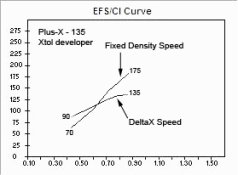
Even if its possible to get a hold of a sensitometer with a know exposure value, theres one more thing to consider when determining film speed. The ISO standard has a set of contrast conditions the film most have before speed can be determined. The reason for this parameter is frequently misinterpreted. Its incorporation into the standard is that under those parameters a density difference of 0.80 over 0.10 over Fb+f with a log-H range of 1.30, there is a known relationship between 0.10 over Fb+f and the minimum gradient point which is where the most accurate speed is calculated from (the original Fractional Gradient Method). That means if film speed is calculated at any contrast other than what is in the ISO standard, there no longer exists the relationship between the two methods resulting in a film speed that isnt accurate. And even if you properly calculate the film speed under the ISO conditions, continuing to calculating film speed using the density of 0.10 simply isnt accurate for extended and contracted development. So while the film speed for normal is accurate, the film speeds for every other contrast isnt. You have to use a different method to calculate speeds for extended or contracted development. For that you have to resort back to using the Fractional Gradient Methodology or a modified version of it called the Delta-X Criterion Method (or a method called the w-speed method).
While none of this means you cant get good exposures using any method you want, as that is about exposure and exposure index and not film speed, these are some of the things to consider when pondering how confident you are with the results from your recent film test.