
• Welcome to Photrio!
    Registration is fast and free. Join today to unlock search, see fewer ads, and access all forum features.
    Click here to sign up

Some thoughts on the use and management of salts in making Silver Halides.

Temporary Jewels

H
Temporary Jewels

  • 1
  • 0
  • 49
Horicon Marsh-5

A
Horicon Marsh-5

  • 2
  • 0
  • 107

Recent Classifieds

Forum statistics

Threads
201,260
Messages
2,821,371
Members
100,624
Latest member
ericstoynov
Recent bookmarks
1

Photo Engineer

Subscriber
Allowing Ads
Joined
Apr 19, 2005
Messages
29,018
Location
Rochester, NY
Format
Multi Format
In the early days of chemistry, “researchers” used all manner of things to create a name for themselves. An example is the early isolation of the element Phosphorous which was first prepared by the distillation of decomposed horse urine from a bed of sand. Well, it works notwithstanding the probable odor and mess not to mention the difficulty of obtaining the sample. So, great effort was expended for expected great reward.

The same is true of the early days of photographic emulsion making where any and all chemicals were used in hopes that the experimenter would have that “ah hah” moment and discover something great. And, if they failed to produce anything significant, well they could still write a paper or book about their “super dooper” method of emulsion making. Some were good and some were bad. Here are some thoughts on the matter.

1. Potassium vs Sodium salts.

I saw both used at EK with no rhyme nor reason. I saw no real logic so I went to the best emulsion maker that I knew, and who was at the peak of his career. If you went any higher you might suffer nosebleed. Anyhow, I asked him which was better and why. His answer was that there was no best. Each gave a slightly different result, but there was no best and no easy way to predict what might happen if one used one salt over the other. In fact, he pointed out that most formulas originating in Europe (Kodak Harrow and Kodak Chalon) used Potassium salts and most from the US used Sodium salts. His reasoning was thus: Na salts are easier to get here in the US and are less expensive but the opposite is true in Europe. IDK if this is true and I never followed up, but after that I did see the trend of formulas from Europe did indeed use K salts more than Na salts. And, I also came to realize that there was no real way to predict what one would give compared to another, and what changes would be needed to convert from one salt to another. The bottom line here is use what you prefer, have the most of, what costs less or whatever, but stay consistent.

2. Lead, Cadmium and Mercury salts

These salts were used in many early warm tone emulsion formulas, but what goes in must come out. This means in the wash or in the process. Cadmium was the biggest offender being used anywhere from 100 mg per mole of Silver up to about 18 GRAMS / mole of silver. Cadmium and Lead have been history since about 1970, but Mercury (as a very toxic Methiodide salt) is still in use in some cases, but at very very low concentrations. It is now used as a keeping agent more than anything.

3. Ammonium salts

It had been known for years that Ammonium hydroxide dissolved Silver Nitrate to form a complex soluble material. I had been used for years in making emulsions up to the ‘60s when better methods were put into play. You see, this method causes fog and the effect varies with pH which varies with concentration and also during the pptn, As the Silver is precipitated, Ammonia is released and pH goes up. If it goes up too much or too fast, then fog forms. The clear advantage is that you can form uniform rounded cubic crystals which is nice. You also form a lot of fog which is bad and must be avoided by some means such as time, temperature or the use of antifoggants.

Now, some propose that Ammonium Halide salts be used, but with them, pH goes down with time during pptn. Since you are already slightly acidic, and pH goes down a bit, what you see is a decrease in the effect of Ammonia as the pptn proceeds. Well, in this case it was never very large anyhow. So, over my time at EK, I never saw a practical emulsion that used Ammonium Halides. Either Ammonium Hydrixide was used or better solvents or methods of handling the Ammonia were used. The trick, what you want, is to have the Ammonium ion present in a slightly alkaline medium and at a constant amount for the desired time. You will find this hard to do with Ammonium Halides.

4. Other positive ions

Almost every positive ion on the Periodic Chart has been used, via their halide salts or otherwise, for making Silver Halide emulsions. AFAIK, even after studying over 1000 emulsions over 15 years, only good old Na and K are still in there and still being used. All of the others have vanished due to lack of interest, cost or pollution not to mention lack of some overriding utility.

Finally, lets go back to the opening paragraphs of this post. When Phosphorous was first isolated as a pure element, the original worker considered himself a “scientist”. But, in view of today’s chemistry he was not. In a similar fashion, emulsion chemistry was published by what we might call “dabblers” in the proto science of photographic science. All of the texts up to that time were done with a less than scientific method when compared with today. And so, even with the publication of the Agfa formulas in the ‘40s, they were published as-is with no explanation or qualification. Since then, everything has been cloaked in secrecy and all books including Glafkides and Haist have been redacted or contain outright errors in the text.

I will pass this way only one time, and during that time, I have determined that I will publish modern and correct descriptions of the science of photographic engineering as far as I am able. I had much more information before I retired, but I returned that material to EK archives when I retired. I had stacks of data that were nearly overwhelming. They would have been useful today, so all I can present is a pale comparison compared to what exists.

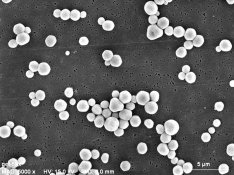
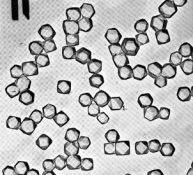
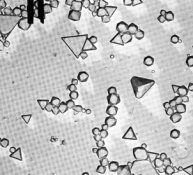
Attached is a set of electron micrographs that depict an SR (Single Run – Silver Nitrate into Halide salt + gelatin) emulsion (Na or K – not much difference) and an Ammonia digest using the Silver complex of Ammonia rather than NH4Br (Silver + NH4OH run into Halide salt + gelatin. The third electron micrograph is of a modern dual run emulsion in which salt and silver were run together. Note that the use of the Ammonia complex of Silver ion only approaches the quality of a dual run emulsion. Note also that an ammonium salt alone such as NH4B4 will only approach the SRAD (Ammonium complex) version very very slightly if at all!

Enjoy.

PE
 

Attachments

  • SR polydisperse K grains resized.jpg
    SR polydisperse K grains resized.jpg
    73.8 KB · Views: 178
  • Electron  micrograph - BrI SRAD.jpg
    Electron micrograph - BrI SRAD.jpg
    86.9 KB · Views: 179
  • Double run octahedra resized.jpg
    Double run octahedra resized.jpg
    80.5 KB · Views: 180

Tom1956

Member
Allowing Ads
Joined
May 6, 2013
Messages
1,989
Location
US
Format
Large Format
A curiosity question: Picturing in mind's eye a batch-run of 35mm Plus-X as an example, I would suppose the emulsion, (if only a single-layer is done); is mixed up in a vat or vats and brought up to the coating machine and hooked up to the feed inlet. Then it begins coating what was previously a cleaned-up and empty machine (fountains, rollers, and drums, whatever). Then at some point the base begins its feed, and the run is on, as long as the run was planned for. Not knowing how many shifts a run might last, at some point the run is over and the machine is washed-up. The whole process could be, or must be not unlike an offset web press, in my imagination. In the event that I do have a reasonable grasp on how film is made, comes my question: In such a run, about how many pounds of actual pure Ag went in to that batch run? And how much in grams or ounce fractions of Ag would there be in a 36 exp. roll?
 
OP
OP
Photo Engineer

Photo Engineer

Subscriber
Allowing Ads
Joined
Apr 19, 2005
Messages
29,018
Location
Rochester, NY
Format
Multi Format
Tom;

Sorry to say this, but your fundamental concept is a bit off. The machine is already threaded with about 1 mile or more of film support (that is 72" x 5000 ft at Kodak Park). The hopper is running with the many layers of the film substituted by water at the coating temp. The emulsions, overcoats, undercoats and all begin feeding and a stable bead is established in the light and then they go dark. Meanwhile the coating machine (support) and the feed pumps are ramping up to operational speed and then they go dark and run until that job is finished.

A typical kettle can contain from 10L (Research) to 50 - 100L for prototyping up to 1000L for some applications.

Silver in most films run about 3 grams per square meter or more. That is a very rough approximation.

The coating machine is left threaded with film after the job. Rethreading a mile of film support is a job you do not want! :wink: Never let the machine run out!

PE
 

NedL

Subscriber
Allowing Ads
Joined
Aug 23, 2012
Messages
3,409
Location
Sonoma County, California
Format
Multi Format
So, when I put some Tri-X into my camera it is coming from a process like this? That boggles the mind! Just think of the production scale necessary for developing such a thing to be feasible! Not to mention the films and emulsions. I have a strange sense of "retroactive luck"... I'm glad film had such a golden age so that we can still benefit from all that was gained. I'm over 50 years old so I lived through some of it, but I don't think it was commonly appreciated. ( I know the product was appreciated.. I mean what was behind developing and making that product. )
 

Tom1956

Member
Allowing Ads
Joined
May 6, 2013
Messages
1,989
Location
US
Format
Large Format
I realize computer technology is nothing to sneeze at, or belittle. I concede it does indeed take some fine minds and collaborative efforts in that field. That said, I simply do not have the awe or respect for Apple or Microsoft, et al; as I do for companies like Kodak, DuPont, and the likes of them. Probably never will.
 

dwross

Member
Allowing Ads
Joined
Feb 13, 2004
Messages
1,263
Location
Oregon Coast
Format
Multi Format
Ron,

Thanks for the meaty post. Fun!

To paraphrase a movie I watched WAY too many times when my son was young: I do not think you are as old as you think you are. Little surprise that EK wasn't using ammonium bromide when you were there. :smile:

A couple of times recently you have alluded to ammoniacal emulsions being obsolete technology. I've never run into that tidbit anywhere else, so I assume it is one of those proprietary things (??) Another silver solvent? I don't read much beyond the mid-70's. After that date, the literature becomes pretty much meaningless for the home darkroom, so I can easily believe I've just missed the "breaking news". Anyway, would love to hear all about it.

For the micrographs of crystals you've posted, what are the indicators of "quality"? I see differences in crystal structure. Is there something else? The third image is very uniformly octahedra. That's cool, but a little boring. Is this likely an emulsion that is intended to be used with other, different-structured emulsions in a final, multi-layer (or blended) product?

In point #1, I'm guessing you mean Na and K chlorides, as for, in general, paper emulsions (??). Are there many NaBr negative emulsions? Also, in point #4, most regular readers of this forum know you mean the halides used for the bulk of the precipitation, but don't forget iodide on your list of "survivors."
 

Mustafa Umut Sarac

Member
Allowing Ads
Joined
Oct 29, 2006
Messages
4,866
Location
İstanbul
Format
35mm
Potassium and Sodium salts in optics have long story. When the Europe accepted the Christianity , they wanted to make churches and decorate with glass panes. Constantine was the first Roman Emperor who accepted the Christianity for Roman Empire and than he came to Istanbul and built East Roman Empire than the Byzantine Empire. At AD 573 , Byzantians built Hagia Sophia - the biggest building in the world for coming 1000 years - and decorated the walls with Gold leafed , Red , Green and Blue mosaics. The secret of Byzantine mosaics and their long life for the coming 1500 years was potassium salts were produced by Istanbul sea weed catched from Bosphorus. There is only one place you can find that weed is Venice another glass capital. Potassium salts lowers the melting point of glass batch and protects the glass from elements for a long time.

At that time Europe was using sodium salts to lower the melting temperature of glass batch and sodium harmed the glass and all european church glasses start to deteoriates.

Until mid ages , they could not solve the problem and source of potassium. Later they discovered if you burn some mid european alges and put the burned ashes to the glass , they are the potassium source.

Sourcing potassium was a battle for Europe for 1000 years until the mid ages.

Umut
 

Prof_Pixel

Member
Allowing Ads
Joined
Feb 17, 2012
Messages
1,917
Location
Penfield, NY
Format
35mm
In point #1, I'm guessing you mean Na and K chlorides, as for, in general, paper emulsions (??). Are there many NaBr negative emulsions? Also, in point #4, most regular readers of this forum know you mean the halides used for the bulk of the precipitation, but don't forget iodide on your list of "survivors."


Since his opening sentence says "salts in making Silver Halides" - it would seem to me that he was NOT limiting his comment to chlorides, but halides in general.
 
OP
OP
Photo Engineer

Photo Engineer

Subscriber
Allowing Ads
Joined
Apr 19, 2005
Messages
29,018
Location
Rochester, NY
Format
Multi Format
Indeed, Fred is correct. I meant all Na and K halides to be included as possible examples. And, unlike glass making, the Na or K is not included in the crystal or molecule. In some cases, Cd, Sr, Hg and Pb are included in the crystal.

To continue with the halides though, there are NaBr and KBr halides used in emulsions aplenty out there as well as NaCl/Br and other mixtures. I even know of a make that uses NaCl, NaBr, and Methyl Mercuric Iodide to make a 90% Br, 9.9% Cl, 0.1% I emulsion. The Mercury is also there, retained in the crystal. AFAIK, this latter make was abandoned in about 1990 or thereabouts for a better method.

Now, as for the use of Ammonia. I have said that NH4 halides are restrictive and less effective than NH4OH. I've also said that the use of Ammonium Hydroxide also can cause fog. I've also said that it has been abandoned. Well, here s the modern way:

Kettle - Gelatin, Halide salt mix (Na or K salts). Feed lines are AgNO3 and Salt in 2 lines as needed.

Begin the run. When DIGESTION is to start, add the desired amount of (NH4)2SO4 (Ammonium Sulfate) and then add KOH or NaOH solution to get a pH of about 8. Digest as desired (your time and temp) and then add an equivalent of H2SO4 to bring the pH back to the starting point! NH4 Halides and Sulfate are so ineffective at the acid pH, that you effectively turn on and then turn off the ammonia digest along with any fog. This is not only the common modern method if Ammonia Digestion, it is controllable and illustrates how acid can turn off the digestion properties of the Ammonium ion.

I hope this answers those questions. BTW, the above Acid / Base cycle is about out of date now having given way to an even newer method that we really cannot use in our home labs very easily.

Science marches on.

PE
 

Hexavalent

Member
Allowing Ads
Joined
Nov 19, 2009
Messages
592
Location
Ottawa, Onta
Format
Multi Format
The coating machine is left threaded with film after the job. Rethreading a mile of film support is a job you do not want! :wink: Never let the machine run out!

PE

I can only imaging what a undertaking it would be to thread such a monster machine. I suppose the entire works has to be kept absolutely dust-free and temperature/humidity controlled. Does the coating machinery have some sort of "self-cleaning" apparatus?
 
OP
OP
Photo Engineer

Photo Engineer

Subscriber
Allowing Ads
Joined
Apr 19, 2005
Messages
29,018
Location
Rochester, NY
Format
Multi Format
Ian, you are correct except for the words "self cleaning". After a bad mess due to a poor coating formula, I worked until midnight with the coating crew and a large putty knife cleaning up the machine! :sad:

PE
 

dwross

Member
Allowing Ads
Joined
Feb 13, 2004
Messages
1,263
Location
Oregon Coast
Format
Multi Format
Ron,

As is often the case, you have raised more questions than you have answered, but I won’t nag :smile:.

I did learn that NaBr is more than a rarely used novelty. I did not know that. I’ve never seen a NaBr emulsion recipe. Obviously, I’m not implying that I am privy to all of the recipes that have ever been made. I’d rather contemplate the number of stars in the sky than try to guess how many variations on AgX have been run through the kettles!

I do have one observation. I believe you would contribute more to the knowledge that I know you want to share if you could be a little more careful with the shorthand and jargon. Back in the thread, ‘Ammonia or Ammonium salts in emulsion making’, you stated, “And, virtually none of the hundreds of emulsion that I worked with at Kodak used Ammonia in any form.” But, you have posted your Single Run Ammonia Digest recipe on APUG, and today, you are describing the use of ammonium sulfate. I find those juxtapositions confusing and I have a fairly good chemistry background. Just a thought, submitted with the greatest respect.
 
OP
OP
Photo Engineer

Photo Engineer

Subscriber
Allowing Ads
Joined
Apr 19, 2005
Messages
29,018
Location
Rochester, NY
Format
Multi Format
Denise, I have examined literally thousands of emulsions over my 15 years in Emulsion Research. Of those, very few used any form of Ammonia, and few used Digestion. You see, if you want a cube (Essential component of Ektar 100) you cannot digest as it rounds the corners and you no longer have cubes.

If you want a thin t-grain, use of an Ammonia digestion will change thickness or shape. In other words, very often Ammonia keeps you from getting from here to there. Ripening works (no solvent) but digestion is an impediment.

So, out of these thousands of emulsions, very few used Ammonia in any form. Then too, we had more recent methods of doing a digestion, which is far far beyond the scope of the work we might discuss here.

And so, as an easy way to make a fast, single run emulsion that is fairly monodispersed, I used the Ammonia digest that is in my book and posted (in part) here on APUG. It is subject to fog but has reached speeds of ISO 40 - 80, and I have made an ortho version of it.

We do not plan to do that at GEH, as the Ammonia fumes, even in trace amounts, can be detrimental to the rare objects preserved there. We are approaching the speed angle from a different POV.

As you will find, Ammonia digests of any sort without massive ventilation is quite daunting. However, my current and past comments are not mutually exclusive but merely reflect a broad range of possible emulsion types.

We had over 200 emulsion makers in our division (and WW). They averaged 1 emulsion per week. This is about 1000 / year and over 15 years is over 10,000. They all did not go into production, but just about every one passed through my hands or the hands of a member of my group at one time or another. I cannot generalize these easily, but can say that the use of any form of Ammonia was a rarity.

PE
 

Hexavalent

Member
Allowing Ads
Joined
Nov 19, 2009
Messages
592
Location
Ottawa, Onta
Format
Multi Format
Ah... so that was a method of "employee discipline" at EK?

Ian, you are correct except for the words "self cleaning". After a bad mess due to a poor coating formula, I worked until midnight with the coating crew and a large putty knife cleaning up the machine! :sad:

PE
 

Tom1956

Member
Allowing Ads
Joined
May 6, 2013
Messages
1,989
Location
US
Format
Large Format
Pondering the R&D, testing, production, and waste that must be involved, it occurs to me that there must have been a spliced areas in the film web that had to be discarded with emusion on them, beginnings and ends of run pieces discarded, along with leftover coating "syrup". And all the fil from laboratory test runs... on and on. I'd have to guess that there was a very high spoilage rate all told. And all this waste with silver, a precious metal, just going to waste. Kodak must have had a whole silver recovery department. I didn't even mention all the punched-out sprocket holes from 35mm film, all with silver emulsion on them. Come to think of it, did you EVER head of one "hanging chad" on a roll of 35mm film? I never did. I'll bet at one time, a 35mm film hole-punching machine must have spit out sprocket-hole confetti by the barrelful as fast as they counld hand-truck it away and bring up another bin. A lot of silver in all that.
 

Steve Smith

Member
Allowing Ads
Joined
May 3, 2006
Messages
9,110
Location
Ryde, Isle o
Format
Medium Format
I realize computer technology is nothing to sneeze at, or belittle. I concede it does indeed take some fine minds and collaborative efforts in that field. That said, I simply do not have the awe or respect for Apple or Microsoft, et al; as I do for companies like Kodak, DuPont, and the likes of them. Probably never will.

I work as an electronic engineer (but seem to do more mechanical engineering now) and I am always more impressed with the ingenuity shown in clever mechanical solutions to problems compared with electronic solutions.

An example of this is the Compur type of shutter. Look inside and you will see a quite complex mechanism which was designed to fit in a small space and was drawn up without the aid of computer modeling or CAD. There was not much margin for error as each part would need tooling to make it so it had to be close to right first time.

Compare this to an electronic timer controlling a servo to open and close the shutter - a trained monkey could design that!


Steve.
 

Rafal Lukawiecki

Member
Allowing Ads
Joined
Feb 23, 2006
Messages
789
Location
Wicklow, Ireland
Format
Multi Format
just imaginhow hard and costly itwill be to get all this knowledge and technology back once it is gone. the effort of reentry into a 'lost' technology is gigsntic. 'too bad' just doesn't cut it anymore.

That's the gist of what I heard Neil Armstrong say about the technology and the know-how of going to the Moon. He remarked, a few years ago only, that we have lost that ability.

Preserving knowledge, especially that which is unwritten, or is passed on as experience, or remains locked up in corporate drawers to be forgotten lest be shared, seems much more important than society cares for. Many thanks to Ron, and others, for sharing it, and the Ralphs of this world for neatly tabulating it in hugely informative books. Hats off to you.
 

kb3lms

Member
Allowing Ads
Joined
Jun 24, 2006
Messages
1,004
Location
Reading, PA
Format
35mm
Ah... so that was a method of "employee discipline" at EK?

As an aside, there is an electrical engineer that I know that once worked at an Australian colliery on a belt system that moves 24 tons of coal per minute. There was a bug in the software that caused one section of belt to stop dead while the previous section kept running. Due to the mass of the coal it takes the belt a while to stop.

The miners handed the engineer a shovel and went home.
 

kb3lms

Member
Allowing Ads
Joined
Jun 24, 2006
Messages
1,004
Location
Reading, PA
Format
35mm
Ron, this is very interesting. Thank you for your posting.

We once exchanged some messages about using Ammonium Thiocyanate as a solvent in a double run emusion. I had found it in a Kodak patent from 1967. Is that method used at all for production purposes?

-- Jason
 
OP
OP
Photo Engineer

Photo Engineer

Subscriber
Allowing Ads
Joined
Apr 19, 2005
Messages
29,018
Location
Rochester, NY
Format
Multi Format
Jason, NH4SCN is used as both a solvent and as a source of Sulfur in sensitization. It rather depends on level and time of addition to get the desired effect. The problem is that SCN is hard to shut off if used as a solvent and so you can over Digest the emulsion leading to fog.

In some cases, it is (or was) removed by Ultrafiltration which is rather messy for home darkrooms.

PE
 

kb3lms

Member
Allowing Ads
Joined
Jun 24, 2006
Messages
1,004
Location
Reading, PA
Format
35mm
So, a door is opened to a new mystery. :D Good!

Time to check understanding:

Everything I have made so far has used a full ammonia digest, meaning all the silver has been converted with ammonia before precipitation. (Precipitation being the combining of the silver with the halide to create, for example, silver bromide.) But from my reading and studying, it seems ammonia digest is NOT the way forward to "better" emulsions. (In my case better means more speed with good contrast. I can get to ISO 50, but I want to get ISO 100 give or take a few "isos".) Everything written so far in all these postings seems to confirm that.

What I gather, then, from this and other postings and books is that a solvent is not actually necessary. And many, or most, emulsions are made without a solvent.

Ammonia can be used to "homogenize" the crystal types and get you a good (better?) but not ideal dispersion. (Dispersion in this case meaning distribution of sizes and crystal types) The longer the solvent is active, the narrower the range of sizes you get (because the ammonia dissolved the smaller ones and they attach to or form larger crystals) which makes the emulsion more monodisperse, which increases contrast. And you might get a speed increase because you get larger crystals. If you keep this going long enough you get fog.

But the crystals all become rounded and eventually you wind up with round pebble grains, or klunkers I think you once called them PE. So you would lose any advantage of making cubes, octahedra or t-grains because the ammonia solvent would round them all down to pebbles. So, basically, using ammonia you lose the possibility of controlling crystal habit.

To summarize, an ammonia solvent makes it easier to get a decently working emulsion but not something you'd actually use in production work. It's a short-cut, but you give up control to get there.

Am I on the right track?
 
OP
OP
Photo Engineer

Photo Engineer

Subscriber
Allowing Ads
Joined
Apr 19, 2005
Messages
29,018
Location
Rochester, NY
Format
Multi Format
Jason, a true Ammonia digest had been used for years in making high speed (ISO 100 or thereabouts) emulsions but that is not done currently. The reasons are fog, non-uniformity from batch to batch and the odor. Today, the same (or similar) results are obtained with double run emulsions.

Now, while DR is important, don't dismiss the Ammonia digest. It will work for you and at less cost (but more odor). The only Ammonia make that I don't use and don't recommend is one using NH4X (Ammonium Halide salts) as they have many additional problems and do not work as well.

I will say that the straight lines and long curves of modern high speed films are obtained by DR makes with vAg control, but then again, a lot of speed comes from the Sulfur+Gold sensitization as well. Without that latter step, you have nothing much.

PE
 
Photrio.com contains affiliate links to products. We may receive a commission for purchases made through these links.
To read our full affiliate disclosure statement please click Here.

PHOTRIO PARTNERS EQUALLY FUNDING OUR COMMUNITY:


Ilford ADOX Freestyle Photographic Stearman Press Weldon Color Lab Blue Moon Camera & Machine
Top Bottom