

• Welcome to Photrio!
    Registration is fast and free. Join today to unlock search, see fewer ads, and access all forum features.
    Click here to sign up

Some history regarding Sakura/Konica films and developers I found interesting and translated

Recent Classifieds

Forum statistics

Threads
201,664
Messages
2,828,193
Members
100,879
Latest member
MdeC
Recent bookmarks
1

loccdor

Member
Joined
Jan 12, 2024
Messages
2,545
Location
USA
Format
Multi Format

“Sakura” was the brand name used by Konishiroku (小西六) for their photographic films and papers. Konishiroku was one of Japan’s oldest photo companies, founded in the 1870s. Products included Sakura films, papers, and developers.
“Konica” became the company name after Konishiroku Photographic Industries rebranded. In 1987, the company formally changed its name to Konica Corporation. After the brand change, Sakura film became Konica film.

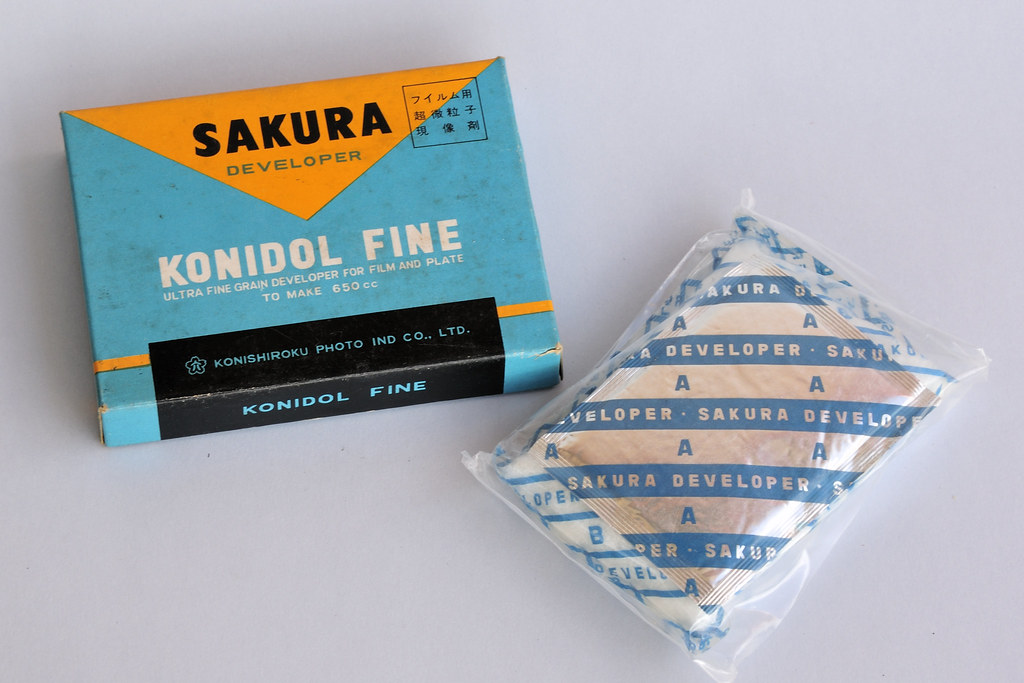
Konidol Fine Developer

Film / Dry-Plate Super Fine-Grain Developer
Konidol Fine
Working Solution: 650 cc

Konidol Fine is a new-generation fine-grain developer created by Konishi.
This liquid fine-grain developer chemically supplements the mixed developing agents used in conventional fine-grain developers, producing a superior fine-grain effect on film without sacrificing practical density or gradation.

With Konidol Fine, even films with normally coarse grain are rendered with remarkably finer grain, and the tonal gradation becomes uniform and smooth.
Compared to ordinary fine-grain developers, its sensitivity loss is very small, making it ideal for 35mm film, where fine grain is especially important.

Konidol Fine, being a liquid concentrate, dissolves easily and, due to the addition of stabilizers, the working solution retains its developing power for a long period.
Another advantage is that it has very little staining, giving clean negatives.

Preparation Method

Konidol Fine is supplied as two solutions, A and B, to make 650 cc of working solution. Warm about 450 cc of water to 50–60°C, Add solution A, mix thoroughly, Add solution B, mix again, Then add cold water to reach a total of 650 cc.

If the water is too cold, chemicals may precipitate. If used while turbid or not fully dissolved, the developer’s performance will suffer. When the developer is ready, use it immediately, and after development, discard it—it is a one-shot developer, not reusable.

Film Speed When Using Konidol Fine

When developing film in Konidol Fine, the following exposure indices (ASA values) should be used: (note, this corresponds to 1/2 box speed)

Film Type ASA
Konipan SSS 100
Konipan SS 50
Konipan S 25

(note the S, SS, and SSS naming were also used by Fujifilm for their B&W line which was initially 50, 100, and 200 speed)

Development Times (20°C)

Konipan SSS Film …… 10 min
Konipan SS Film …… 8 min
Konipan S Film …… 7 min
Infrared 750 Film …… 7 min

Films developed in Konidol Fine show excellent stability, reduced risk of softening or damage, and very clean negatives.

Konidol Fine gives extremely fine grain, beautiful gradation, and is especially recommended for 35mm film.


Konitone Developer

Photographic Printing Paper Developer
Working Solution: 1000 cc

Konitone is a new type of developer designed for all Sakura-brand papers and all other photographic printing papers.
It provides excellent tone, clean whites, rich blacks, and strong image permanence.

This developer uses phenidone as the main developing agent.
This eliminates several drawbacks found in conventional MQ (Metol–Hydroquinone) developers and provides numerous advantages.

Konitone reproduces five tonal regions (from deep shadows to bright highlights) with exceptional clarity.
It also preserves delicate tonal differences and faithfully renders subtle textures.

Because it does not use metol as the primary agent, it has very little tendency to cause skin irritation, even with prolonged use.

In addition, the developer’s highly effective agents exhibit strong developing action, allowing development times to be cut nearly in half compared to typical MQ developers—making Konitone extremely economical.

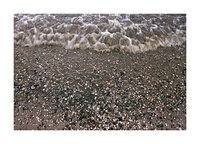
An example of Tri-X @800 ASA in Konidol:


john_s

Member
Allowing Ads
Joined
Nov 19, 2002
Messages
2,203
Location
Melbourne, A
Format
Medium Format
I have an article by Ryuji Suzuki about Japanese film developers (Konica and Fuji) if anyone is interested.
 
OP
OP
loccdor

loccdor

Member
Joined
Jan 12, 2024
Messages
2,545
Location
USA
Format
Multi Format
@john_s Of course! Please feel free to post it.
 

john_s

Member
Allowing Ads
Joined
Nov 19, 2002
Messages
2,203
Location
Melbourne, A
Format
Medium Format
Cut and paste didn't work. Attached pdf might work.
 

Attachments

  • Japanese photo dev by Ryuji Suzuki.pdf
    10.8 KB · Views: 59

Mr Bill

Member
Allowing Ads
Joined
Aug 22, 2006
Messages
1,524
Format
Multi Format
“Sakura” was the brand name used by Konishiroku (小西六) for their photographic films and papers. Konishiroku was one of Japan’s oldest photo companies, founded in the 1870s. Products included Sakura films, papers, and developers.

I know this in a B&W forum, but Konishiroku was also, at one time, well-known for its color paper. In the early 1980s, or so, they introduced into the US a color paper sometimes called "Century Paper," or something to that effect; perhaps also SR100? Its main selling point was a projected lifespan of 100 years in so-called dark storage (ie, Photo albums) before color dye loss exceeded some specific level. And, I think perhaps an improvement in the so-called base stain level.

Up to that time no major manufacturer had ever promoted a product based on image stability ratings. The outfit where I worked was one of the first major labs to begin using it (at least in the USA). It was most definitely a top-notch material of its era.

The stability projections were based on so-called Arrhenius testing, where multiple samples are tested at different temperatures. (Higher temperatures bring about faster chemical reactions.) Essentially, the time for each dye to fade to some density aim was measured, then plotted vs temperature on a certain type of graph. This resulted in a straight line that could then be projected down to give a room temperature lifespan. Thus the 100-year album-storage projection.

A great deal of research was presented by Konishiroku/Konica scientists and engineers in photographic symposiums by the SPSE/IS&T during (roughly the 1980s and 1990s?). Especially in the field of effluent control, a major issue in the 1980s.
 
OP
OP
loccdor

loccdor

Member
Joined
Jan 12, 2024
Messages
2,545
Location
USA
Format
Multi Format
Thank you so much for those details! It's amazing the amount of scientific know-how that went into developing these products. Well, now you need to grab something printed on that paper to see how it held up!
 

Mr Bill

Member
Allowing Ads
Joined
Aug 22, 2006
Messages
1,524
Format
Multi Format
Well, now you need to grab something printed on that paper to see how it held up!

Well, kinda did over the years. We used to print well over a million 8x10 "units" every week for our mass market portrait chain (USA and Canada), with a "100% satisfaction" guarantee. (If it fades noticeably, OR ANY OTHER REASON why the customer no longer likes it, bring it back for a full refund, etc). So anything unusual that was returned would eventually make its way back to my department, with the question of "what caused this?"

Somewhere around that time we set up our own in-house image stability testing program. Using single point testing, only, for both light AND dark fading; comparative testing against the best industry products. We ran a new set of tests any time we were evaluating new films or papers in our operation. Anything significantly deficient compared to the current standards was immediately a non-contender.
 
Last edited:

Mr Bill

Member
Allowing Ads
Joined
Aug 22, 2006
Messages
1,524
Format
Multi Format
It's amazing the amount of scientific know-how that went into developing these products.
Yes, probably more than you might imagine. For over 30 years we would have at least one, usually a couple of people, from my department at the pertinent SPSE/IS&T symposiums. Three day affairs, generally, with the last day typically including papers that were sort of new product "commercials" presented as "research."

If you're curious at a deeper level you can look on the is&t website regarding past symposium "proceedings;" I'm thinking these were each typically about 150 pages; maybe a bit more. (You don't wanna buy any, $$, but you can see a list of the papers presented.) It's at imaging.org as I recall.

Something to keep in mind is that every one of the manufacturer's papers presented was most likely cleared by company execs and lawyers, so they represent what the company was WILLING to reveal, not necessarily the latest research.
 
OP
OP
loccdor

loccdor

Member
Joined
Jan 12, 2024
Messages
2,545
Location
USA
Format
Multi Format
So anything unusual that was returned would eventually make its way back to my department, with the question of "what caused this?"

That sounds a lot like the role I play at my job, the "fix it guy" for a very niche group of processes (nothing to do with chemistry though).
 

Mr Bill

Member
Allowing Ads
Joined
Aug 22, 2006
Messages
1,524
Format
Multi Format
That sounds a lot like the role I play at my job, the "fix it guy" for a very niche group of processes (nothing to do with chemistry though).

Yep, could be.

However the whole image stability testing, etc., was a relatively minor part of what we did.

FWIW if you're interested in the chronological history of Konica COLOR films and papers, Henry Wilhelm's book has a fairly complete listing. It's primarily about stability data, but includes the manufacturering date ranges for everything. At least approaching the book publication date... early 1990s?

The book is a free download... wilhelm-research.com/book_toc.html
 

Craig

Subscriber
Joined
Apr 8, 2004
Messages
2,522
Location
Calgary
Format
Multi Format
I used to use a quite a bit of Sakura E6 film in the 80's, as it was a house label local department store film which included processing. Much cheaper than Kodachrome when I was learning photography.
 
OP
OP
loccdor

loccdor

Member
Joined
Jan 12, 2024
Messages
2,545
Location
USA
Format
Multi Format
Starting film photography in 2010 (not counting the one roll I shot as a 4 year old or the polaroids as a 7 year old) I hadn't heard at all of Sakura photographic company until recently.
 

xkaes

Subscriber
Allowing Ads
Joined
Mar 25, 2006
Messages
5,117
Location
Colorado
Format
Multi Format
I stocked up on Konica Impresa 50 -- color negative film -- years ago. Super nice C-41 film that I shoot at ISO 25. I got several 100 foot rolls when I heard it would be discontinued.
 

reddesert

Member
Allowing Ads
Joined
Jul 22, 2019
Messages
2,599
Location
SAZ
Format
Hybrid
"Sakura" means cherry blossom in Japanese, and is also a common proper name. I think older Konica cameras sometimes have a Konica/Sakura sticker on the inside; possibly the US importer used both names.

In the late 80s - early 90s in the US, I recall seeing Konica color films in the US in the blue box (they had discontinued using the Sakura name on film by then), and I have a memory of being aware of the Konica near-IR B&W film, but I can't recall seeing in the US a normal Konica panchro B&W film, or Konica B&W chemistry.

Also in the early 90s, Konica sold a neat panoramic single-use camera with a 17mm plastic lens, loaded with C-41 film. I got a couple of these and opened them up to reload with B&W. I think I still have one.
 
Photrio.com contains affiliate links to products. We may receive a commission for purchases made through these links.
To read our full affiliate disclosure statement please click Here.

PHOTRIO PARTNERS EQUALLY FUNDING OUR COMMUNITY:


Ilford ADOX Freestyle Photographic Stearman Press Weldon Color Lab Blue Moon Camera & Machine
Top Bottom
