• Welcome to Photrio!
    Registration is fast and free. Join today to unlock search, see fewer ads, and access all forum features.
    Click here to sign up

Solargraphs in this month's New Scientist

Afternoon Calm

D
Afternoon Calm

  • 2
  • 0
  • 40
Toby's Bar

H
Toby's Bar

  • Tel
  • Apr 25, 2026
  • 1
  • 0
  • 61

Recent Classifieds

Forum statistics

Threads
203,498
Messages
2,855,581
Members
101,868
Latest member
Elderlogan
Recent bookmarks
2

crispinuk

Member
Allowing Ads
Joined
Jul 23, 2006
Messages
195
Location
Southsea UK
Format
Multi Format
A friend of mine has tipped me off about an article in this month's New Scientist on Justin Quinnell's solargraphs.
Just passing on the tip:

Dead Link Removed.

Crispin
 
Really interesting: he used the photo paper as a very slow printing-out paper. That explains the colours.
 
Interesting...same view of the Clifton suspension bridge as one afforded by William West's 175 year old camera obscura housed in an abandoned mill.
 
His negatives were scanned immeadiately after taking them out of the pinhole cameras...and I assume with the intensity of the light of the scanner on the undeveloped photopaper, he can only scan them once. Probably too much fogging to use them for anything else after scanning. So the question is...does this thread actually belong on the hybrid site? :tongue:

Vaughn
 
I was reading about this the other day. I still can't get my head around colour images being burnt onto black and white photographic paper. I guess I'm going to have to try this for myself and see what happens. Should be most interesting.
 
So the question is...does this thread actually belong on the hybrid site? :tongue:

Vaughn

I don't think so, the article is about solargraphs and of those who have replied to the original post, most have expressed interest and some have stated they might have a go themselves. Mr Quinell happened to use a scanner, that doesn't invalidate all the skill and knowledge that went into getting the solargraph onto the photopaper in the first place. Perhaps you could kick off with the first suggestion as to how the image could be made permanent using purely chemical processes :wink:?
 
I don't think so, the article is about solargraphs and of those who have replied to the original post, most have expressed interest and some have stated they might have a go themselves. Mr Quinell happened to use a scanner, that doesn't invalidate all the skill and knowledge that went into getting the solargraph onto the photopaper in the first place. Perhaps you could kick off with the first suggestion as to how the image could be made permanent using purely chemical processes :wink:?

Sure...since the problem with developing and fixing the image is that massive amount of exposure the paper got, it is just a matter of applying a dilute developer...perhaps 20 to 25 molecules of developer per square inch of paper...:wink::tongue:

My post was all in fun, but it is a hybrid process by necessity. The result on paper is a negative -- with lots of orangy colors. It is scanned and reversed in PhotoShop, or other applications, to be a positive color image -- thus the orange becomes cyan, dark becomes light. So while it is a hybrid process, it is worthy of making an exception for it. (and I just realized that one might be able to contact print the original onto photo paper, B&W or color, and make it a fully analog process)

It does appear that the original can be saved for re-scanning later.

Vaughn
 
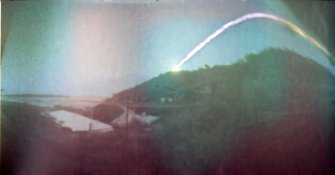
i stumbled across solargraphs a couple of weeks ago, so i made some cameras to have a go. here is my first attempt which was exposed for around three days
 

Attachments

  • RavensbourneSun08.jpg
    RavensbourneSun08.jpg
    43.5 KB · Views: 179
I had forgotten about Justin's website. I visited it about a year ago. He has done some work for the magazine. Very inventive photographer.
 
With the winter solstice approaching I'm going to have a go at these. The only question I have (at the moment) is whether or not any sort of ND filtering is required or does one just use a 'standard' beer can pinhole camera or such like ? I know photographic paper is slow but 6 months of 12 hours average exposure per day seems a bit much even at f/200.
Any and all advice gladly recieved.
 
With the winter solstice approaching I'm going to have a go at these. The only question I have (at the moment) is whether or not any sort of ND filtering is required or does one just use a 'standard' beer can pinhole camera or such like ? I know photographic paper is slow but 6 months of 12 hours average exposure per day seems a bit much even at f/200.
Any and all advice gladly recieved.

A couple of clicks down, he goes into more detail of how it was done.

http://www.pinholephotography.org/Solargraph%20instructions.htm
 
Photrio.com contains affiliate links to products. We may receive a commission for purchases made through these links.
To read our full affiliate disclosure statement please click Here.

PHOTRIO PARTNERS EQUALLY FUNDING OUR COMMUNITY:



Ilford ADOX Freestyle Photographic Stearman Press Weldon Color Lab Blue Moon Camera & Machine
Top Bottom