
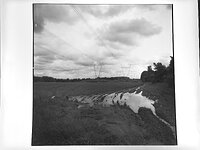
If you do, where do you sign your prints and using what? Also, what information? name, number of print and date?
-
Welcome to Photrio!Registration is fast and free. Join today to unlock search, see fewer ads, and access all forum features.Click here to sign up
You are using an out of date browser. It may not display this or other websites correctly.
You should upgrade or use an alternative browser.
You should upgrade or use an alternative browser.
Signing prints
-
A
- Thread starter Jarvman
- Start date
Recent Classifieds
-
For Sale Zone VI 5x7 Enlarger & Accessories $1500 obo
- Started by oficinouno
-
For Sale Antique Darkroom Red Safe Lights _ Electric Lamps
- Started by Manual Camera
-
For Sale Antique contact printing frames, Kodak and others, several sizes
- Started by Manual Camera
-
For Sale Transposing Frames for stereo photography ("châssis alterneur"), several sizes
- Started by Manual Camera
-
Found Nikon F2 black camera
- Started by ediz7531
Forum statistics
- Joined
- Jun 21, 2003
- Messages
- 29,810
- Format
- Hybrid
i sign the back and date it in pencil
and if matted, i sign the window mat
the same way name+date.
i never drymount. my mounted prints from the 80s
are all separating from the board, but my window mats look fine ...
john
and if matted, i sign the window mat
the same way name+date.
i never drymount. my mounted prints from the 80s
are all separating from the board, but my window mats look fine ...
john
- Joined
- Sep 10, 2002
- Messages
- 3,336
- Format
- 35mm
when i sell something i sign my name with pencil under the right side of the print which is the traditional manner. 40 years ago i would number the prints, but now, i rarely print editions so i don't brother.
I never give an image a name, or at least as far as the client is concerned. I sometimes have a working name in my head.
I never give an image a name, or at least as far as the client is concerned. I sometimes have a working name in my head.
What kind of pencil is best?
A plain, old fashioned #2 pencil works just fine for me.

If you do, where do you sign your prints and using what? Also, what information? name, number of print and date?
#2 pencil as soft as you can
Attachments
i sign the back and date it in pencil
and if matted, i sign the window mat
the same way name+date.
i never drymount. my mounted prints from the 80s
are all separating from the board, but my window mats look fine ...
john
John
Have you tried to just through them into the press again? I haven't because mine are all fine, but I heard that has worked for some people who had the same problem.
- Joined
- Jun 21, 2003
- Messages
- 29,810
- Format
- Hybrid
John
Have you tried to just through them into the press again? I haven't because mine are all fine, but I heard that has worked for some people who had the same problem.
hi ralph,
nope, i haven't done that yet ..
but thanks for the suggestion!
john

Why not sign the way your buyer asks you to sign.

Why do you use a pencil and not a pen or fine-tipped marker?
Will ink damage the print?
Adam
Will ink damage the print?
Adam
Why do you use a pencil and not a pen or fine-tipped marker?
Will ink damage the print?
Adam
Maybe not, but a pencil is very archival, but the main reason is that a pen or a marker is too dominant. The signature should not 'fight' with the image. It needs to be 'quiet'.

I always had a resistance to signing on the emulsion with any kind of writing instrument. Was always concerned that an ink would either fade, bleed, or even react with the emulsion. I guess a pencil is the safest option but have never tried it - how does it adhere to glossy FB ? I'm sure I heard once of a 'silver-safe' pen - think it may have been in a Silverprint catalogue some years ago. Be interesting to know if yhere is such a thing available ?
In my 'purist' efforts I did once go to the trouble of making up a lith negative with my initials on and actually contact printing this onto the paper. It was quite a faff though and often doubled the time in making a print.
In my 'purist' efforts I did once go to the trouble of making up a lith negative with my initials on and actually contact printing this onto the paper. It was quite a faff though and often doubled the time in making a print.
I always had a resistance to signing on the emulsion with any kind of writing instrument. Was always concerned that an ink would either fade, bleed, or even react with the emulsion. I guess a pencil is the safest option but have never tried it - how does it adhere to glossy FB ? I'm sure I heard once of a 'silver-safe' pen - think it may have been in a Silverprint catalogue some years ago. Be interesting to know if yhere is such a thing available ?
In my 'purist' efforts I did once go to the trouble of making up a lith negative with my initials on and actually contact printing this onto the paper. It was quite a faff though and often doubled the time in making a print.
Not on the print, never on the print. On the mount-board!
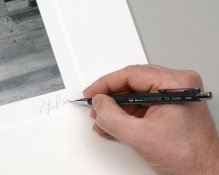
Looking at your picture Ralph it appeared that you were signing the white emulsion border on the actual print. I'm taking it the image doesn't have a print border and is printed full bleed, then drymounted onto board with the bevel on the overmat cut back from the edge of the paper ?

Sirius Glass
Subscriber
I use two mat levels [two or four layers each] and I sign the lower level.
Steve
Steve
Yes, thats my method aswell lately
Looking at your picture Ralph it appeared that you were signing the white emulsion border on the actual print. I'm taking it the image doesn't have a print border and is printed full bleed, then drymounted onto board with the bevel on the overmat cut back from the edge of the paper ?
correct
Here are a few of the methods of signing photographs that currently appear in my collection. These are not my methods, but some methods of notable photographers circa 1880-1925.
1. Pencil on mounting board, under bottom edge of photograph.
2. Pencil on photograph directly, in margin under image.
3. Same as above, but at a 45 degree angle to the photograph.
4. Quill pen/Fountain pen directly on the photogragh.
5. Quill pen/Fountain pen, very lightly written on mounting board and then written boldly and hidden underneath the photograph, only viewable if photograph is lifted.
6. Inked seal stamps, multicolored, on mounting board.
7. Colored paint/colored opaque ink applied onto the photograph directly, in a corner.
There are other methods of marking prints also, to include embossing, ink stamps on the back, logos inscribed in the negative, etc. But, all of the methods above have passed the test-of-time. I don't believe there are any resin coated type papers here. I think the nearest to that are the gelatin coatings, and in those cases the signatures appear as pencil on the mounting board, or ink directly on the photograph. Sometimes the markings can be found as written signatures only, written signatures plus the year, and personal logos depicting the photographer's initials or last name.
1. Pencil on mounting board, under bottom edge of photograph.
2. Pencil on photograph directly, in margin under image.
3. Same as above, but at a 45 degree angle to the photograph.
4. Quill pen/Fountain pen directly on the photogragh.
5. Quill pen/Fountain pen, very lightly written on mounting board and then written boldly and hidden underneath the photograph, only viewable if photograph is lifted.
6. Inked seal stamps, multicolored, on mounting board.
7. Colored paint/colored opaque ink applied onto the photograph directly, in a corner.
There are other methods of marking prints also, to include embossing, ink stamps on the back, logos inscribed in the negative, etc. But, all of the methods above have passed the test-of-time. I don't believe there are any resin coated type papers here. I think the nearest to that are the gelatin coatings, and in those cases the signatures appear as pencil on the mounting board, or ink directly on the photograph. Sometimes the markings can be found as written signatures only, written signatures plus the year, and personal logos depicting the photographer's initials or last name.
Last edited by a moderator:
It's a wonder there isn't a marker pen that contains the same dye as spotting dyes ...
It's a wonder there isn't a marker pen that contains the same dye as spotting dyes ...
There is! A fountain pen filled with Spotone. Trouble is, Spotone is not archival (according to Ansel Adams, or at least he had his doubts), but regular China Ink is very archival, so that would work.

Why do you use a pencil and not a pen or fine-tipped marker?
Will ink damage the print?
Adam
At least some markers bleed ugly with time. I'd stick to pencils.
Sirius Glass
Subscriber
Some markers fade even though they claim to be permanent or archival. Maybe the have not figured out the light can fade some inks.
Steve
Steve
- Greg Davis
- Deleted
Edward Weston once got deeply insulted when a buyer asked for his full name rather than his initials when signing a print. He felt the buyer was paying for a print, not a signature!
That somehow reminds of that open source guy who feels offended when somebody wishes him merry christmas because his an atheist.
| Photrio.com contains affiliate links to products. We may receive a commission for purchases made through these links. To read our full affiliate disclosure statement please click Here. |
PHOTRIO PARTNERS EQUALLY FUNDING OUR COMMUNITY:  |