
• Welcome to Photrio!
    Registration is fast and free. Join today to unlock search, see fewer ads, and access all forum features.
    Click here to sign up

Signing prints

Somewhere...

D
Somewhere...

  • 0
  • 0
  • 0
Iriana

H
Iriana

  • 4
  • 1
  • 71

Forum statistics

Threads
202,734
Messages
2,844,806
Members
101,489
Latest member
Sunnydoran
Recent bookmarks
3

walbergb

Member
Allowing Ads
Joined
Sep 19, 2005
Messages
429
Location
Brandon, Man
Format
Multi Format
Any suggestions regarding signing glossy prints? I find that the gloss is too much even for the softest pencil leads. I could use a fine felt pen, but I fear the signature would be quite pronounced. I don't use glossy paper often, but when I do, I don't look forward to signing the print. I like to leave a paper border--wider at the bottom--and sign the print as opposed to putting my signature on the overmat.
 
I sign my prints on the back, where the paper surface doesn't matter.

If you dry-mount, sign it on the back of the mount since you won't ever remove the print from it. You might even consider a custom stamp to use on the verso, for authenticity. Looks nice.
 
I use a stamp with my name and address on the back and I sign with a soft pencil also on the back.
 
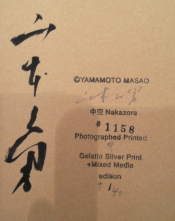
Here's a pic of Masao Yamamoto's print stamp.

Screen Shot 2013-05-29 at 2.46.26 PM.png
 
I have signed in the white border of hinge mounted, overmatted color (yech!) glossies with various fine point felt style pens. This is not, of course, archival, but neither are the prints, so I don't fret over it.

The situation is quite different with archivally processed monochrome prints. Even if you choose not to dry mount, signing on the front of the print itself is widely considered to be gauche. Sign somewhere immediately close to the print on the mat, preferably in pencil, whichever mounting procedure you choose. But also, and this is more critical than an actual signature, label the print with all suitable identifying provenance information using any of a number of methods searchable elsewhere on this site, either on the back of the print itself if not permanently attached to its mount, or on its mount. If a print is good enough to present (e.g., mount, frame), it should be properly identified. Personally, I also despise signing, but it is a necessary evil.
 
FWIW, many print competitions will disqualify prints that show information that would identify the photographer when viewed by the judges.

So for that purpose, any signature on the front would need to be hidden by a mat.
 
signing on the front of the print itself is widely considered to be gauche.


I've never heard such a thing in the 20 years I have exhibited and sold my work. Most photos I see in museums and galleries are signed on the front of the print right under the image in the lower right corner. Drymounted ones are often signed on the backing board under the print (mat window is cut larger on the bottom to allow the signature to show). Signing a mat should never be done because the signature is lost if the mat ever needs replaced.
 
You have not understood what I have written. Most properly presented traditionally produced monochrome prints (GSP, platinum, etc.), and that includes major museums I have visited, are not signed on the front of the PRINT, though many are unsigned anywhere on the front of the piece at all. I make no claim as to pigment prints, inkjets, color, or chriscrawfordphotos of any kind.

Your own written claim that dry mounted prints are signed below the print on the mount is contrary to your claim that signing a mat should never be done... At least be consistent in your written communication. Mat board is mat board whether it is used for mounting or windowing. The separation argument is the reason for properly identifying the work unambiguously on the back of the PRINT, if not permanently attached to its mount.
 
Last edited by a moderator:
Thank you all for your comments. I do dry mount my prints (on acid-free foam board), and overlap the print border with the mat. It is the print border that shows and not the backing board. Perhaps with glossy prints I can change that practice.
 
Thank you all for your comments. I do dry mount my prints (on acid-free foam board), and overlap the print border with the mat. It is the print border that shows and not the backing board. Perhaps with glossy prints I can change that practice.

What is the importance of having the signature show on the front?
 
What is the importance of having the signature show on the front?

None, I guess. I've never been formally schooled in signing prints, so I instinctively copied what I was exposed to. On the other hand, I was recently talking to a former professional photographer friend of mine, and he recommended signing on the back of the print in the border and away from the image.
 
Walberg - I'm probably opening another can of worms here, but I wouldn't dry mount to any kind of foam board. I have seen the board collapse, or compress in areas, which can be seen viewing the print. I've also seen foam core do this in sections, if the heat in the dry mounting process is too high (or long, or pressure too much).
Why do you mount to foam board, anyway, just curious?
 
Walberg - I'm probably opening another can of worms here, but I wouldn't dry mount to any kind of foam board. I have seen the board collapse, or compress in areas, which can be seen viewing the print. I've also seen foam core do this in sections, if the heat in the dry mounting process is too high (or long, or pressure too much).
Why do you mount to foam board, anyway, just curious?

You can buy self-adhesive foam board, so why would you want to use the archaic process of dry mounting?
 
To each their own regarding dry mounting, but I always refer back to the photography conservationist I had a conversation with. Her name is Patty Landres, and works/workes at the Minneapolis Institute of Arts. When I first started seriously photographing, and asked her advice for mounting my prints, she very assertively exclaimed the following: "Whatever you do, do NOT dry mount your photographs. Ever".
And then began to explain to me what a pain in the neck it is to try to save a print where something had happened to the board the print was mounted to. You may draw your own conclusions, but I don't think advice gets more expert than that.
 
Walberg - I'm probably opening another can of worms here, but I wouldn't dry mount to any kind of foam board. I have seen the board collapse, or compress in areas, which can be seen viewing the print. I've also seen foam core do this in sections, if the heat in the dry mounting process is too high (or long, or pressure too much).
Why do you mount to foam board, anyway, just curious?

Why use foamboard? I'm assuming your question is getting at the medium (foamboard versus mounting board) and not the method. Two articles (Dead Link Removed by Michael A. Smith and ‘Inherent Vice’ and Quality A Photograph Conservator’s View by Barbara E. Lemmen) played a big role in my decision. I get the ArtCare Archival Foamboard through a local framing shop. Controlling the entire process from taking the shot to mounting the print is a hobby for me. My prints are not destined for a museum or for profit. They are destined for my pleasure and the pleasure of friends and family and the occasional art gallery supporter who is willing to support the gallery by buying one of my prints. I donate a print, and the gallery sells it in an auction as a fundraiser. It's my way of donating to the gallery.

As for your concerns, they are valid, and I have taken measures to avoid such problems. Besides using archival foamboard, I have refurbished my drymount press so the temperature is quite accurate and the pressure is minimal and uniform. I have never had the foamboard fail.
 
It's your print, you are the artist, sign it any darn place you want any way that works.

I sign mine with fine point Sharpie on the lower right, with a title on the lower left, just in the white space outside the picture area. If someone thinks that gouche, well, tough noogies.
 
To each their own regarding dry mounting, but I always refer back to the photography conservationist I had a conversation with. Her name is Patty Landres, and works/workes at the Minneapolis Institute of Arts. When I first started seriously photographing, and asked her advice for mounting my prints, she very assertively exclaimed the following: "Whatever you do, do NOT dry mount your photographs. Ever".
And then began to explain to me what a pain in the neck it is to try to save a print where something had happened to the board the print was mounted to. You may draw your own conclusions, but I don't think advice gets more expert than that.


Thats what I was taught by my photography professor. Do not do anything that can not be undone. Never dry mount ,and sign with a pencil rather then a pen, referring to fiber based prints. For RC prints I would think a pen would be ok because it is coated and not likely to bleed. Signing and titling the print on the bottom white border was acceptable, but it really a matter of personal preference. If you photograph is strong enough signing it isn't distracting. I would worry more about un spotted dust spots or someones hair getting trapped between the print and the glass, now that is distracting.
 
Linen hinges. That or supply your mounter with reversible mounting sheets; almost all "professional" framers have only the permanent kind. I sign on the front with an extra fine Sharpie and have yet to see any bleed or creep. (I may come to regret using that.) I also sign in very soft pencil in the middle of the print's back. No problems there either.
 
Photrio.com contains affiliate links to products. We may receive a commission for purchases made through these links.
To read our full affiliate disclosure statement please click Here.

PHOTRIO PARTNERS EQUALLY FUNDING OUR COMMUNITY:


Ilford ADOX Freestyle Photographic Stearman Press Weldon Color Lab Blue Moon Camera & Machine
Top Bottom