
Ok, I recently had located from this forum the shutter speed tester app. and the plugin tool to go with it, but now I can't find them. Can't remember what they were called. Does anyone remember? Thank you.
-
Welcome to Photrio!Registration is fast and free. Join today to unlock search, see fewer ads, and access all forum features.Click here to sign up
- Home
- Forums
- Analog Workflow Forums (100% Analog/Traditional)
- Analog Equipment
- Miscellaneous Equipment
You are using an out of date browser. It may not display this or other websites correctly.
You should upgrade or use an alternative browser.
You should upgrade or use an alternative browser.
Shutter testerq
-
A
- Thread starter scheimfluger_77
- Start date

Recent Classifieds
-
Want to Buy Lomo UPB-1 - 16mm cine film processing tank
- Started by blee1996
-
For Sale Really Right Stuff RRS BH-55 Ball Head
- Started by samuelphoto
-
For Sale Gitzo GT3532LS Systematic Series 3 Carbon Fiber Tripod
- Started by samuelphoto
-
For Sale SUMMILUX M 35MM F;1.4
- Started by Guillaume Zuili
-
For Sale (NOS) Fuji Slide Processing Mailers
- Started by UsedFilmCameras
Forum statistics

Ok, I recently had located from this forum the shutter speed tester app. and the plugin tool to go with it, but now I can't find them. Can't remember what they were called. Does anyone remember? Thank you.
I use the shuttertester once sold by Calumet but it isn't available anymore.short of that, I preferthe combination of a light sensor and audacity plugged into the microphone port of my ccomputer,It's fast enough to measure the duration of a flash!

Yes and the one you describe in your book is awesome, I just don't have the space or time to build one myself.

I believe you are referring to the photoplug and Shutter-speed app.
I do not see the app listed in the App Store any longer.
I do not remember who it was that originally sold them here.
Sent from my iPad using Tapatalk HD
I do not see the app listed in the App Store any longer.
I do not remember who it was that originally sold them here.
Sent from my iPad using Tapatalk HD
Lukas Fritz was the one who sold both the app and the optical sensor. He also was active on eBay.
Sent from my iPad using Tapatalk HD
Sent from my iPad using Tapatalk HD
Yes and the one you describe in your book is awesome, I just don't have the space or time to build one myself.
you need very little space and no more than a weekend to make one.If you don't have that, buy one of have anyone who knows which way to hold a soldering iron make one for you.It's worth it.I see the Calumet timer off and on on, the one in my book is many times faster because it uses the audio sampling rates of your computereBaybut
Hi,
I'm the developer of "Shutter-Speed" and the PhotoPlug.
The App is still available for download in the Apple AppStore and I still sell the PhotoPlugs on eBay.
During the last months, I was working on an android-version of the App, and I'm happy to announce that it is now available for download in the Google PlayStore ! The PhotoPlug works with android devices as well.
You can find all information about the App, the plug and the iOS and android version on http://www.photoplug.de
Best,
Lukas
I'm the developer of "Shutter-Speed" and the PhotoPlug.
The App is still available for download in the Apple AppStore and I still sell the PhotoPlugs on eBay.
During the last months, I was working on an android-version of the App, and I'm happy to announce that it is now available for download in the Google PlayStore ! The PhotoPlug works with android devices as well.
You can find all information about the App, the plug and the iOS and android version on http://www.photoplug.de
Best,
Lukas
Glad to hear it is still there. When I searched, I must have done something wrong.
I am a very satisfied user of the software and the plug.
Sent from my iPad using Tapatalk HD
I am a very satisfied user of the software and the plug.
Sent from my iPad using Tapatalk HD

I've been looking into building a shutter tester and a quick search on the web turns up many of the simple plans for the use of a phototransistor coupled with the audio input on the computer. So I went out and bought a phototransistor and hooked it up and instead of using the audio measurement technique, I looked at the actual waveform on an oscilloscope. While the pulse was present, what troubled me was the slow response time of the phototransistor. The "rise time" of the signal was nearly 5 milliseconds, and the "fall time" was even slower.
Changing the bias resistor and the supply voltage did very little to improve the signal. With these slow signals it would be difficult to resolve a shutter speed better than 1/100 with any accuracy. I think what this circuit needs is a photodiode which is much faster than a phototransistor. But it would need a pre-amp to properly capture the signal.
I'm going to research this a little more, and hopefully come up with a simple circuit that will still interface to an audio input as the measurement scheme, but as a detector will be much more precise.
Changing the bias resistor and the supply voltage did very little to improve the signal. With these slow signals it would be difficult to resolve a shutter speed better than 1/100 with any accuracy. I think what this circuit needs is a photodiode which is much faster than a phototransistor. But it would need a pre-amp to properly capture the signal.
I'm going to research this a little more, and hopefully come up with a simple circuit that will still interface to an audio input as the measurement scheme, but as a detector will be much more precise.
I've been looking into building a shutter tester and a quick search on the web turns up many of the simple plans for the use of a phototransistor coupled with the audio input on the computer. So I went out and bought a phototransistor and hooked it up and instead of using the audio measurement technique, I looked at the actual waveform on an oscilloscope. While the pulse was present, what troubled me was the slow response time of the phototransistor. The "rise time" of the signal was nearly 5 milliseconds, and the "fall time" was even slower.
Changing the bias resistor and the supply voltage did very little to improve the signal. With these slow signals it would be difficult to resolve a shutter speed better than 1/100 with any accuracy. I think what this circuit needs is a photodiode which is much faster than a phototransistor. But it would need a pre-amp to properly capture the signal.
I'm going to research this a little more, and hopefully come up with a simple circuit that will still interface to an audio input as the measurement scheme, but as a detector will be much more precise.
that's odd, using the same technique, I was able to measure flash durations with my iMac. without issue
/Users/rlambrec/Desktop/rlambrec/My Documents/My Books/WBM Edition2a/337 ShutterTester/ShutterTesterEd2a.pdf

All this new tech for old gear!
I think I'll stick with my old Northern Instruments optical shutter timer...... that goes from 9.999999 to 1/4000 sec.
I think I'll stick with my old Northern Instruments optical shutter timer...... that goes from 9.999999 to 1/4000 sec.
All this new tech for old gear!
I think I'll stick with my old Northern Instruments optical shutter timer...... that goes from 9.999999 to 1/4000 sec.
???:confused:
If I suspect my shutter speeds are in accurate I have the technician I use check and recalibrate them, because it's one thing to know they they are inaccurate but another to have the test equipment and skill to correct them.
There are two requirements for shutter speed testing. Is it accurate, and is it consistent (over time)? The first requirement really needs a calibrated measuring device. For consistency, the measuring device only needs to be, well, consistent. That's where the phone apps come in, especially with the photo sensor. As long as I get the same measured time, the shutter is consistent, and I can work with it.
The nice thing about the photo sensor is that it can be used across the gate of a focal plane shutter. This is useful for consistency of speed and blind separation at higher speeds.
Just pick the tool that gives you the type of results you need.
The nice thing about the photo sensor is that it can be used across the gate of a focal plane shutter. This is useful for consistency of speed and blind separation at higher speeds.
Just pick the tool that gives you the type of results you need.

I am having problem to find fast responding sensor also.
If properly biased, limited to its dynamic region, and with collimated light, an ordinary photodiode is much faster than a camera shutter allowing accurate measuremets.
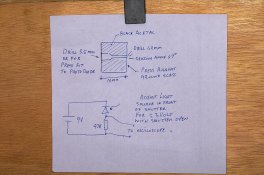
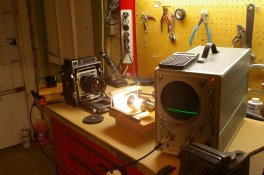
I have a tester as follows, it works well for leaf shutters and focal plane shutters.
( I have put scope traces from it on another thread somewhere)
I have a tester as follows, it works well for leaf shutters and focal plane shutters.
( I have put scope traces from it on another thread somewhere)
Attachments
???:confused:
Uses a photocell instead of sound. Dedicated unit with a 6-digit display. Measures the shutter open time from 9.99999 to 0.00025. Very hard to find as only 300 were ever made.
OK,thanks.the benefit of using sound are the high sampling rates ofup to 96 kHz,enough to plot ramp up and ramp down of a brief flash exposure.

I've been looking into building a shutter tester and a quick search on the web turns up many of the simple plans for the use of a phototransistor coupled with the audio input on the computer. So I went out and bought a phototransistor and hooked it up and instead of using the audio measurement technique, I looked at the actual waveform on an oscilloscope. While the pulse was present, what troubled me was the slow response time of the phototransistor. The "rise time" of the signal was nearly 5 milliseconds, and the "fall time" was even slower.
Changing the bias resistor and the supply voltage did very little to improve the signal. With these slow signals it would be difficult to resolve a shutter speed better than 1/100 with any accuracy. I think what this circuit needs is a photodiode which is much faster than a phototransistor. But it would need a pre-amp to properly capture the signal.
I'm going to research this a little more, and hopefully come up with a simple circuit that will still interface to an audio input as the measurement scheme, but as a detector will be much more precise.
Photo-transistors can switch in well under 100 uS (both rise and fall) when properly biased. I would suggest:
1. Use common-collector configuration (collector connected to supply, output taken from the emitter) to avoid the Miller effect (multiplication of base-collector capacitance due to transistor voltage gain).
2. Use a high value resistor (values around 100k are common) from the photo-transistor base to ground. This helps drain the base charge that is generated when the photo-transistor is exposed to light, so that when it is no longer exposed to light the charge dissipates rapidly speeding up the turn-off response. Note that in common-collector configuration, the resistance looking into the base is the emitter resistor multiplied by the small-signal current gain. So a 4k7 emitter resistor could result in a 470 K (or higher) resistance looking into the base, which is why the 100k base resistor significantly speeds up turn-off time.
3. Use a fairly low value load resistor (at the emitter), around 4k7, to minimize the RC time constant formed with the transistor output capacitance and the input capacitance of the following stage; and of course ensure that the following stage has low input capacitance.
Using these techniques, both rise and fall times should be under 100 uS. Of course it is also necessary to select the correct photo-transistor - in general low-power parts with low input and output capacitance will switch faster than high-power parts, which generally have greater input and output capacitance.
Last edited by a moderator:
How do you know what margin of error is acceptable and within the manufacturers tolerance when you've tested a shutter speed ?
The service manual does specify theses tolerances.
It stands to reason Chan that all the shutter speeds can't be precisely the marked ones there must be a plus or minus allowable margin of error or tolerance, my engineering training tells me this.The service manual does specify theses tolerances.

How do you know what margin of error is acceptable and within the manufacturers tolerance when you've tested a shutter speed ?
The manufacturer's tolerance is immaterial. The photographer should establish his own margin of error for shutter speed, aperture, and processing variables.
It stands to reason Chan that all the shutter speeds can't be precisely the marked ones there must be a plus or minus allowable margin of error or tolerance, my engineering training tells me this.
Sure Benji. Nothing is exact and for example in the service manual for the Nikon F3, Nikon specify the aim point for 1/500 is actually 1/512 (that is if it's 1/512 it's perfect) and it can be up to 1/699 and as slow as 1/375 and it's still in specs.
| Photrio.com contains affiliate links to products. We may receive a commission for purchases made through these links. To read our full affiliate disclosure statement please click Here. |
PHOTRIO PARTNERS EQUALLY FUNDING OUR COMMUNITY:  |