• Welcome to Photrio!
    Registration is fast and free. Join today to unlock search, see fewer ads, and access all forum features.
    Click here to sign up

Shutter Tester

Recent Classifieds

Forum statistics

Threads
202,969
Messages
2,848,245
Members
101,564
Latest member
noelchenier
Recent bookmarks
1

bd3

Member
Allowing Ads
Joined
Apr 22, 2006
Messages
16
Location
Central Kentucky
Format
Multi Format
Hope this it the correct place to post this. I'd like to find out where one would purchase a shutter tester. I have tried google but haven't found much.

Thanks,
Bill
 
I have one from Calumet that I bought years ago. Give them a try.

Patrick
 
I have the one that Calumet sells under its original maker's name and it is very competent. I also have one built into the Metrolux II timer that I have. I just got the Metrolux and it's not functioning correctly on the enlarger power outlet and I may be sending it back for a likely fuse repair but I briefly played with the shutter timer on it and it seems to work well and agreed with my old timer on the few runs I tried. I had forgotten about that feature until the timer arrived but for the right situation, where you might be considering an enlarging timer/analyzer anyway, it would save owning 2 devices.
 
I made mine, there are several plans on the internet and most of them involve using the soundcard in your computer and free software.

tester.jpg

shutter1.gif
 
I made mine, there are several plans on the internet and most of them involve using the soundcard in your computer and free software.

Do you happen to remember any of the link addresses? I, too, have searched for a schematic on Google and not found one. Thanks.
 
All I've ever used is a microphone plugged into the sound card. I use audio manipulation software to see what the times are between the significant sounds which are the opening and closing of the shutter. It's scarily accurate according to what I've seen.

cheers
 
I was thinking about building one using an LED and a photo transistor. I was going to buy a simple stand alone counter and build a stable 1kHz oscilator.

The phototransistor is then used to gate the oscilator into the counter so that the counter counts up whilst the shutter is open.

So the operation is: Reset counter, release shutter, read shutter opening time in milliseconds on counter display.

Then convert the time e.g. 2mS = 1/500; 250ms = 1/4; etc.


I do like the sound recording method though. I had not thought of that.


Steve.
 
I ordered one from Calumet after building one of those sound card types. The Calumet is real simple and real fast to use; I highly recommend it.

You could even carry it with your other camera equipment if necessary.
 
I was thinking about building one using an LED and a photo transistor. I was going to buy a simple stand alone counter and build a stable 1kHz oscilator.

The phototransistor is then used to gate the oscilator into the counter so that the counter counts up whilst the shutter is open.

So the operation is: Reset counter, release shutter, read shutter opening time in milliseconds on counter display.

Then convert the time e.g. 2mS = 1/500; 250ms = 1/4; etc.


I do like the sound recording method though. I had not thought of that.


Steve.

A clock rate much higher than 1kHz is required for accuracy at high shutter speeds. For 5% accuracy one should count at least 20 cycles.

Accuracy in the sound recording method requires knowing which sound is actually related to the opening and closing of the shutter. Using light through the shutter to trigger a phototransistor, and the phototranstor output to trigger the sound card, might be more reliable.

The ultimate shutter tester is a oscilloscope. It can measure flash sync timing and shutter efficiency. It can detect problems like shutter bounce. Learning to use an oscilloscope is certainly easier than learning to use most cameras well.
 
The ultimate shutter tester is a oscilloscope. It can measure flash sync timing and shutter efficiency. It can detect problems like shutter bounce. Learning to use an oscilloscope is certainly easier than learning to use most cameras well.

That's why I didn't build it. I already have an oscilloscope.


Steve.
 
I'll look around and see if I can find the links. I know there are several link buried in the Yahoo group "camera fix"
 
http://www.google.com/search?hl=en&q=shutter+tester&btnG=Google+Search

Looks like it turns up a few.

This is a good one http://www.willegal.net/photo/repair/shuttertester.htm

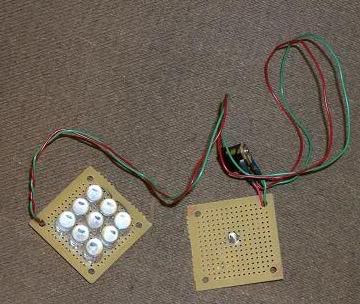
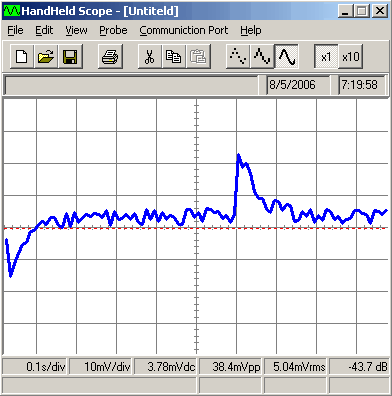
There is nothing special about mine. It is a grid of super bright LEDs with load resistors to make sure they don't pop. A simple detector diode (I forget the exact part number) and a power supply and Oscope. The diode is reverse biased because it operates better that way, though you may be able to use it in photovoltaic mode (I never tried it). Keep an eye on the proper voltages from your detector, that is important for the speed of the device. The one I used is something like 10 volts DC for optimum speed. That makes it a little hard on the scope that I have since I can't offset that much DC, so I run it in AC mode which is why the picture looks like it does. This is also what you will see on a sound card, but with the sound card you can not use 10 volts!

The data sheet for the detector showed exactly how I needed to connect the power for this to work, there are VERY few components in this and almost any should be able to build it. If you want to get really tricky, use IR LEDs for this detector to get the largest voltage change. The trick is determining if the LEDs are actually turned on, which is why I went with the white LEDs. Cost me about $25 in parts, and I had to buy more than I needed to beat the service charge.
 
Greg & Denis, thanks for the links. It is so strange! I typed "photo shutter speed measure" into google and got pages about lasers and optical lab equipment and never got the entries you did!

I think I'm headed out to radio shack tonight to get the parts. Thanks.
 
I can verify Denis's cheap and simple device worked for me... It's worth it's weight in platinum... well, almost!
pete
 
I followed Denis' link, constructed a tester and have tested every shutter I own, MF and LF... all in the past 10 days. As a result I have sent 1 shutter to Carol Miller, with another ready to go when the first returns. I have also decided that my MF TLR lenses are all fine, within 1/3 stop. Thanks to Denis for the advice and link!
 
Next step.... Servicing those shutters yourself. Lots to learn doing this, but you might find it fun. Start with something nice like a Rolleicord, they are easier to work on than a Yashica.
 
The most analog (and traditional DIY) way was to photograph a rotating phonograph turntable with a marker on it.
 
The most analog (and traditional DIY) way was to photograph a rotating phonograph turntable with a marker on it.

Great for between-the-lens shutters, but unpredictable for slow moving focal plane shutters. This method probably upset a few Speed Graphic users.

Another way to check moderate speeds is to photograph a neon or mercury vapor lamp while moving the camera to spread the image out during exposure. These lamps flash 120 times a second. For focal plane shutters, move the camera at a right angle to shutter movement.

Viewing a TV screen through the shutter is a quick way of testing speeds from about 1/30 second to high speeds.
 
I use a pair of photo emitter and receiver from Banner Engineering. It uses modulated red light with the 1mm diameter fiber optics. The response time is 50microsecond so it's at least good for shutter speed of 1/1000. I simply observe the sensor output on an oscillocope.
 
Photrio.com contains affiliate links to products. We may receive a commission for purchases made through these links.
To read our full affiliate disclosure statement please click Here.

PHOTRIO PARTNERS EQUALLY FUNDING OUR COMMUNITY:



Ilford ADOX Freestyle Photographic Stearman Press Weldon Color Lab Blue Moon Camera & Machine
Top Bottom