• Welcome to Photrio!
    Registration is fast and free. Join today to unlock search, see fewer ads, and access all forum features.
    Click here to sign up

Shooting in the dark at weddings

Vertical WPC

A
Vertical WPC

  • sly
  • Jan 30, 2026
  • 3
  • 1
  • 38
Conversations.

A
Conversations.

  • 8
  • 4
  • 82

Recent Classifieds

Forum statistics

Threads
202,051
Messages
2,834,444
Members
101,093
Latest member
Photorjp
Recent bookmarks
0

kbrede

Member
Allowing Ads
Joined
May 23, 2012
Messages
285
Location
Nebraska
Format
Multi Format
I'm attending a wedding tonight. I thought it might be fun to try and photograph people during the dance. I'm assuming low light conditions but have no idea what they will actually be like. I'm assuming I should look for 1600 or 3200 ISO. My Pentax ME Super only goes to 1600, so I'm not sure 3200 would even be usable. I've read a little about pushing and pulling but I really don't understand it yet. What B&W film would you go with? If I'm suppose to push or pull, just tell me the ISO to set the camera and I'll work out the development details later. :smile: The fastest lens I have is a 50mm f/1.7
Thanks for any advice,
 

andrew.roos

Member
Allowing Ads
Joined
Jan 4, 2011
Messages
572
Location
Durban, Sout
Format
35mm
I would use Ilford Delta 3200 or Kodak T-Max 3200 (both B&W films) rated at 1600 ISO (if lighting allows) or 3200 ISO (if necessary). If your ME super has exposure compensation then you could get 3200 ISO by setting it to 1600 ISO and also setting -1 EV exposure compensation. Both films are actually rated around 800/1000 ISO so you get 1600/3200 by pushing. Of course (indirect) flash is the preferable alternative.
 

removed-user-1

This is just my personal opinion, but I've shot many - dozens if not hundreds probably - rolls of Tri-x or HP5 pushed to 1600 in low light: street scenes, stage plays, bands in small clubs and bars. That would be my first suggestion. Shoot wide open or close to it, at the slowest speed you can handhold. 400 is actually quite fast; you might not have to push.
 
OP
OP

kbrede

Member
Allowing Ads
Joined
May 23, 2012
Messages
285
Location
Nebraska
Format
Multi Format
I would use Ilford Delta 3200 or Kodak T-Max 3200 (both B&W films) rated at 1600 ISO (if lighting allows) or 3200 ISO (if necessary). If your ME super has exposure compensation then you could get 3200 ISO by setting it to 1600 ISO and also setting -1 EV exposure compensation. Both films are actually rated around 800/1000 ISO so you get 1600/3200 by pushing. Of course (indirect) flash is the preferable alternative.

OK, just so I get this straight. I can shoot this film with either a 1600 ISO setting on the camera, or at 3200 ISO if I give it a -1 EV? I don't have a flash. This will just be for learning and fun.
Thanks,
 
OP
OP

kbrede

Member
Allowing Ads
Joined
May 23, 2012
Messages
285
Location
Nebraska
Format
Multi Format
This is just my personal opinion, but I've shot many - dozens if not hundreds probably - rolls of Tri-x or HP5 pushed to 1600 in low light: street scenes, stage plays, bands in small clubs and bars. That would be my first suggestion. Shoot wide open or close to it, at the slowest speed you can handhold. 400 is actually quite fast; you might not have to push.

OK, when you say to push. That means I take the 400 ISO film and set the camera to 1600?
Thanks,
 

removed-user-1

OK, when you say to push. That means I take the 400 ISO film and set the camera to 1600?
Thanks,

Yes. If 400 doesn't give a reasonable exposure, under-expose (by dialing in a higher ISO) and over-develop to compensate.
 

MattKing

Moderator
Moderator
Joined
Apr 24, 2005
Messages
55,343
Location
Delta, BC Canada
Format
Medium Format
"pushing" really only refers to an adjustment to the development. It doesn't improve the shadow detail (the dark parts of the scene will lose detail) but the mid-toned subjects will have their contrast bumped up, and will look better for it.

And the suggestion to set the "ISO" on the Pentax to the maximum of 1600 and adjust the exposure compensation one stop may not work - the exposure adjustment control may be limited by the travel available in the film speed dial.

If you use manual exposure, you can meter at 1600 and then manually open up a stop.
 

Colin Corneau

Member
Allowing Ads
Joined
Nov 20, 2007
Messages
2,365
Location
Winnipeg MB Canada
Format
35mm RF
I really wouldn't trust your meter too much, anyway.

For what my experience is worth, I've found it helpful to get a reading from a light source and simply use that when photographing on manual.

With less light, well...it'll be too dark, anyway. That way you can concentrate on making images and not fiddling with a meter.
 
OP
OP

kbrede

Member
Allowing Ads
Joined
May 23, 2012
Messages
285
Location
Nebraska
Format
Multi Format
"pushing" really only refers to an adjustment to the development. It doesn't improve the shadow detail (the dark parts of the scene will lose detail) but the mid-toned subjects will have their contrast bumped up, and will look better for it.

And the suggestion to set the "ISO" on the Pentax to the maximum of 1600 and adjust the exposure compensation one stop may not work - the exposure adjustment control may be limited by the travel available in the film speed dial.

If you use manual exposure, you can meter at 1600 and then manually open up a stop.

OK, thanks, good to know. There are some kind of limits to the EV dial, depending on what ISO is dialed in. I've noticed this playing around.
Thanks,
 

tkamiya

Member
Allowing Ads
Joined
Oct 3, 2009
Messages
4,284
Location
Central Flor
Format
Multi Format
Obviously, you are still trying to learn (and we all are...) and your experience is very limited at this time. Why don't you keep this simple?

Pickup some Tmax400 or Tri-X400. Set your camera to ISO1600 and shoot. You'll be developing a little longer than usual. How much longer depends on what developer you are using. If you tell us that, we can point you to an information you need.

You can do some amazing things with these "basic" films....
 
OP
OP

kbrede

Member
Allowing Ads
Joined
May 23, 2012
Messages
285
Location
Nebraska
Format
Multi Format
Obviously, you are still trying to learn (and we all are...) and your experience is very limited at this time. Why don't you keep this simple?

Pickup some Tmax400 or Tri-X400. Set your camera to ISO1600 and shoot. You'll be developing a little longer than usual. How much longer depends on what developer you are using. If you tell us that, we can point you to an information you need.

You can do some amazing things with these "basic" films....

Very limited. I've developed one roll of B&W and shot maybe 6ish? :smile: I'm using D-76 for a developer.
Thanks,
 

tkamiya

Member
Allowing Ads
Joined
Oct 3, 2009
Messages
4,284
Location
Central Flor
Format
Multi Format
Cool.

Say you have Tmax400. Say you are using D-76 at stock. Say your developer is at 20C/68F.
If you shoot this film with your camera set at ISO 400, you'd develop it for 8 minutes.
If you shoot this film with your camera set at ISO 1600, you'd develop it for 10 1/2 minutes.

Rest of the process stays the same.

I've done something like this with Tmax400, Tri-X, and Delta3200 all shot at the same scene. They were all very good.
 

markbarendt

Member
Allowing Ads
Joined
May 18, 2008
Messages
9,422
Location
Beaverton, OR
Format
Multi Format
First things first.

Your subjects will be moving pretty quick so you'll want to keep the shutter speed up, say 1/125 or 1/250.

F/1.7 is going to make nailing focus "interesting", it's not impossible, but it isn't easy. If you can get up to 2.8 or 4 you'll probably get more keepers.

If those thoughts make sense then the only variable left is the ISO/EI. My guess is that you will need to get up around 3200 or even 6400.

My suggestion is to shoot on manual and set the camera once and shoot.
 

dehk

Member
Allowing Ads
Joined
Aug 4, 2010
Messages
881
Location
W Michigan
Format
Multi Format
Make sure you shoot at the same ISO the whole roll. And develop the film to THAT ISO, mark it down.
 

j-dogg

Member
Allowing Ads
Joined
Jun 26, 2010
Messages
1,541
Location
Floor-it-duh
Format
Multi Format
If you can find it, Neopan 1600, they discontinued it right before I bought my last brick for my brother's wedding. The grain is top notch and actually doesn't look too bad.

Be sure to be in full manual mode no camera in the world knows what to do in a dark church room. I was doing 1/60th at f4 and lower on many of my 1600's, there's a few in the gallery.
 
OP
OP

kbrede

Member
Allowing Ads
Joined
May 23, 2012
Messages
285
Location
Nebraska
Format
Multi Format
Thanks for all the tips everyone! I've learned a lot in this thread. I ended up with Tri-x 400. 400 is the fastest film my camera shop has. It made for an easy choice. :smile: Tomorrow I'll see what the light is like. I'm going to take a light meter with me. I saw a couple shots online where someone pushed Tri-x to 3200 with D-76. If I have to I'll try it. :smile:
Thanks again,
 

Diapositivo

Member
Allowing Ads
Joined
Nov 1, 2009
Messages
3,257
Location
Rome, Italy
Format
35mm
I would try some shots with 1/30" or so. You take the picture when the couple/person nearest you is in "pause": imagine a pendulum swing, there is a moment when the movement stops before swinging the other way, by the same token you try to get the moment when the movement is reduced or stopped, as it can happen in tango, in certain waltzes etc. Couples in the background will be motion-blurred which will make an interesting background.

Pay special attention to the head. You want the heads to be "acceptably" sharp, so try to catch the moment in which the heads move less. If, that moment, the legs or the arms move more and come out blurred, the image will actually "gain" in effect.

You will not have light enough to freeze movement so just try to exploit the inevitable motion blurs in an aesthetically valid way.

Good luck!

Fabrizio
 

Diapositivo

Member
Allowing Ads
Joined
Nov 1, 2009
Messages
3,257
Location
Rome, Italy
Format
35mm
If you use manual exposure, you can meter at 1600 and then manually open up a stop.

Matt certainly means that if you set the camera at 1600 ISO but want to use it at 3200 ISO, i.e. at a higher speed, you meter at 1600 and then manually close a stop.

I don't want to be pedantic but a marriage is a marriage and you could screw the work if you apply the correction the wrong way.
 

MattKing

Moderator
Moderator
Joined
Apr 24, 2005
Messages
55,343
Location
Delta, BC Canada
Format
Medium Format
Matt certainly means that if you set the camera at 1600 ISO but want to use it at 3200 ISO, i.e. at a higher speed, you meter at 1600 and then manually close a stop.

I don't want to be pedantic but a marriage is a marriage and you could screw the work if you apply the correction the wrong way.

Oops

Matt certainly does mean that!
 

mabman

Member
Allowing Ads
Joined
Jun 7, 2007
Messages
834
Location
Winnipeg, MB
Format
35mm
Also, it really depends how dark it is at the reception. I tried something similar at a family wedding a number of years ago (also with an ME Super, BTW), and the DJ at the reception decided the lights should be extremely low - I tried to take a meter reading with a handheld meter and the ambient readings were approx. EI 3-4. As I recall, I gave up on the ME Super's aperture-priority mode as it kept telling me I need 1 or 1/2 second exposures, which weren't going to happen handheld :smile:

Ultimately I tried to take pics with the shutter at 1/30 (the slowest I can reliably handheld), and open up to f/4 max (anything wider the depth of field becomes problematic for me). At the time I hadn't done much developing on my own, so I had a local lab do it and push it to the max they had on their charts. Unfortunately this meant a good 80% of those reception shots were blank :sad:

From this experience I learned a couple of things, namely:
- use a flash if at all possible at future wedding receptions - the guests are probably too drunk to care anyway :smile:
- I learned how to use "semi-stand" development for this type of situation and future development. It develops whatever the film can record, so if it was shot at 1600 or 3200 (or even different ISOs on the same roll of film) it will develop what is there. It also works exactly the same for most if not all b&w films. Semi-stand is done using extremely diluted developer, for long periods of time, with minimal agitation. It is usually done with Rodinal - I use a dilution of 1+200, agitate for 30 sec, and then leave for 1 hr, and agitate for another 30 sec, then leave for another hour. Rinse, fix, rinse as normal.

So, in the end, I'm not sure if my 1/30, f/4 experiment with Tri-X would have worked with semi-stand given the exceptionally low light conditions, but if I do run into that situation again, at least the semi-stand development would give me a fighting chance :smile:

Good luck (and buy a flash) :smile:

 

Brian C. Miller

Member
Allowing Ads
Joined
Dec 13, 2010
Messages
486
Location
Everett, WA
Format
Large Format
I'm attending a wedding tonight.

Of course by the time you read this, the advice will be a bit late. :smile: Oh, well.

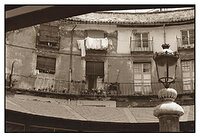
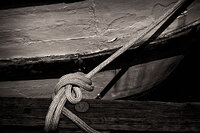
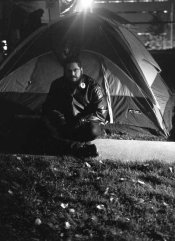
Use a film that's made for speed, like TMax 3200 or Delta 3200. I have tried TMax 400 at 1600 and 3200, and it's OK at 1600, but at 3200 there isn't enough light for it to get any shadows at all. Below Zone V, it's toast. I recommend using a seperate light meter. The last time I was shooting in low light, I was using Delta 3200 @ 3200, and f2.8 at 1/2 second with a Pentax 645. I know that TMax 400 wouldn't hold the shadows.
 

Attachments

  • OccupyEverettNov2011-001.jpg
    OccupyEverettNov2011-001.jpg
    14.6 KB · Views: 76
  • OccupyEverettNov2011-006.jpg
    OccupyEverettNov2011-006.jpg
    36.5 KB · Views: 89
  • OccupyEverettNov2011-006cro.jpg
    OccupyEverettNov2011-006cro.jpg
    24.4 KB · Views: 85
Photrio.com contains affiliate links to products. We may receive a commission for purchases made through these links.
To read our full affiliate disclosure statement please click Here.

PHOTRIO PARTNERS EQUALLY FUNDING OUR COMMUNITY:


Ilford ADOX Freestyle Photographic Stearman Press Weldon Color Lab Blue Moon Camera & Machine
Top Bottom