• Welcome to Photrio!
    Registration is fast and free. Join today to unlock search, see fewer ads, and access all forum features.
    Click here to sign up

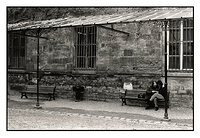
Semi-stand develoopment: Rodinal 1:100 2 hours, Tri X @ 6400

The Chicken

A
The Chicken

  • 2
  • 3
  • 44
Amour - Paris

A
Amour - Paris

  • 1
  • 0
  • 63

Recent Classifieds

Forum statistics

Threads
203,237
Messages
2,851,885
Members
101,741
Latest member
Bruceluvsfilm
Recent bookmarks
0

ymc226

Member
Allowing Ads
Joined
Oct 13, 2006
Messages
408
Location
Santa Monica
Format
Medium Format
I've read that someone was very happy with the results, similar grain compared to Tri X @400 in D76 undiluted.

I am going to give this a try as I need more speed for outdoors sports in drabby weather but never would have come up with this combination.

Anyone else ever use this combination?
Rodinal 1:100/ Tri X exposed at 6400
Gently invert 20 times/1 minute
swirl gently (do not invert) x 15 seconds every 30 minutes
total development time of 2 hours
 
swirl gently (do not invert) x 15 seconds every 30 minutes
total development time of 2 hours

Is there really any difference between swirling gently and inverting? I always thought the key was no agitation except every 30 minutes. Beyond that, I was under the impression that agitation is agitation is agitation...
 
You are on the right track, from what I have read in this forum. I use Rodinal 1:00 for normal development, semi stand (agitation every 4 min). But I don't use such high films speed values.
You are under exposing Tri-x by 4 stops if my math is right. This means your lowest values will not record, and by using a compensating developer and method (weak dilution, semi stand, long development times) you would hope to bring out what you can in the low values without blowing out highlights, which you should be able to do.
This is a big topic and if you search this forum, for "Rodinal" and "Semi stand", you can find many threads. With this combination, the amount, frequency, and vigor of your agitation would be used to control contrast. Much of your initial work will be trial and error to find the right balance of these things. Look at some of the posts to get a sense of dilution (some folks go higher, like 1:200 or more, but there is a minimum amount of developer concentrate you need per roll of film).

"Beyond that, I was under the impression that agitation is agitation is agitation..."
I have found contrast variation to be quite responsive to agitation, especially with this developer in semi stand technique, and I am very careful to repeat my technique to maintain consistent contrast from roll to roll.
Give the search a shot, make your best stab at a dilution, time, and agitation scheme, start experimenting, and be sure to record your methods and results on each roll.

My experience with Tri-x and Rodinal at 1:100 would indicate that you might try 1:200 for a 2 hour time, with agitation maybe every 30 min. My normal time for Tri-x at 1:100 at 75F would be around 20 minutes, 1 minute agitation at the beginning, 10 sec every 4 minutes. But see what others say.
 
There are two limiting factors for stand and Rodinal.

#1 - minimum amount of developer, it is being said to be safe 5ml - some tried with 3ml, but I would stick on safer side

#2 - working power of this minimum amount; I would tend to disbelieve that it lasts more than one hour and you should change for fresh developer then
 
... #2 - working power of this minimum amount; I would tend to disbelieve that it lasts more than one hour and you should change for fresh developer then
One major part of the idea of stand developing - and for that matter, compensating development in general - is that very dilute developer will be exhausted in highlight areas, while at the same time continuing to work in the shadow areas, so as to produce a compensated development - restraining the highlights, and more fully developing shadows. To put it crudely, a sort of built in burn and dodge mechanism.

It all depends upon weak developer running out of steam most strongly where highlights demand the most chemical activity. Adding new developer, or refreshing the developer in proximity to highlights by agitation will weaken this action. So, paradoxically, what you want is a weak developer that will be quite spent part way through the process, at least in highlight areas.

Adding fresh developer halfway along the process will suppress the compensating action and render the process less compensating.

The edge effects widely noted in highly dilute developer / low agitation usage also depend upon localized exhaustion of developer near highlight edges. Absent local exhaustion, the edge effects don't happen.

If one takes the agitation techniques one is first taught as a beginner, so many seconds every minute, as gospel, then compensating development with diluted and therefor weak developer and low to no agitation is heresy, but it is a useful heresy.

I might add that there is at least one other compensation strategy; two bath development, where the film is saturated with a slow acting developer in the first bath, and then, before development is anywhere near complete, transferred to a second bath consisting mainly or solely of an activator. Since the developer carried over within the film is the only developer available, it exhausts quickly in highlights, restricting development, whereas in shadow areas, development continues further, once again providing a compensated activity.

Regardless of all this, I am i bit curious about using compensated development in an intentionally seriously underexposed situation. Would you not want to build up all available densities?

 
One major part of the idea of stand developing - and for that matter, compensating development in general - is that very dilute developer will be exhausted in highlight areas, while at the same time continuing to work in the shadow areas, so as to produce a compensated development - restraining the highlights, and more fully developing shadows. To put it crudely, a sort of built in burn and dodge mechanism.

It all depends upon weak developer running out of steam most strongly where highlights demand the most chemical activity. Adding new developer, or refreshing the developer in proximity to highlights by agitation will weaken this action. So, paradoxically, what you want is a weak developer that will be quite spent part way through the process, at least in highlight areas.

Adding fresh developer halfway along the process will suppress the compensating action and render the process less compensating.

The edge effects widely noted in highly dilute developer / low agitation usage also depend upon localized exhaustion of developer near highlight edges. Absent local exhaustion, the edge effects don't happen.

If one takes the agitation techniques one is first taught as a beginner, so many seconds every minute, as gospel, then compensating development with diluted and therefor weak developer and low to no agitation is heresy, but it is a useful heresy.

I might add that there is at least one other compensation strategy; two bath development, where the film is saturated with a slow acting developer in the first bath, and then, before development is anywhere near complete, transferred to a second bath consisting mainly or solely of an activator. Since the developer carried over within the film is the only developer available, it exhausts quickly in highlights, restricting development, whereas in shadow areas, development continues further, once again providing a compensated activity.

Regardless of all this, I am i bit curious about using compensated development in an intentionally seriously underexposed situation. Would you not want to build up all available densities?


I've often wondered about this. There are two kinds of exhaustion going on: one is in the emulsion where the developer in highlight areas becomes exhausted faster allowing compensation, and the other is the general exhaustion of all of the developer in the tank. Does the latter inhibit adequate development of the shadow detail?

My guess is that it does. I see nothing wrong in tipping out and replacing some extremely diluted developer after, say, half an hour and replacing it with a fresh batch. The compensation in the emulsion will continue (although I admit that it would have got a good agitation during the emptying and refilling).

Something to try on a rainy weekend.
 
I've often wondered about this. There are two kinds of exhaustion going on: one is in the emulsion where the developer in highlight areas becomes exhausted faster allowing compensation, and the other is the general exhaustion of all of the developer in the tank. Does the latter inhibit adequate development of the shadow detail? ... I see nothing wrong in tipping out and replacing some extremely diluted developer after, say, half an hour and replacing it with a fresh batch. ...
I wish there was a solid body of quantitative research to back me up here, but regardless, here are my best guesses.

It stands to reason that within a standing body of developer, subjected to no agitation for protracted periods, the developer especially within emulsion highlights and nearest the emulsion will weaken first, running out of steam long before the more remote volumes of developer could reach the same depletion. Development byproducts will tend to be most concentrated in the areas closest to highlights. Further away, the developer will continue to have more life. That makes replenishment of the developer during the process more of a way to agitate, than a rescue of too weak developer.

Perhaps if one contemplated extremely, wildly, diluted developer, I don't know, like 1 to 1000 or 1 to 2000 or more, then sure, but it might be days or weeks to build enough density even with repeated replenishings. I guess someone else will have to try out that possibility. Not me.

In more likely scenarios, the mobility of molecules within a liquid will transport some newer and more active developer into the emulsion and keep development more active. Fine scale motion within the liquid will also carry away some development byproducts. There will never quite exist a perfect state of utterly depleted developer stopping all density buildup in the highlights, nor perfect unchecked full development in shadows.

My suspicion is that any result one could achieve with repeated fill ups of fresh developer could be perfectly replicated by the easier and simpler use of some correct dilution of developer in combination with some amount of agitation.
 
Photrio.com contains affiliate links to products. We may receive a commission for purchases made through these links.
To read our full affiliate disclosure statement please click Here.

PHOTRIO PARTNERS EQUALLY FUNDING OUR COMMUNITY:


Ilford ADOX Freestyle Photographic Stearman Press Weldon Color Lab Blue Moon Camera & Machine
Top Bottom